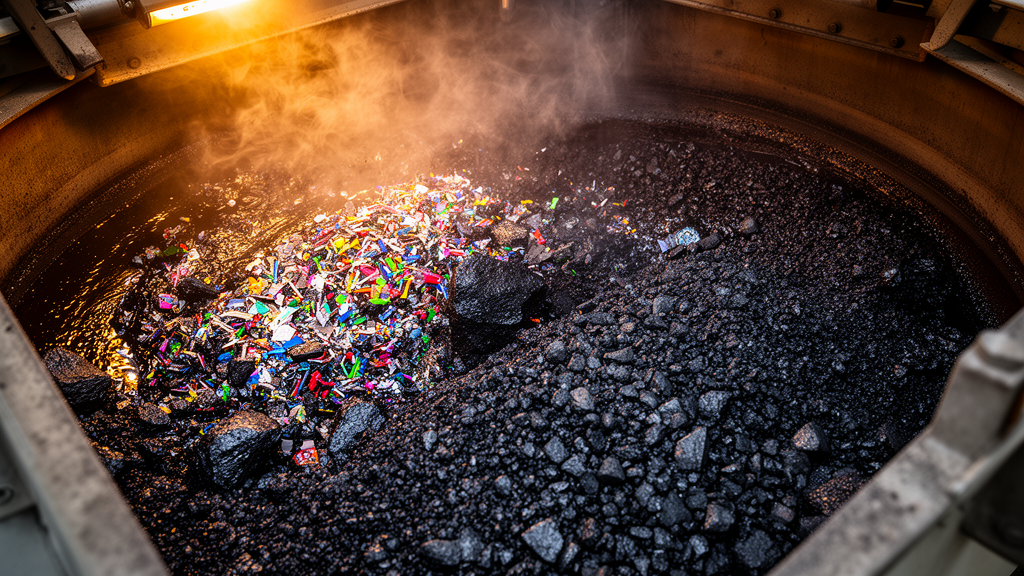
The study, published in Discover Applied Sciences, utilizes response surface methodology to determine the most effective dosages of recycled plastic waste and Sasobit wax in asphaltic concrete.
The research team, led by Lukman Olaide Salami and colleagues, processed waste plastic bottles and water sachets, blending them in equal proportions to create a composite modifier known as Combined Waste Polymer (CWP). The study employed a Centred Central Composite Design, a statistical experimental design, to systematically evaluate the effects of four independent variables on the mixture’s performance. These variables included bitumen content ranging from 4.5% to 8.0%, CWP content from 0% to 18% by bitumen weight, Sasobit dosage from 0% to 4%, and mixing temperatures between 110 and 160 degrees Celsius.
The experimental design allowed the researchers to assess eleven distinct performance responses, providing a comprehensive view of the mixture’s behavior. These metrics included Marshall stability, flow, Marshall quotient, air voids, bulk density, indirect tensile strength, tensile strength ratio, resilient modulus, fatigue life, compressive strength, and skid resistance.
Quadratic polynomial models were developed to predict the outcomes based on the experimental data. The validity of these models was confirmed through Analysis of Variance (ANOVA) at a 95% confidence level. The results indicated that all developed models were statistically significant, with p-values less than 0.0001. Furthermore, the models demonstrated high coefficients of determination, with R-squared values ranging from 0.9239 to 0.9677, indicating that the models explained a substantial portion of the variance in the observed data.
The predictive capability of the models was further supported by Adequate Precision values exceeding 27 and low coefficients of variation below 6%. These statistical indicators confirm that the response surface methodology effectively captured the complex relationships between the input variables and the performance outputs.
Among the variables tested, the Combined Waste Polymer emerged as the most influential factor across nearly all performance responses. The incorporation of CWP significantly enhanced the stiffness, tensile properties, moisture resistance, fatigue life, and rutting resistance of the asphalt mixture.
The study also identified positive interaction effects between the CWP and Sasobit wax. These interactions further improved the mixture’s cohesion and elastic recovery, indicating that the two additives work synergistically rather than independently. However, the quadratic terms in the models confirmed the existence of optimum modifier dosages.
The optimized mixtures demonstrated superior structural performance at reduced production temperatures, confirming the technical viability of integrating recycled polymer composites into energy-efficient pavement systems.
Subject of Research: Optimization of waste polymer in warm mix asphalt using response surface methodology
Article Title: Optimising combined waste polymer in warm asphalt mixture using response surface methodology
Article References: Salami, L. O., Oyebisi, S., Akinleye, M. T., Adeyemo, K. A., Salami, M. O., Ameen, I. O., & Bello, A. A. (2026). Optimising combined waste polymer in warm asphalt mixture using response surface methodology. Discover Applied Sciences. https://doi.org/10.1007/s42452-026-09774-9
Image Credits: AI Generated
DOI: 10.1007/s42452-026-09774-9
Keywords: warm mix asphalt, waste polymer, response surface methodology, pavement engineering, sustainable construction, bitumen modification, Sasobit wax, plastic recycling, mechanical performance, durability, Optimising, combined
News Source: Neil Sanderson. (November 10, 2026). Waste Polymer Optimized for Warm Asphalt Performance. Scienmag.