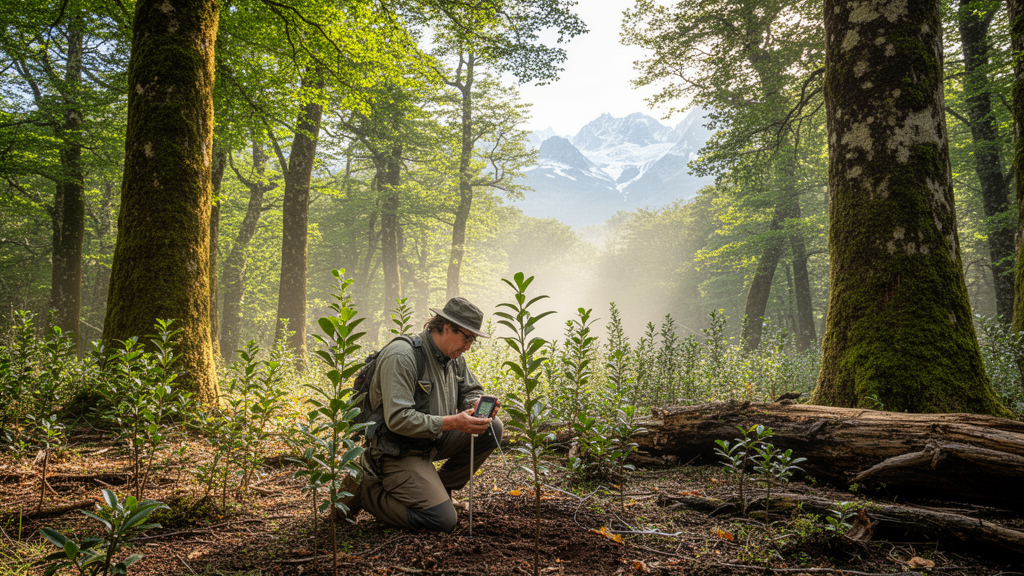
A comprehensive assessment of unmanaged Patagonian temperate forests demonstrates that reference benchmarks for conservation, management, and ecological restoration are better characterized across multiple developmental stages and ecological dimensions than by relying solely on traditional old-growth stands. Published in Ecological Processes, the study evaluated monospecific Nothofagus pumilio forests across Tierra del Fuego, Argentina, investigating how dynamic natural cycles generate structural, biological, and edaphic heterogeneity. Historically, ecological baseline definitions have disproportionately favored late-successional or undisturbed uneven-aged old-growth stands as single universal targets. The researchers showed that a solitary stage cannot capture the natural range of variation produced by natural disturbance regimes, which include both gap dynamics and stand-replacing windthrow or landslides. Instead, establishing effective benchmarks requires evaluating structural attributes, understory vegetation, soil properties, and animal use across a spectrum of forest stages.
To capture the natural dynamic cycle, the research team developed a conceptual model identifying seven distinct developmental stages shaped by regional disturbance regimes. Natural disturbances in Tierra del Fuego generate both even-aged cohorts following large-scale canopy removal and uneven-aged structures maintained by recurrent, localized canopy gaps. The authors identified four successive even-aged stages that develop in the absence of recurrent stand-replacing events: Initial, Late Initial, Mature, and Late Mature. Alongside these, uneven-aged conditions resulting from cumulative multi-scale disturbances were classified into Bimodal Young, Bimodal Old, and Uneven-aged stages. Stand classification was based on the proportional contribution of distinct tree growth phases rather than tree diameter, because diameter varies substantially with site quality, crown position, and competition across broad environmental gradients. These recognized growth phases comprise optimal initial growth under 40 years, optimal final growth between 40 and 120 years, mature growth between 120 and 220 years, and decay exceeding 220 years.
The field evaluation sampled 93 unmanaged forest stands situated below 500 meters above sea level on relatively flat terrain, selecting sites that experienced no timber harvesting over the preceding 50 years. Stands ranged from 1 to 13 hectares across the geographic distribution of Nothofagus pumilio in the province. Stands where a single tree growth phase accounted for more than 70 percent of total basal area were categorized into even-aged groups, yielding 5 Initial, 7 Late Initial, 16 Mature, and 6 Late Mature stands. Stands where reaching the 70 percent threshold required multiple growth phases were grouped into uneven-aged categories, comprising 9 Bimodal Young stands combining young and old cohorts, 43 Bimodal Old stands combining mature and decay phases, and 7 Uneven-aged stands requiring at least three growth phases. Across these stands, the investigators quantified 39 forest attributes organized into four analytical dimensions: forest structure, soil properties, understory vegetation, and animal use.
Structural measurements captured both live and dead wood components along 50-meter transects using laser dendrometry and point sampling to quantify basal area, tree density, quadratic mean diameter, and modeled live volume growth. Hemispherical photography with fisheye lenses estimated crown cover, while point-intercept transect recordings determined coarse woody debris cover and scaled volume. Regeneration surveys tracked seedling and sapling densities, mean heights, seedling quality, and first-year recruitment. The soil dimension evaluated physical and chemical parameters from surface samples taken at zero to 15 centimeters depth, determining bulk density, pH, organic carbon, total nitrogen, and Bray-extracted available phosphorus, alongside calculated net nutrient stocks. Understory vascular vegetation was inventoried for total, native, and exotic plant cover and richness. Animal use metrics integrated understory forage biomass, palatable cover, potential stocking capacity, and standardized herbivore densities derived from guanaco and livestock fecal surveys across 200-square-meter belt transects.
Univariate analyses revealed marked differences in how individual ecosystem attributes responded along the developmental sequence. Structural characteristics exhibited the most pronounced variation across stages: coarse woody debris cover, stand volume growth, and densities of live and dead trees reached their highest values in the Initial stage and steadily declined into mature and late-mature stages. Conversely, total live tree volume, quadratic mean diameter, and seedling density peaked in the Late Mature stage, illustrating the transition from rapid initial growth to structurally complex decayed cohorts. In contrast to stand structure, several variables showed no significant variation among developmental stages, including crown cover, total height, and both live and dead basal area. Within the soil dimension, physical properties, organic carbon, and total nitrogen remained largely stable, whereas phosphorus stock was uniquely elevated in the Initial stage before stabilizing.
Understory vegetation and herbivore use exhibited stability or dimension-specific trends rather than sharp developmental boundaries. Plant species richness, total understory biomass, and vegetation cover did not differ significantly among forest developmental stages in univariate tests, reflecting localized microsite conditions rather than stand age alone. Similarly, total large herbivore density, guanaco presence, and domestic livestock activity showed no statistically significant differences across stages, though intermediate developmental phases tended toward slightly higher utilization values. The authors noted that unmanaged Nothofagus pumilio stands maintained relatively low livestock pressure compared to other regional ecosystems. These findings indicate that while certain structural metrics and soil phosphorus reliably track forest development over time, understory community attributes and animal occupancy operate under broader environmental controls that do not align neatly with single-phase stand successions.
To synthesize multivariate variation, the researchers calculated centered dimension-specific indices and an overall Integrative Index, scaling values between negative and positive deviations relative to the multi-stage mean condition. The Forest Structure Index displayed pronounced differentiation: early even-aged stands and uneven-aged stages exhibited strong negative deviations, bimodal and mature forests clustered closer to the multi-stage mean, and Late Mature stands stood out as the only stage with a strong positive deviation. The Soil Index showed minimal divergence overall, with Initial and Late Mature stands anchoring opposing ends of the gradient. The Understory Vegetation Index progressed steadily from negative values in early even-aged stands toward positive values in older even-aged structures, highlighting the conservation value of structurally advanced stands for forest flora. When aggregated, the Integrative Index formed a continuous gradient from early even-aged cohorts through intermediate bimodal structures to older mature stands.
Multi-response permutation procedures and hierarchical cluster analyses further clarified ecological affinities among stages. When integrating all four analytical dimensions, the Initial stage separated significantly from all other developmental stages, while the remaining six stages resolved into two overarching clusters: stands containing a substantial young tree component, including Late Initial, Bimodal Young, and Uneven-aged, and stands dominated by older age classes, including Bimodal Old, Mature, and Late Mature. When parsed by separate dimensions, distinct clustering patterns emerged. Forest structure isolated the Late Mature stage as statistically unique from all other groups, mirroring its elevated volume and complex deadwood characteristics. In the understory analysis, older stands were largely indistinguishable from one another, whereas soil and animal use demonstrated limited global differentiation across developmental stages.
These analytical separations indicate that the selection of reference forests must correspond directly to the specific conservation, restoration, or management goals being pursued. When forest restoration projects seek targets to monitor structural recovery following timber harvesting, stage-dependent indicators such as live tree volume, coarse woody debris volume, dead tree density, and available soil phosphorus provide sensitive benchmarks. Conversely, attributes that remain stable across natural stages, such as soil physical properties and basal area thresholds, offer reliable baselines for detecting whether human intervention has pushed an ecosystem outside its natural range of variation. The researchers caution that utilizing extreme boundary stages—such as Late Mature stands for structural baselines—can impose unrealistic management goals, whereas intermediate bimodal and mature structures often provide more representative multi-attribute baselines.
The authors concluded that establishing reference frameworks rooted in the natural range of variation offers essential ecological flexibility for adaptive management under ongoing environmental change. Rather than enforcing a static, universal old-growth baseline, recognizing multiple developmental stages captures the natural heterogeneity produced by complex disturbance regimes. This multidimensional approach enables foresters and conservationists to assess whether managed stands remain within sustainable limits or if post-disturbance trajectories risk crossing critical ecological thresholds. While specifically calibrated for the monospecific Nothofagus pumilio forests of southern Patagonia, the authors noted that this framework provides a reproducible model for evaluating forest baselines, adaptive harvesting designs, and post-disturbance recovery across temperate and non-temperate forest ecosystems facing shifting climatic and disturbance pressures.
Subject of Research: Multidimensional reference conditions and developmental stages in Nothofagus pumilio forests
Article Title: Defining reference forests for management, restoration and conservation: a multidimensional evaluation of Nothofagus pumilio forests
Article References: Chaves, J. E., Rodríguez-Souilla, J., Cellini, J. M., Lencinas, M. V., Peri, P. L., & Pastur, G. M. (2026). Defining reference forests for management, restoration and conservation: a multidimensional evaluation of Nothofagus pumilio forests. Ecological Processes, 15(1), Article 77. https://doi.org/10.1186/s13717-026-00740-2
Image Credits: AI Generated
DOI: 10.1186/s13717-026-00740-2
Keywords: Nothofagus pumilio, forest ecology, reference forests, forest management, ecological restoration, Tierra del Fuego, forest structure, soil dynamics, Defining, reference, forests, management
News Source: Drew Townsend. (November 10, 2026). Study Challenges Old Growth as Sole Benchmark for Patagonian Forest Management. Scienmag.