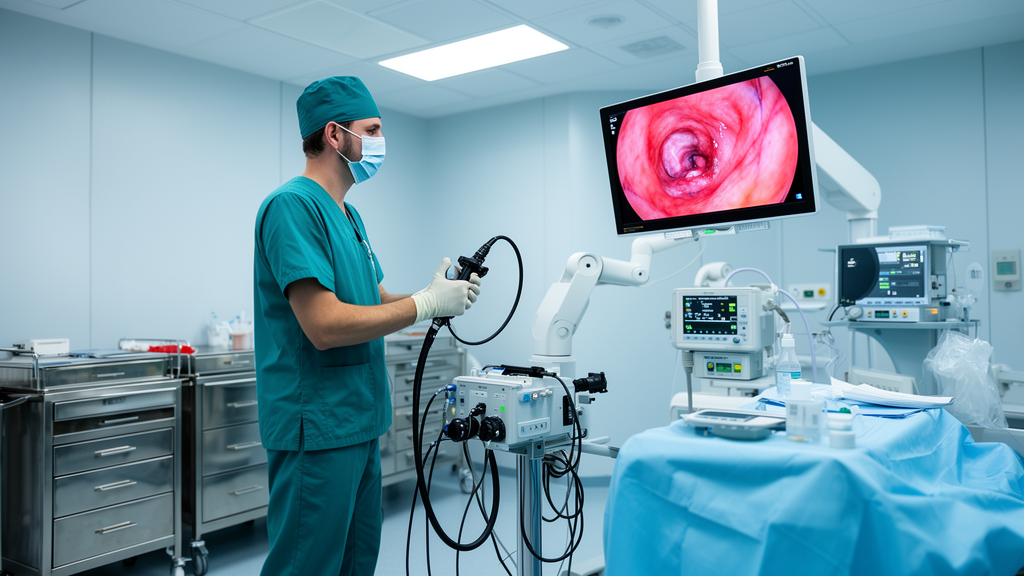
Researchers have developed and externally validated an explainable multimodal artificial intelligence model designed to predict delayed bleeding after colorectal endoscopic submucosal dissection. The study, published in BMC Gastroenterology, addresses a significant gap in current clinical tools, which traditionally rely solely on structured clinical variables while ignoring the diagnostic information contained in post-procedure mucosal defect images. By integrating these visual data with standard clinical features, the team created a system that offers a more comprehensive approach to risk assessment for patients undergoing this specific endoscopic procedure.
The research team retrospectively included 3,416 patients who underwent colorectal endoscopic submucosal dissection at two hospitals between January 2022 and June 2026. The cohort was divided into a development group of 2,778 patients and an external validation group of 638 patients. Delayed bleeding was strictly defined as active bleeding occurring between six hours and 28 days after the procedure, confirmed by repeat endoscopy and requiring endoscopic hemostasis.
The technical architecture of the model relies on a multi-stage processing pipeline. First, a YOLOv11m-seg segmentation model was employed to isolate mucosal defects from the post-ESD images. Subsequently, a ResNet50 convolutional neural network generated an image-derived prediction score, referred to as the E-Score. This visual score was then fused with clinical features to create a multimodal input for the final prediction algorithm. To determine the most relevant clinical variables, the researchers applied LASSO feature selection, which retained six specific features for the final model construction.
Five different machine learning algorithms were evaluated using fivefold stratified cross-validation, both with and without Synthetic Minority Over-sampling Technique (SMOTE) to address class imbalance. The XGBoost algorithm without SMOTE, designated as PrismDB, demonstrated the best overall performance. In the development cohort, where delayed bleeding occurred in 224 patients (8.06%), PrismDB achieved an area under the receiver operating characteristic curve of 0.804, with a 95% confidence interval ranging from 0.769 to 0.837. The model also showed a sensitivity of 64.73%, a specificity of 85.40%, and a negative predictive value of 96.50%.
External validation confirmed the stability of the model’s discrimination capabilities. In the validation cohort, where 53 patients (8.31%) experienced delayed bleeding, the PrismDB model maintained an AUC of 0.788, with a 95% confidence interval of 0.724 to 0.850. The sensitivity in this external group was 79.25%, specificity was 83.25%, and the negative predictive value reached 97.79%.
To enhance the interpretability of the AI system, the researchers utilized SHAP (SHapley Additive exPlanations) and Grad-CAM (Gradient-weighted Class Activation Mapping) for post-hoc analysis. The E-Score, derived from the image analysis, had the highest mean absolute SHAP contribution, highlighting the critical importance of visual data in the prediction process. Representative activation maps from the Grad-CAM analysis overlapped with specific anatomical features such as exposed vessels, adherent clots, and eschar, providing clinicians with visual cues as to why the model flagged a particular case as high-risk.
Probability calibration in the development cohort under the natural event distribution showed a calibration slope of 1.101 and an intercept of +0.227, with a Brier score of 0.0584. While these metrics suggest acceptable calibration in the development set, the authors note that external evaluation of probability calibration has not yet been performed.
The study concludes that PrismDB shows stable discrimination for predicting delayed bleeding after colorectal endoscopic submucosal dissection. However, the authors emphasize that a low-risk classification does not completely exclude the possibility of delayed bleeding. Furthermore, the safety of using the model to guide changes in postoperative care remains to be established. A companion web application demonstrates the prediction workflow.
Subject of Research: Development and validation of a multimodal AI model for predicting delayed bleeding after colorectal ESD
Article Title: An explainable multimodal model integrating post-ESD mucosal defect images and clinical features to predict delayed bleeding after colorectal endoscopic submucosal dissection
Article References: Zhao, H., Xu, X., Wang, G., Xia, K., Wang, T., & Chen, J. (2026). An explainable multimodal model integrating post-ESD mucosal defect images and clinical features to predict delayed bleeding after colorectal endoscopic submucosal dissection. BMC Gastroenterology, 26(1), Article 751. https://doi.org/10.1186/s12876-026-05418-9
Image Credits: AI Generated
DOI: 10.1186/s12876-026-05418-9
Keywords: colorectal ESD, delayed bleeding, multimodal AI, medical imaging, risk prediction, XGBoost, SHAP, gastroenterology, machine learning, clinical validation, explainable, multimodal
News Source: Ophelia Keating. (November 10, 2026). Multimodal Model Predicts Delayed Bleeding After Colorectal Endoscopic Submucosal Dissection. Scienmag.