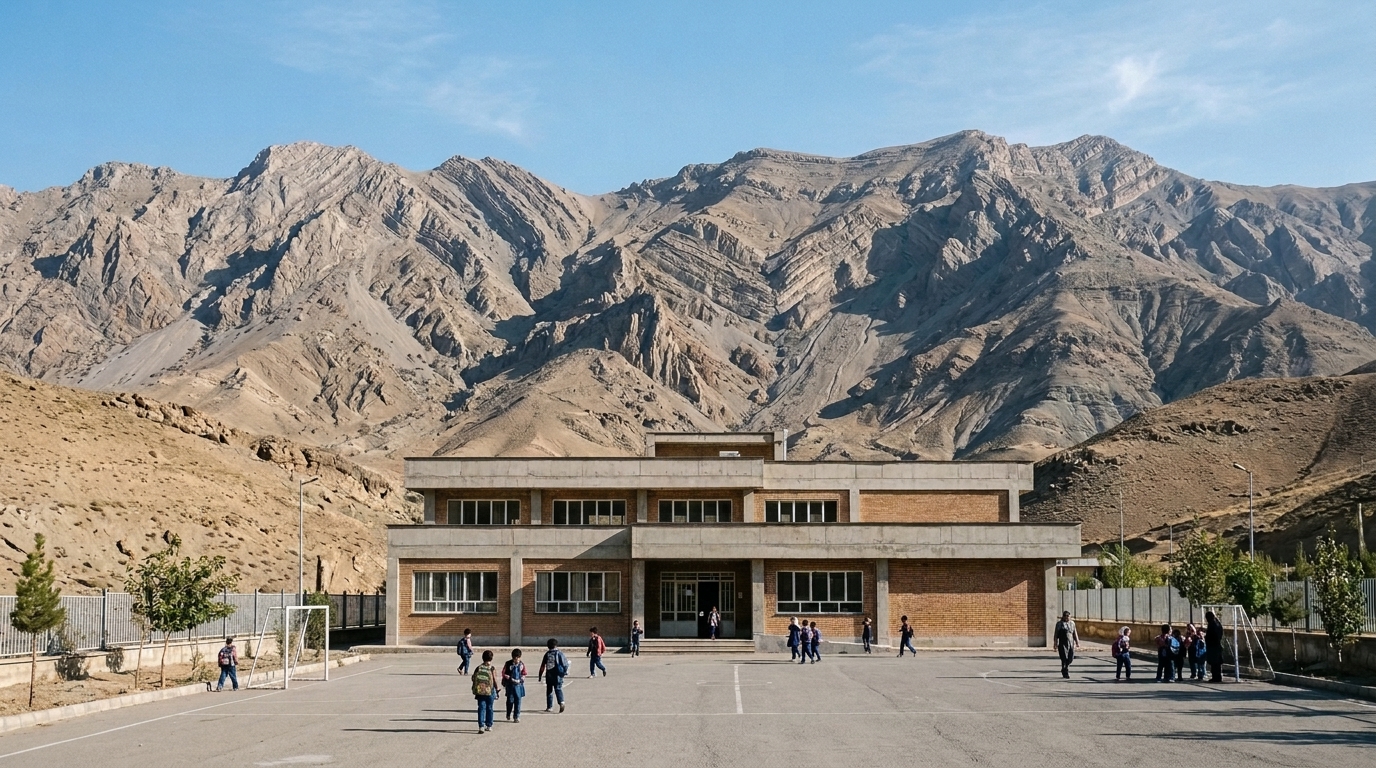
Researchers from Iran have developed a multi-hazard risk assessment framework to evaluate the safety of existing and potential school sites in Alborz Province. Published in the journal City, Territory and Architecture, the study integrates geospatial analysis, engineering geology principles, and quantitative decision-making techniques to identify areas with elevated geological and environmental risks. The primary objective was to create a science-based method for mapping safe, low-hazard locations for primary and secondary schools, addressing the complex interplay of seismic activity, subsurface conditions, and geopathic stress in a tectonically active region.
The study focuses on Alborz Province, located northwest of Tehran, which sits on a major convergent boundary characterized by high seismicity and complex geological structures. The province is traversed by significant fault systems, including the Mosha, North Alborz, and Kahrizak faults, which pose direct rupture hazards and amplify ground motion during earthquakes. In addition to seismic risks, the region faces secondary hazards such as landslides, rockfalls, and land subsidence in alluvial plains, particularly in southern urban centers like Karaj. These geological factors create a diverse hazard landscape that requires a comprehensive assessment approach for critical infrastructure like schools.
A central component of the research is the incorporation of geopathic stress, a concept referring to physiological stress allegedly caused by disturbances in the Earth’s natural electromagnetic field. The authors define geopathic hazards as environmental risks originating from geological processes or subsurface conditions, such as groundwater flows, geological faults, and mineral deposits. While mainstream science often categorizes certain aspects of geopathic energy as pseudoscience, the study notes that recent research in geobiology and environmental medicine has explored potential links between these zones and health outcomes, including sleep disruption and chronic fatigue. The framework treats these factors as ancillary indicators of subsurface instability, particularly near active fault structures.
To conduct the assessment, the researchers selected 25 schools across different geographical points in Alborz Province, including Karaj, Savojbolagh, Fardis, Nazarabad, Eshtehard, Taleqan, and Chaharbagh. The selection process utilized published geological and radon data to ensure a representative sample of the province’s diverse geological settings. The methodology involved gathering data from various sources, including 1:100,000 scale geological and neotectonic fault maps from the Geological Survey of Iran, groundwater depth and flow direction maps, and historical qanat line maps for hydrological context.
Geospatial data played a crucial role in the hazard specification, with the use of a 12.5-meter resolution Digital Elevation Model from ALOS PALSAR and cloud-free Sentinel-2 satellite imagery at 10-meter resolution. The researchers also incorporated land use/cover maps, road networks, and administrative boundaries to contextualize the hazard layers. Each hazard parameter, including seismic activity, subsidence, radon potential, and landslide susceptibility, was standardized into a hazard-intensity index ranging from 0 to 1, where 1 represents the highest risk. These standardized layers were then weighted using the Analytic Hierarchy Process to calculate a final Geohazard Index for each school site.
The proximity to major faults was a key determinant in the risk assessment, calculated using the Haversine formula to determine the great-circle distance from each school to the nearest active fault. The study identified that distances under 10 kilometers from faults such as the Mosha and North Alborz significantly increase seismic and geopathic risks. Radon levels were also evaluated, with an assumed average value of 55.8 Bq/m³ across the selected schools, a range of 18.9–95.6 Bq/m³. This average is well below the 148 Bq/m³ threshold often associated with elevated lung cancer risk, suggesting that radiological hazards were less dominant than tectonic factors in this specific assessment.
The statistical results revealed that 32% of the 25 schools, or 8 schools, are located in high hazard zones. These high-risk sites are predominantly found in mountainous areas like Taleghan and Chaharbagh, as well as in the urban parts of Karaj, which are characterized by alluvial deposits. Another 44% of the schools, or 11 schools, were classified as being in moderate hazard zones, while the remaining 24%, or 6 schools, were in low hazard zones. The analysis indicated that fault proximity and seismic activity contributed most significantly to the high hazard scores, with Karaj urban schools showing elevated risks due to the combination of alluvial saturation and seismic exposure.
The study highlights the variability in hazard exposure across the province, with an average distance to major faults of 16.83 kilometers. However, a standard deviation of 9.66 kilometers underscores the significant differences between zones, with northern and western areas generally experiencing lower risks due to distances exceeding 30 kilometers from major fault lines. The concentration of high-risk schools in urban centers suggests that population density and infrastructure development in these areas may exacerbate the impact of geological hazards, necessitating targeted mitigation strategies.
Limitations of the study include the reliance on regional proxies for certain hazard parameters and the simplicity of the scoring system used to integrate multiple risk factors. The radon levels were assumed to be uniform across all schools due to the lack of site-specific data, which may not fully capture local variations in radon potential. Additionally, the study acknowledges that while geopathic stress is a subject of ongoing debate, the empirical evidence for its health impacts beyond recognized geological risks like radon exposure and seismic activity remains limited. The detection methods for geopathic zones, such as gas discharge visualization, are noted as not being reliable as rigorous scientific tools.
Despite these limitations, the framework provides a valuable tool for planners and engineers involved in school site selection. The authors suggest that for existing schools, seismic retrofitting using base isolation and reinforced structures is essential to withstand earthquakes. Enhancing ventilation systems is also recommended to mitigate any potential radon buildup, although current levels are considered low. For future school construction, the study advises selecting sites more than 20 kilometers away from major faults to minimize geopathic and seismic exposure. Incorporating resilient design principles, such as elevated foundations to avoid underground water influences, is also proposed to improve long-term safety.
The research emphasizes the importance of multi-hazard planning to address cascading risks, such as landslides in fault zones, which can be triggered by earthquakes or heavy rainfall. By integrating geopathic hazard zoning with standard planning criteria, the framework aims to ensure that safety rules are not weakened by administrative or geographical boundaries. The study concludes that a comprehensive approach to risk assessment is necessary to protect students and staff in a region with high tectonic activity and complex geological conditions.
This study contributes to the broader discourse on sustainable urban planning and the safety of public infrastructure in hazard-prone areas. By combining traditional geological data with emerging concepts of geopathic stress, the researchers offer a nuanced perspective on site selection that goes beyond conventional seismic hazard analysis. The findings underscore the need for continued research into the potential health and environmental impacts of subsurface conditions, particularly in regions with active tectonic settings.
Subject of Research: Multi-hazard risk assessment for school site selection in Alborz Province, Iran
Article Title: A multi-hazard risk assessment for school site selection in Alborz Province; consideration the presence of geopathic hazards
Article References: Taher Tolou Del, M. S., & Torabi, N. (2026). A multi-hazard risk assessment for school site selection in Alborz Province; consideration the presence of geopathic hazards. City, Territory and Architecture, 13(1), Article 17. https://doi.org/10.1186/s40410-026-00300-3
Image Credits: AI Generated
DOI: 10.1186/s40410-026-00300-3
Keywords: seismic risk, geopathic stress, school safety, Alborz Province, geospatial analysis, hazard mapping, radon exposure, fault proximity, urban planning, geological hazards, multi-hazard, risk
News Source: Denise Maddox. (November 10, 2026). Study Maps Seismic and Geopathic Risks for Schools in Alborz. Scienmag.