• HOME
  • NEWS
  • EXPLORE
    • CAREER
      • Companies
      • Jobs
    • EVENTS
    • iGEM
      • News
      • Team
    • PHOTOS
    • VIDEO
    • WIKI
  • BLOG
  • COMMUNITY
    • FACEBOOK
    • INSTAGRAM
    • TWITTER
Tuesday, November 10, 2026
BIOENGINEER.ORG
No Result
View All Result
  • Login
  • HOME
  • NEWS
  • EXPLORE
    • CAREER
      • Companies
      • Jobs
        • Lecturer
        • PhD Studentship
        • Postdoc
        • Research Assistant
    • EVENTS
    • iGEM
      • News
      • Team
    • PHOTOS
    • VIDEO
    • WIKI
  • BLOG
  • COMMUNITY
    • FACEBOOK
    • INSTAGRAM
    • TWITTER
No Result
View All Result
Bioengineer.org
No Result
View All Result
Home NEWS Science News Technology

Paper-based sensor detects trace phenolic pollutants

by
November 10, 2026
in Technology
Reading Time: 2 mins read
0
Paper-based sensor detects trace phenolic pollutants

Paper-based sensor detects trace phenolic pollutants

Share on FacebookShare on TwitterShare on LinkedinShare on RedditShare on Telegram

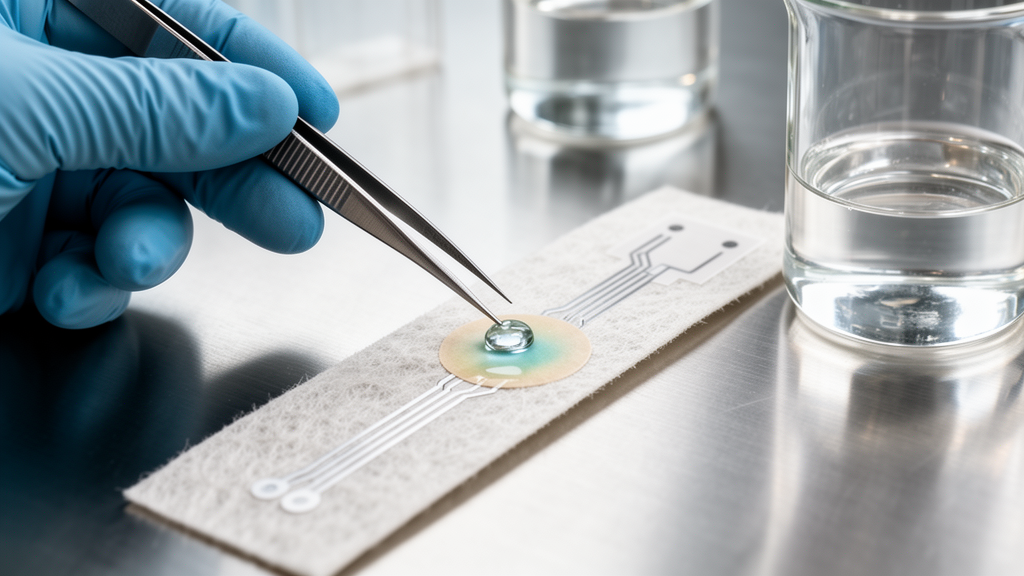
Researchers have developed a flexible, paper-based electrochemical biosensor capable of detecting trace levels of phenolic pollutants in water. The device, described in a study published in the journal Ionics, utilizes a nanohybrid material composed of molybdenum disulfide and reduced graphene oxide, modified with ionic liquids, to achieve high sensitivity. The primary targets of this detection method are the phenolic pollutants 17β-Estradiol and hydroquinone.

The core of the sensor is a conducting paper electrode modified with a nanohybrid structure. The research team combined molybdenum disulfide and reduced graphene oxide, then introduced two specific ionic liquids: 1-Butyl-3-methylimidazolium chloride and 1-Allyl-3-methylimidazolium chloride. Structural and morphological analyses confirmed that the nanohybrid was successfully fabricated and deposited uniformly onto the paper electrode.

To enable the selective detection of the target pollutants, the team immobilized the enzyme Laccase onto the modified electrode. By integrating this biological component with the conductive nanohybrid, the sensor can specifically identify and measure the presence of 17β-Estradiol and hydroquinone.

The performance of the developed biosensor was evaluated through conductivity measurements and detection range analyses. Conductivity tests conducted in methanol revealed that the MoS2/rGO@ILs/CPE configuration achieved a conductivity of 5.12 × 10⁻³ S/cm, which was higher than when tested in other solvents. For detection capabilities, the sensor demonstrated a wide linear range for 17β-Estradiol, from 0.01 to 70.0 µM, and for hydroquinone, from 0.1 to 90.0 µM. The limits of detection were determined to be 0.01 µM for 17β-Estradiol and 0.10 µM for hydroquinone, indicating the sensor’s ability to detect these compounds at very low concentrations.

Validation of the sensor’s practical utility was performed using spiked water samples. The research team successfully detected the phenolic pollutants in these samples with high recovery rates, suggesting that the device can function effectively in real-world matrices. The study characterizes the platform as low-cost, flexible, disposable, and environmentally friendly.

The findings support the potential of ionic liquid-modified nanohybrids in enhancing the performance of paper-based electrochemical devices.

Subject of Research: Development of a paper-based electrochemical biosensor for detecting phenolic pollutants

Article Title: Ionic liquid mediated graphene oxide@MoS₂ nanohybrid-based conducting paper for trace-level electrochemical detection of phenolic pollutants

Article References: Raza, M. J., Riyazuddeen, & Pandey, C. M. (2026). Ionic liquid mediated graphene oxide@MoS₂ nanohybrid-based conducting paper for trace-level electrochemical detection of phenolic pollutants. Ionics. https://doi.org/10.1007/s11581-026-07630-9

Image Credits: AI Generated

DOI: 10.1007/s11581-026-07630-9

Keywords: electrochemical biosensor, phenolic pollutants, molybdenum disulfide, graphene oxide, ionic liquids, water quality, conducting paper, Laccase, 17β-Estradiol, hydroquinone, Ionic, liquid

News Source: Denise Maddox. (November 10, 2026). Paper-based sensor detects trace phenolic pollutants. Scienmag.


Tags: 17β-estradiolconducting paperelectrochemical biosensorgraphene oxidehydroquinoneionicionic liquidslaccaseliquidMolybdenum Disulfidephenolic pollutantswater quality
Share12Tweet7Share2ShareShareShare1

Related Posts

Ionic Liquids Protect Metal-Organic Frameworks During Room-Temperature Dry Etching

Ionic Liquids Protect Metal-Organic Frameworks During Room-Temperature Dry Etching

November 10, 2026
Study Finds No Single Standard Covers All Restorative Design Scales

Study Finds No Single Standard Covers All Restorative Design Scales

November 10, 2026

Split Diesel Injections Combined with Port-Injected Ethanol Cut Nitrogen Oxide Emissions in Dual-Fuel Engines

November 10, 2026

Silver Nanoflowers From Pongamia Seed Cake Remove Malachite Green Dye

November 10, 2026

POPULAR NEWS

  • More Than Half of Bottled Waters in Ecuador Show Fluoride Discrepancies

    More Than Half of Bottled Waters in Ecuador Show Fluoride Discrepancies

    29 shares
    Share 12 Tweet 7
  • Trichoderma and Organomineral Fertilizer Mitigate Salinity Stress in Sugar Baby Watermelon

    29 shares
    Share 12 Tweet 7
  • Curcumin and Rosmarinic Acid Inhibit Intracellular Leishmania Parasites Synergistically

    29 shares
    Share 12 Tweet 7
  • Study Identifies Cell Surface Targets Linked to Treatment Resistant Breast Cancer

    29 shares
    Share 12 Tweet 7

About

We bring you the latest biotechnology news from best research centers and universities around the world. Check our website.

Follow us

Recent News

Ionic Liquids Protect Metal-Organic Frameworks During Room-Temperature Dry Etching

Ice Cores Reveal Massive Early 20th Century Arsenic Pollution

Blood signal could potentially detect ovarian cancer precursor years before a tumor

Subscribe to Blog via Email

Enter your email address to subscribe to this blog and receive notifications of new posts by email.

Join 87 other subscribers
  • Contact Us

Bioengineer.org © Copyright 2023 All Rights Reserved.

Welcome Back!

Login to your account below

Forgotten Password?

Retrieve your password

Please enter your username or email address to reset your password.

Log In
No Result
View All Result
  • Homepages
    • Home Page 1
    • Home Page 2
  • News
  • National
  • Business
  • Health
  • Lifestyle
  • Science

Bioengineer.org © Copyright 2023 All Rights Reserved.