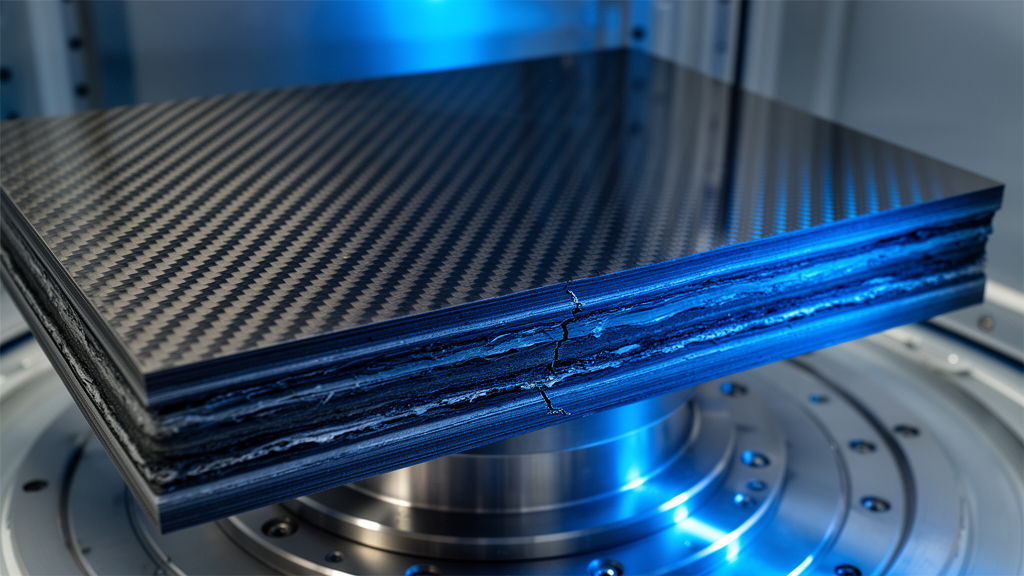
A critical review by Eugeniy Beliayev of the B. Verkin Institute for Low Temperature Physics and Engineering of the National Academy of Sciences of Ukraine, published in Frontiers in Materials, reveals that retaining a single material property under irradiation does not ensure the serviceability of a multifunctional composite component. Synthesizing experimental evidence across polymers, ceramics, and hybrid laminates, the study demonstrates that distinct physical attributes degrade at unequal rates during radiation exposure. A component can experience catastrophic embrittlement, matrix delamination, or heat-transport breakdown long before its primary shielding or nominal mechanical strength registers significant decay. Consequently, material survivability must be evaluated against component-level performance boundaries within realistic multi-variable operating environments rather than through isolated laboratory property retention.
Rather than offering a systematic meta-analysis with rigid query logs, Beliayev conducted an iterative narrative review examining how competing property changes undermine composite serviceability. The literature discovery targeted multi-property studies of radiation-shielding composites, silicon-carbide and carbon-based thermostructural materials, and fusion-magnet cryogenic insulation across databases including Google Scholar and preprint repositories. The analysis prioritised peer-reviewed datasets monitoring multiple service-relevant parameters under documented exposure conditions, emphasizing specimen geometry, beam characteristics, operating atmospheres, and temperature regimes. Acknowledging narrative reporting standards like SANRA, the author notes that literature records lack archived deduplication counts or universal damage correlations across diverse radiation types. Instead of treating absorbed dose, incident particle fluence, and displacements per atom as interchangeable damage coordinates, the review assesses each exposure history as a specific empirical record of radiological, environmental, and thermal parameters, distinguishing reported specimen standard deviations from uncertainties of estimated means to prevent unsupported physical generalizations.
To link physical property trajectories to engineering qualification, the paper formalises component serviceability through operational signed margins. For each engineering requirement within a specified operational envelope, a dimensionless signed margin quantifies the available distance between the instantaneous property value and its acceptance boundary relative to a positive scaling constant. Positive values reflect operating reserve, zero represents the compliance limit, and negative values denote failure. Under the adopted first-boundary rule, component lifetime ends when the first margin reaches zero, regardless of whether other properties remain intact. Crucially, this operational formulation demonstrates that the fastest-changing material property is not necessarily the life-limiting factor. A property suffering rapid fractional degradation can retain substantial margin if its baseline sits far above its threshold, whereas a property showing negligible decay can trigger catastrophic failure if its operational demand begins near its acceptance limit. Dose series alone therefore cannot establish operational lifetimes without application-specific acceptance limits and exposure histories.
The decoupling of functional degradation is prominently evidenced in silicon-carbide thermostructural composites developed for high-temperature nuclear applications. Evaluating experimental data for chemical-vapour-infiltrated silicon carbide composites reinforced with Hi-Nicalon Type-S or Tyranno SA3 fibres and pyrolytic-carbon interphases, the review highlights an acute divergence between thermal transport and mechanical strength. Room-temperature thermal conductivity collapsed from an unirradiated baseline of 18.94 watts per metre-kelvin down to 2.71, 3.16, and 2.38 watts per metre-kelvin after neutron exposures of 2.0, 11.8, and 30.2 displacements per atom, respectively. Meanwhile, ultimate flexural strength remained resilient, measuring 412 ± 35 megapascals before irradiation and 509 ± 49, 486 ± 72, and 482 ± 45 megapascals across the respective irradiation intervals. While these results show robust interphase stability, the severe loss of heat conduction could cause thermal overheating in heat-removal hardware long before mechanical failure occurs, with the author emphasizing that the exposures reflect varying temperatures between 500 and 640 kelvin rather than an isothermal law.
Divergences between competing mechanical properties appear with comparable magnitude in carbon-fibre-reinforced silicon carbide composites. In two-dimensional carbon-fibre-reinforced silicon carbide irradiated near 730 degrees Celsius at 9.3 displacements per atom, the material exhibited severe embrittlement alongside a notable increase in stiffness. Flexural tangent modulus increased from 54.5 ± 3.8 to 100.6 ± 9.3 gigapascals, while flexural strength dropped from 168 ± 21 to 78 ± 14 megapascals and strain at maximum load collapsed from 0.41% ± 0.04% to 0.09% ± 0.01%. This stiffening, driven by internal clamping and microcracking, proves that monitoring elastic modulus alone yields deceptive estimates of composite toughness and damage tolerance. Related phenomena emerge in polymer composites, where gamma-irradiated glass-fibre-reinforced plastics show rising volume resistivity alongside deteriorating thermal stability, while basalt-fibre epoxies display temporary interlaminar shear strength increases that conceal advancing glass-transition temperature loss. In carbon-carbon composites, mechanical gains can accompany altered Poisson’s ratios and dimensional distortion, proving that beneficial trends in single observables do not reflect overall material endurance.
Cryogenic electrical insulation developed for superconducting fusion coils provides another clear demonstration of how testing conditions can obscure structural damage. In studies assessing glass-fibre-reinforced polymers and hybrid polyimide-epoxy laminates for ITER model coils, irradiated specimens displayed surface swelling, mass loss, and interlaminar delamination while maintaining high dielectric strength at 77 kelvin. Beliayev explains that testing specimens submerged in liquid nitrogen yields overly optimistic electrical results because the cryogenic fluid infiltrates cracks and suppresses gas-mediated discharges. Conversely, room-temperature shear testing of glass-fibre-reinforced plastics caused dielectric breakdown at shear stresses of roughly 28 megapascals, well below their 34 megapascal apparent interlaminar shear strength. Because operational fusion magnet insulation functions in vacuum or helium environments under intense mechanical stresses, tests reaching instrument limits—such as surviving 20 or 60 kilovolt proof tests without puncture—provide non-conservative lower bounds rather than proof that electrical safety margins remain uncompromised. Likewise, tests at 6.1 kelvin in vacuum cannot be credited to liquid infiltration or assumed to guarantee mechanical durability.
Direct post-irradiation measurements on gamma-ray shielding composites further illustrate the hazards of relying on single-parameter evaluations. The review examines an experimental series investigating a polypropylene and lead monoxide composite aged with cobalt-60 gamma rays at 10 kilograys per hour in room-temperature air up to 120 kilograys. Subsequent radiation attenuation measurements at 661.7 kiloelectronvolts using a caesium-137 source showed that radiation protection efficiency decreased from 8.66% to 7.67%, representing an approximate 11% relative reduction that mirrored an 11% decrease in tensile strength from 23.54 to 20.86 megapascals. In stark contrast, impact strength fell by roughly 43%, dropping from 8.26 to 4.73 kilojoules per square metre, while polymer matrix crystallinity declined from 60.1% to 37.9%. While the composite retained adequate shielding performance and static tensile capacity, its sharp embrittlement indicates that shock or vibration could induce mechanical failure while radiation protection remains nominally intact, demonstrating that degradation rates between functional shielding and mechanical integrity diverge significantly.
Distinguishing physical measurements from model-based surrogate assessments forms another key analytical distinction in composite evaluation. Several shielding investigations, including work on cement-waste glass composites and samarium-oxide-modified polyethylene, evaluate radiation attenuation by feeding measured post-irradiation physical densities and compositions into radiation-transport simulations rather than performing direct transmission experiments across an aging sequence. Although transport calculations reliably predict baseline transmission for idealized homogeneous media, simulations cannot independently detect unmodelled cracks, swelling gaps, or filler redistributions that create streaming channels for radiation. Similarly, studies focusing on irradiation-assisted material processing—such as gamma crosslinking in polyethylene-tungsten carbide or argon-ion surface treatments in gadolinium-filled polymers—demonstrate that property enhancements gained during initial material fabrication cannot be substituted for long-term operational durability. Surface hardness improvements or localized crosslinking optimizations establish synthesis parameters, but they do not confirm that a composite will retain balanced physical and shielding functions under prolonged operational exposure. Validated models provide valuable mechanistic insights, but remain inferences rather than measured performance.
The review also underscores that post-irradiation evolution, testing delays, and dose-rate scaling introduce major interpretive uncertainties. Irradiated polymers frequently experience ongoing chemical reactions, radical annealing, and oxidative degradation long after radiation exposure ceases. A quantitative example in epoxy characterisation revealed that CTD101K resin exposed to 160 megagrays exhibited an approximate 60% increase in rubbery storage modulus and an estimated 50-degree Celsius rise in glass-transition temperature between its first and second dynamic mechanical heating cycles up to 230 degrees Celsius, demonstrating that thermal testing itself altered the irradiated material. Furthermore, dose-rate effects present substantial physical complications; comparing reactor exposures at 860 kilograys per hour with gamma irradiations at 2 kilograys per hour spans more than two orders of magnitude in rate, causing large differences in oxygen diffusion and thermal profiles. Consequently, rigorous experimental reporting must document storage environments, exposure-to-test intervals, and atmospheric purges to ensure observed data reflect genuine material responses rather than transient testing artefacts.
To address these experimental pitfalls, the review outlines a reusable failure-route testing matrix that targets measurements toward credible failure pathways rather than exhaustive, unprioritised characterisation. For radiation shielding, direct gamma or neutron attenuation should be paired with the mechanical stress mode most likely to limit service, along with dimensional and density monitoring. For cryogenic magnet insulation, dielectric breakdown, withstand, or partial discharge testing must be conducted within the authentic operating medium—whether liquid cryogen, helium gas, or vacuum—under representative shear stresses. For thermostructural components, matched cohorts must track thermal transport and directional load capacity across service temperatures. By establishing explicit baseline margins, propagating experimental uncertainties, and treating instrument ceilings as censored lower bounds rather than measured thresholds, this methodology clarifies which functional margin is exhausted first.
Subject of Research: Differential property degradation and component serviceability of irradiated multifunctional composites
Article Title: Beyond single-property retention: how multifunctional composites lose serviceability under irradiation
Article References: Beliayev, E. (2026). Beyond single-property retention: how multifunctional composites lose serviceability under irradiation. Frontiers in Materials, 13, Article 1986968. https://doi.org/10.3389/fmats.2026.1986968
Image Credits: AI Generated
DOI: 10.3389/fmats.2026.1986968
Keywords: radiation damage, multifunctional composites, nuclear materials, thermostructural composites, dielectric breakdown, radiation shielding, thermal conductivity, component serviceability, Beyond, single-property, retention, multifunctional
News Source: Denise Maddox. (November 10, 2026). Multifunctional Composites Risk Operational Failure Under Radiation Despite Preserving Single Properties. Scienmag.