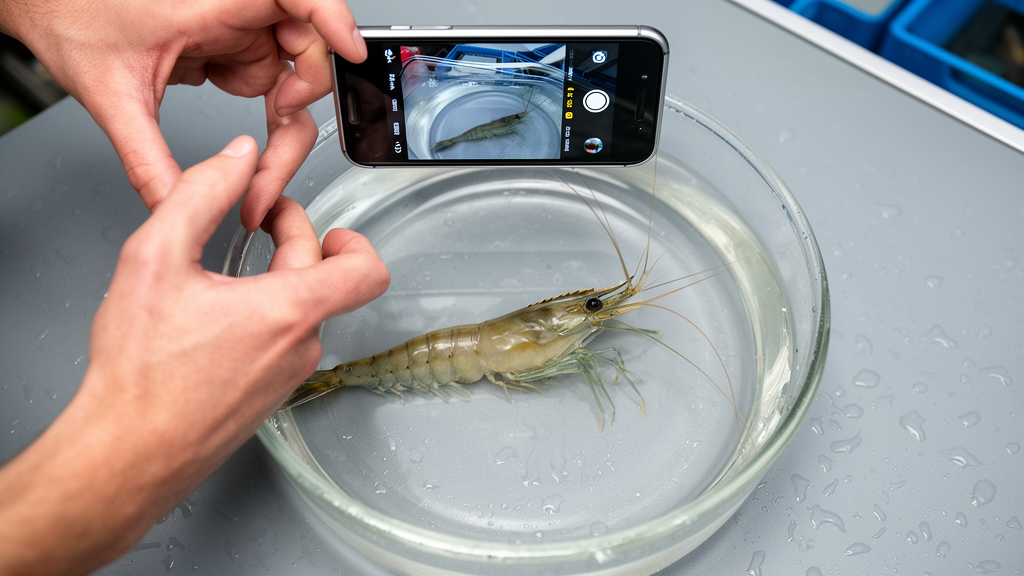
Researchers at Ben-Gurion University of the Negev have developed a physics-informed computer vision framework capable of measuring the length of giant freshwater prawns directly from images captured by mobile platforms in aquaculture ponds. Published in Smart Agricultural Technology, the study introduces a method that integrates optical physics with deep learning to convert pixel measurements into real-world dimensions, addressing a significant gap in automated aquaculture monitoring. By explicitly accounting for optical refraction at the air-water interface and lens distortion, the system provides a non-invasive alternative to traditional manual sampling, which is often time-consuming and stressful for the animals. The framework was tested on Macrobrachium rosenbergii, a species where total length strongly correlates with body weight and is critical for managing growth, feeding, and harvest scheduling.
The primary challenge in underwater imaging is that light bends as it passes from air into water, a phenomenon governed by Snell’s law. Most existing computer vision systems for aquatic life ignore this refraction or rely on fixed cameras with constrained geometries, which limits their spatial coverage and can introduce behavioral bias by requiring animals to enter specific structures. The team integrated a YOLOv11-pose estimation model to detect anatomical landmarks, such as the rostrum, eyes, carapace edge, and telson, while a geometric reconstruction model calculated the actual length based on the camera’s field of view and its distance from the pond bottom.
To validate the system, the researchers employed a dual-validation strategy that is rare in the field. First, they compared the model’s outputs against manual measurements taken by a skilled researcher using ImageJ software on high-quality images containing checkerboards for scale. Second, they used prawn exuviae, which are the naturally shed shells of prawns, as physical ground truth objects with known dimensions. This approach allowed the team to assess the accuracy of the entire optical and geometric measurement chain without harming live animals. The use of exuviae represents a novel application in automated length measurement, providing a non-invasive means to verify that the physics-based scaling correctly converts image coordinates into millimeters.
The experimental setup involved three recirculating aquaculture system ponds at the university facility: a rectangular mixed-sex pond and two circular ponds housing all-male and all-female populations, respectively. Video data were collected using two different mobile platforms: a manually guided floating polystyrene box for the circular ponds and a remote-controlled amphibious vehicle for the rectangular pond. Both platforms mounted a GoPro Hero 11 camera to capture top-down views of the prawns on the pond floor. The team recorded approximately 40 minutes of video in each circular pond and 2.5 hours in the rectangular pond over several months, ensuring a diverse dataset that accounted for varying lighting conditions and water clarity.
Processing the raw video data required a rigorous filtering pipeline to ensure image quality. The team extracted frames from the recordings and used Laplacian variance to discard blurred images, while a two-stage optical flow algorithm removed redundant frames where the camera had not moved sufficiently. This process yielded 2,478 high-quality images, which were manually annotated with keypoints corresponding to specific anatomical landmarks. The dataset was split into training, validation, and testing sets, with separate models trained for the circular and rectangular ponds to account for differences in imaging conditions. A combined model was also trained to evaluate how well the system could generalize across different environments.
The results demonstrated that the physics-informed framework achieved measurement accuracy comparable to human repeatability. In the validation against manual ImageJ measurements, the model’s mean absolute error (MAE) for carapace length ranged from 2.7 to 6.1 mm, while the mean absolute relative error (MARE) was approximately 10% to 17% depending on the pond type. For total length, the MAE was higher, ranging from 12.0 to 17.4 mm, which the authors attributed to the less sharply defined endpoints of the telson and rostrum. Crucially, the model’s errors were largely within the range of variability observed among human raters, with MAE-to-repeatability ratios typically between 0.3 and 0.7. This indicates that the system performs at least as consistently as a trained human observer, validating its reliability for practical applications.
The exuviae validation further confirmed the accuracy of the complete measurement pipeline. Across 90 specimens of known length, the overall MAE was 7.09 mm, corresponding to a MARE of 4.53%. Group-level averages ranged from 3.31% to 5.46% error, showing that the system maintained consistent accuracy across different pond types, camera heights, and specimen sizes. The study found that the circular pond produced nearly identical mean errors for large and small specimens, while the rectangular pond showed slightly more variation. These results suggest that the refraction and distortion corrections effectively minimized optical measurement bias, leaving landmark localization as the primary source of residual uncertainty.
An important methodological contribution of the study is the transparent error decomposition framework, which separates pixel localization uncertainty from geometric reconstruction errors. This analysis revealed that pixel-domain uncertainty was consistently the dominant contributor to total error, while scale-domain uncertainty remained comparatively stable. In many cases, opposing signs of pixel and scale errors led to partial cancellation, reducing the apparent total measurement deviation. This diagnostic approach provides valuable insight into the sources of error and suggests that future improvements should focus on enhancing landmark detection rather than refining the optical scaling model. The framework also highlighted the importance of reporting both algebraic and absolute error components to avoid inflating apparent model performance.
The study also conducted sensitivity analyses to evaluate the system’s robustness under degraded underwater imaging conditions. By applying synthetic degradation operators such as Gaussian blur, haze, low-light attenuation, and noise to a held-out test set, the researchers determined the operational limits of the pipeline. The detection rate dropped below 90% at specific thresholds for each degradation type, such as defocus blurs of sigma greater than or equal to 2 pixels or green-water haze coefficients of alpha greater than or equal to 0.15. However, when detection was successful, keypoint localization remained highly accurate, with rostrum placement accuracy exceeding 95%. This indicates that the primary effect of environmental degradation is a reduction in object detectability rather than a deterioration in the precision of the measurements themselves.
Despite its promising results, the framework has several limitations that must be addressed before commercial-scale deployment. The current system assumes a relatively constant camera-to-substrate distance and planar imaging geometry, which may reduce accuracy in environments with variable bottom topography. Additionally, the study relied on manual annotation for dataset creation, which is a labor-intensive bottleneck. The filtering strategy was designed to evaluate the methodology under controlled imaging conditions, meaning that frames with poor visibility were excluded. For long-term autonomous operation, the system would need to incorporate dynamic scale calibration using depth sensors or stereo vision, as well as automated image-quality assessment to reject low-confidence frames. The team also noted that body length was estimated as a straight-line distance, which may introduce bias if prawns exhibit strongly flexed postures.
The economic implications of this technology are significant for the aquaculture industry, where feed represents approximately 60% to 70% of production costs. Automated morphometric monitoring could improve production efficiency by reducing the labor associated with biomass assessment and enabling more precise feeding strategies. By providing frequent, non-invasive growth data, the system could help adjust feeding to match the actual size distribution of the population, potentially improving the feed conversion ratio and reducing unnecessary feed inputs. The apparent absence of strong behavioral disturbance during image acquisition suggests that robotic monitoring could enable repeated measurements without introducing significant sampling bias, a key advantage over traditional netting and weighing procedures.
This study establishes a foundation for robotic aquaculture monitoring by combining computer vision, optical modeling, and robotic acquisition. The development of a mobile-platform framework for in situ prawn morphometrics represents a step toward continuous, data-driven management of aquaculture production systems. Future work will focus on transitioning from the current offline framework to a fully autonomous system that integrates edge-based inference and temporal tracking. By addressing the challenges of environmental variability and automated quality control, this technology has the potential to transform biomass monitoring from an intermittent manual task into a continuous, non-invasive data stream, supporting more sustainable and efficient prawn farming practices.
Subject of Research: Physics-informed computer vision-based prawn length measurement from mobile camera imagery: toward robotic aquaculture monitoring
Article Title: Physics-informed computer vision-based prawn length measurement from mobile camera imagery: toward robotic aquaculture monitoring
Article References: Ben Or, G., Carmon, T., Shaked, S. A., Kachlon, N., Aflalo, E. D., Sagi, A., Zarrouk, D., & Edan, Y. (2026). Physics-informed computer vision-based prawn length measurement from mobile camera imagery: toward robotic aquaculture monitoring. Smart Agricultural Technology, 15, Article 102671. https://doi.org/10.1016/j.atech.2026.102671
Image Credits: AI Generated
DOI: 10.1016/j.atech.2026.102671
Keywords: Physics-informed, computer, vision-based, prawn, length, measurement, mobile, camera, imagery, toward, robotic, aquaculture
News Source: Katie Riggs. (November 10, 2026). Mobile Cameras Measure Prawn Length with Physics-Informed Vision. Scienmag.