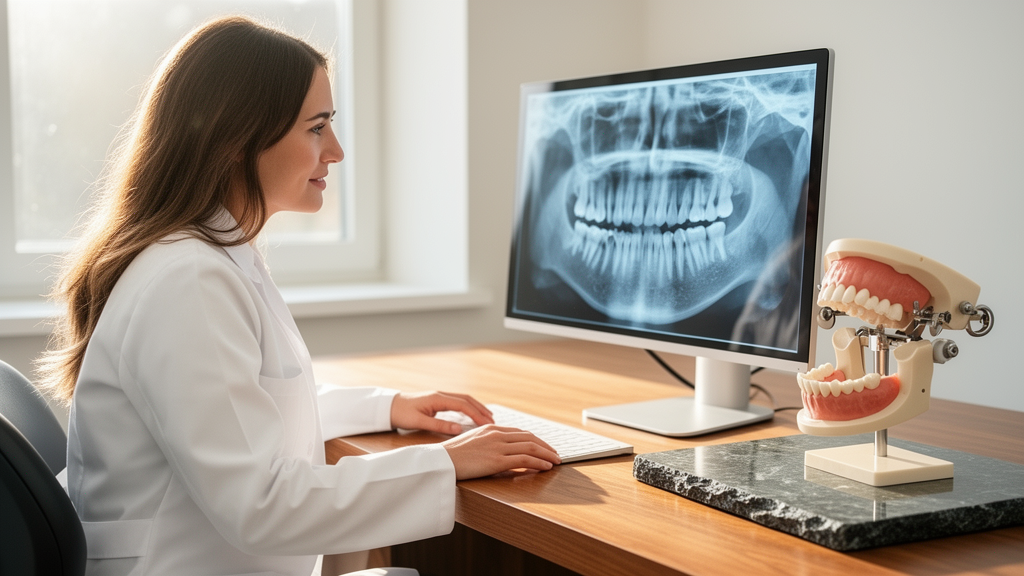
Researchers published a study in the International Journal of Legal Medicine evaluating deep learning models for forensic dental age assessment using panoramic radiographs. The study, led by Cristiana Palmela Pereira and colleagues, aimed to address a gap in artificial intelligence research where most studies focus on either chronological age estimation or legal age threshold classification, limiting direct comparisons between these predictive tasks. The team sought to assess the performance, robustness, and potential applicability of these models as decision-support tools in forensic practice.
The study utilized a retrospective dataset of 9,814 anonymised digital panoramic radiographs from individuals with known chronological age. The images were standardised through a preprocessing pipeline to ensure consistency. The research team applied transfer learning to convolutional neural network architectures to handle two complementary prediction tasks. These tasks included chronological age estimation, treated as a regression problem, and legal age threshold classification at specific ages, treated as independent binary classification problems.
The legal age thresholds selected for classification were 10, 12, 14, 16, 18, and 21 years.
Model performance was evaluated using a comprehensive set of metrics tailored to the specific task. For the regression task, which estimates continuous age, the team used mean absolute error, coefficient of determination, median absolute error, and mean absolute percentage error. For the classification tasks, which determine if an individual is above or below a specific age threshold, the metrics included accuracy, precision, recall, and F1-score.
The regression model demonstrated strong predictive performance on the independent test dataset. It achieved a mean absolute error of 1.122 years, indicating that, on average, the estimated age was within approximately one year of the actual chronological age. The coefficient of determination was 0.917, suggesting that the model explained over 91% of the variance in age. The mean absolute percentage error was 7.67%, reflecting the relative accuracy of the estimates across the analysed age range.
In the classification tasks, the models showed high performance for younger age thresholds. Accuracy exceeded 90% with F1-scores above 0.90 for the 10-, 12-, 14-, and 16-year legal thresholds.
However, predictive performance decreased at the 18- and 21-year thresholds. The researchers attributed this lower performance to increased biological variability and class imbalance associated with later stages of dental development.
The study concludes that deep learning provides good predictive performance from panoramic radiographs for both continuous age estimation and legal age threshold classification. The complementary evaluation of regression and classification tasks demonstrates the versatility of convolutional neural networks for forensic dental image analysis.
Subject of Research: Deep learning models for forensic dental age assessment using panoramic radiographs
Article Title: Deep learning for dental age assessment from panoramic radiographs: regression-based age estimation and threshold-based age classification
Article References: Palmela Pereira, C., Figueiras, A., Nushi, V., Elbawab, M., Francisco, A., & Santos, R. (2026). Deep learning for dental age assessment from panoramic radiographs: regression-based age estimation and threshold-based age classification. International Journal of Legal Medicine. https://doi.org/10.1007/s00414-026-04065-9
Image Credits: AI Generated
DOI: 10.1007/s00414-026-04065-9
Keywords: deep learning, dental age assessment, panoramic radiographs, forensic medicine, convolutional neural networks, age estimation, legal age classification, artificial intelligence, medical imaging, regression analysis, Deep, learning
News Source: Blake Davidson. (November 10, 2026). Deep learning estimates dental age from panoramic radiographs. Scienmag.