Injecting carbon dioxide into deep underground coal seams triggers intricate multi-physical dynamics that govern both gas storage security and reservoir injectivity. Researchers investigating these subsurface interactions have carried out in-situ core flooding experiments using high-resolution synchrotron X-ray imaging technology to track multicomponent sorptive gas flow within fractured coal. Because carbon dioxide geo-sequestration in unmineable seams involves coupled phenomena—specifically multicomponent gas diffusion, competitive adsorption, and mechanical deformation of the surrounding rock—uncovering the exact microscopic mechanisms is essential for evaluating long-term geological storage. The experimental observations demonstrate that gas desorption driven by competitive exchange mechanisms is substantially more dominant than depressurisation alone.
Deep unmineable coal seams represent promising geological targets for permanent carbon dioxide sequestration due to their substantial natural storage capacity and structural sealing efficiency. Because coal matrices possess an inherently higher chemical affinity for carbon dioxide than for naturally occurring methane, injected carbon dioxide acts to displace methane within the porous framework. Gas sorption induces swelling and shrinkage within the solid coal matrix, which directly modifies fracture aperture dimensions and subsequently alters the permeability necessary for sustained gas injection. Past geo-sequestration attempts have encountered reduced injectivity because carbon dioxide adsorption causes the matrix to expand, constricting the cleat networks that facilitate fluid transport. While static equilibrium bench measurements have catalogued isolated adsorption capacities, resolving dynamic diffusion rates and competitive displacement under transient core flooding conditions has remained a key experimental obstacle.
Conventional laboratory assessments using benchtop micro-computed tomography scanners have historically been constrained by prolonged acquisition times. Standard laboratory micro-CT systems require several hours per tomographic scan to attain sufficient spatial resolution and signal-to-noise ratio. This temporal limitation impedes real-time investigation of dynamic gas transport and competitive exchange processes, which evolve rapidly over short timescales. To resolve this hurdle, the research team employed monochromatic synchrotron-based X-ray micro-tomography at hutch 2B of the Imaging and Medical beamline at the Australian Synchrotron, managed by the Australian Nuclear Science and Technology Organisation. Synchrotron radiation delivers monochromatic X-ray beams with intense photon flux and eliminates beam-hardening artifacts, enabling three-dimensional structural and composition scans with micrometre-scale spatial resolution completed in mere minutes.
In this investigation, the authors utilised heavy noble gases as direct imaging analogues for natural reservoir fluids, taking advantage of their high X-ray attenuation coefficients. Krypton was selected as a representative analogue for methane, as both species exhibit similar kinetic diameters—0.36 nanometres for krypton versus 0.38 nanometres for methane—and demonstrate comparable matrix swelling behaviour in coal, reaching maximum volumetric expansions of 1.33 percent and 1.17 percent, respectively. Xenon served as the direct analogue for carbon dioxide due to analogous sorption capacities and similar volumetric matrix swelling responses, documented at 4.34 percent for xenon compared to 4.41 percent for carbon dioxide. High-contrast tomographic imaging was conducted at designated X-ray beam energies tuned relative to elemental absorption edges, with scans performed at 35 kiloelectronvolts for xenon and 28 kiloelectronvolts for krypton.
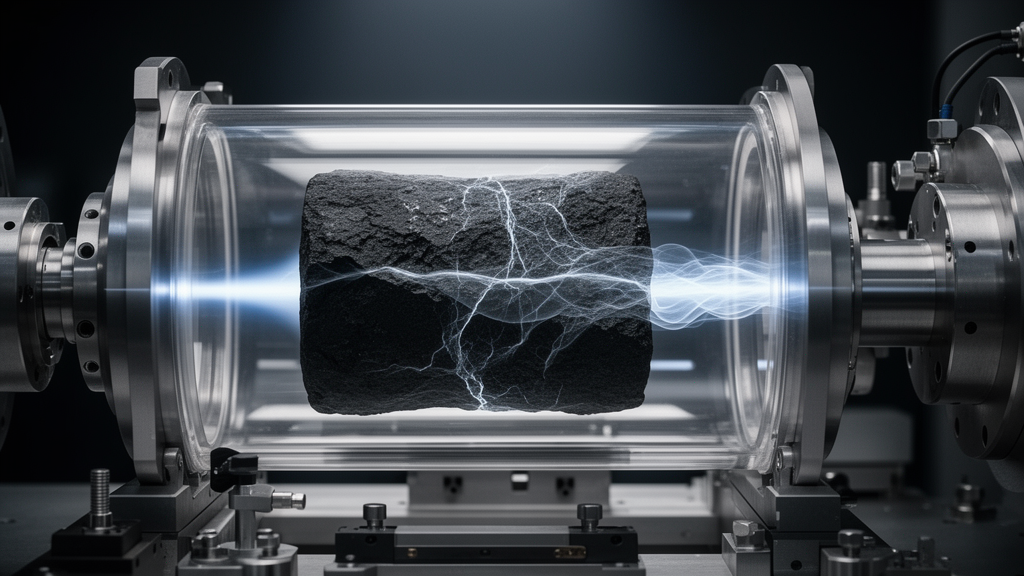
The experimental apparatus centered around an X-ray transparent core holder engineered from polyetheretherketone, a high-performance polymer exhibiting robust mechanical strength alongside low X-ray attenuation. Certified to operate under pressures up to 1500 pounds per square inch and temperatures of 98 degrees Celsius, the core holder housed a cylindrical coal plug measuring 6 millimetres in diameter and 12 millimetres in length mounted on a continuous 180-degree rotation stage. Confining stress was applied through a hydraulic hand pump, while compressed gas delivery was regulated using high-precision inlet lines and back-pressure regulators. Downstream fluid effluent was continuously sampled through an integrated septum port using gas-tight syringes.
Dynamic tomographic datasets captured the structural heterogeneity of the coal specimen, specifically contrasting lithological bands composed of bright coal and dull coal. Bright coal, rich in brittle vitrain material, contained well-developed orthogonal fracture networks, whereas dull durain bands exhibited fewer visible fractures. The time-series micro-CT reconstructions revealed that krypton gas rapidly entered the core within eight minutes and migrated into the microporous matrix. Counterintuitively, the dull lithotype bands adsorbed a higher mass fraction of krypton than the extensively fractured bright coal bands. Even after 337 minutes of continuous krypton injection, an unfilled zone remained within the bright coal matrix, demonstrating that despite possessing interconnected cleat structures, the tighter local microporous fabric of bright coal poses higher transport resistance than the surrounding dull coal matrix.
During secondary injection stages designed to replicate enhanced coal bed methane recovery, carbon dioxide was introduced to displace pre-adsorbed krypton. Tomographic subtraction mapping showed that carbon dioxide quickly desorbed krypton from both the macroscopic fracture boundaries and the inner micropores of the matrix. Because carbon dioxide possesses a kinetic diameter of only 0.33 nanometres—smaller than both krypton and methane—it diffuses rapidly through tight microporous networks. Gas composition analysis of the core effluent revealed that carbon dioxide concentrations rose to 56 percent and plateaued for approximately 200 minutes, indicating that nearly half of the injected carbon dioxide volume was successfully retained by the coal sample via preferential adsorption during the displacement process.
In marked contrast, core flooding runs displacing methane with xenon demonstrated starkly differing kinetic and spatial signatures. Although xenon and carbon dioxide exhibit similar overall equilibrium swelling capacities, xenon possesses a kinetic diameter of 0.40 nanometres, which substantially impedes its diffusion into the fine coal micropores according to size-dependent transport limitations. Three-dimensional concentration maps showed xenon remained heavily concentrated in the immediate vicinity of the main fractures even after 70 minutes of injection. Effluent gas analyses confirmed that xenon broke through rapidly, accounting for 84 percent of total outflow within one hour. Because the near-fracture matrix rapidly reached local capacity and diffusion into deeper matrix pores was hindered by molecular size, excess xenon bypassed the inner rock matrix entirely through preferential flow along open fracture pathways.
Sorption kinetics were mathematically quantified by fitting normalised attenuation profiles from reconstructed grayscale slices to the Linear Driving Force model. The resulting mass transfer coefficients revealed significant kinetic differences across gas species and process directions. The mass transfer coefficient for krypton adsorption in dry coal was calculated at 0.1025 per minute, whereas its competitive desorption rate during carbon dioxide displacement dropped by a factor of nineteen to 0.0054 per minute. Xenon exhibited exceedingly sluggish desorption kinetics, remaining clearly detectable within the coal sample even after twelve consecutive hours under continuous laboratory vacuum. This stubborn retention is attributed to high polarizability and molecular dimensions that generate stronger localized Van der Waals forces, combined with restricted diffusion through constricted micro-pathways.
Direct measurements of mechanical aperture deformation underscored the opposing geomechanical roles of simultaneous gas uptake and release. When krypton adsorbed onto the dry sample under constant confining stress, aperture alterations remained minimal and stayed within the single-voxel resolution threshold of the scanner. However, when carbon dioxide was introduced to displace the krypton, rapid matrix expansion caused the major fracture aperture to constrict to 50 percent of its initial width. Quantitative permeability measurements logged across the test phases confirmed that the partially carbon dioxide-saturated state exhibited the lowest overall hydraulic conductivity, whereas the xenon-treated coal maintained the highest permeability because its localized near-fracture adsorption failed to constrict the broader transport fractures.
To connect laboratory microscale findings with reservoir predictions, the researchers integrated the empirically fitted mass transfer coefficients into a three-dimensional Advection–Diffusion-Sorption model executed within the MATLAB Reservoir Simulation Toolbox. The resulting simulations mapped carbon dioxide penetration fronts over injection durations extending to 120 minutes, confirming that laboratory-derived mass transfer coefficients derived from synchrotron datasets substantially improve the fidelity of large-scale advection-diffusion forecasts by replacing idealized assumptions with verified physical rates.
These experimental and numerical findings delineate essential boundaries for underground carbon sequestration schemes. The data show that competitive gas exchange constitutes the primary driver of methane release in deep seams, while isolated pressure reductions fail to desorb strongly bound species. Furthermore, simultaneous multi-gas adsorption and desorption buffer matrix deformation, dampening severe swings in fracture aperture width. The authors noted that experimental run times restricted xenon penetration to near-fracture domains, highlighting the need for extended exposure periods in future core assessments. Moving forward, combining fast microscopic synchrotron tomography with complementary core-scale Positron Emission Tomography will enable researchers to track dynamic plume migration and multiphysical gas-coal interactions across expanding spatial and temporal domains.
Subject of Research: Synchrotron X-ray imaging of multicomponent sorptive gas flow and deformation in coal
Article Title: Study of multicomponent sorptive gas flow in fractured porous media using in-situ synchrotron X-ray imaging technology
Article References: Jing, Y., Armstrong, R. T., Yuan, M., Lanetc, Z., Holt, P., Kumaran, A. U., Mostaghimi, P., Zhang, Y., & Zhang, X. (2025). Study of multicomponent sorptive gas flow in fractured porous media using in-situ synchrotron X-ray imaging technology. Carbon Neutrality, 4(1), Article 36. https://doi.org/10.1007/s43979-025-00152-9
Image Credits: AI Generated
DOI: 10.1007/s43979-025-00152-9
Keywords: carbon sequestration, synchrotron imaging, coal permeability, gas sorption, fractured porous media, multicomponent gas dynamics, methane displacement, adsorption modelling, multicomponent, sorptive, flow, fractured
News Source: Denise Maddox. (November 10, 2026). Synchrotron X-Ray Imaging Tracks Multicomponent Gas Flow and Coal Fracture Dynamics. Scienmag.