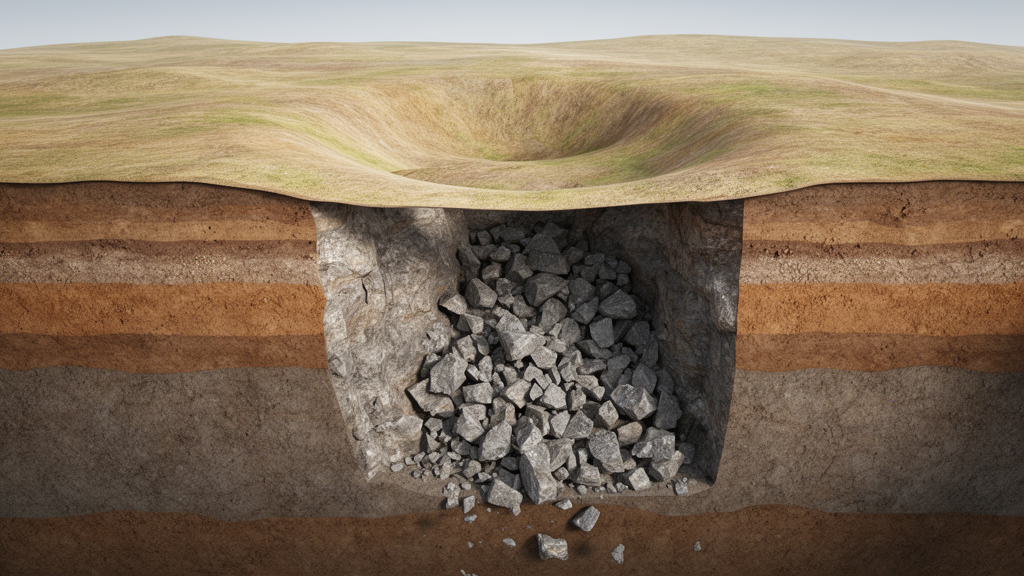
Researchers have developed a new mechanical model to analyze surface movement dynamics and predict displacement ranges resulting from sublevel caving operations in metalliferous deposits. The study, published in Geomechanics and Geophysics for Geo-Energy and Geo-Resources, introduces a novel conceptualization of the subsidence angle, accompanied by a calculation methodology derived from mechanical principles.
The reliability of the newly proposed method was validated through a combined approach involving surface and underground monitoring at the Dahongshan Iron Mine, along with numerical simulation calculations.
The investigation specifically examines how topographical variations, the initial caved zone backfill elevation, and mining depth influence surface deformation patterns.
One of the key findings of the research is that the reconceptualized subsidence angle, defined as the horizontal angle between the movement boundary extending from the deepest extraction level edge to the surface movement perimeter, creates maximum surface fracturing zones.
The study also highlights the impact of terrain on subsidence patterns. Under flat terrain, subsidence zones manifest symmetrically on both sides of the undercut. In contrast, sloped landscapes produce asymmetrical subsidence patterns, with hanging wall subsidence angles exceeding footwall measurements. This asymmetry is attributed to the hanging wall topographic line intersecting the movement boundary at greater distances, which results in hanging wall subsidence zones exhibiting larger dimensions.
Furthermore, the research investigates the role of backfilling initial caved zones in mitigating surface fracturing. The findings indicate that while backfilling minimally affects the distribution areas of tensile stress, it significantly diminishes stress magnitude. However, the study notes that the effect is primarily on stress intensity rather than the spatial extent of the stress distribution.
The influence of mining depth on surface deformation is also explored. The study finds that increasing extraction depths correlates with expanded tensile stress zones, though this is accompanied by decreased stress intensity.
For combined extraction methodologies, the research describes the distribution of principal stress on the surface, extending from the subsidence center towards the open-pit slope. This distribution can be sequentially divided into four distinct zones: the compression stress decay zone, the tensile stress gradual increase zone, the tensile stress fluctuation zone, and the rapid increase zone of compression stress.
Subject of Research: Theoretical model and patterns of surface subsidence by sublevel caving mining
Article Title: Research on theoretical model and patterns of surface subsidence by sublevel caving mining under multiple factors
Article References: Ma, K., Zhao, Y., Yang, T., Liu, H., Liu, Y., Hou, J., He, R., He, Y., Li, J., & Li, X. (2026). Research on theoretical model and patterns of surface subsidence by sublevel caving mining under multiple factors. Geomechanics and Geophysics for Geo-Energy and Geo-Resources. https://doi.org/10.1007/s40948-026-01226-3
Image Credits: AI Generated
DOI: 10.1007/s40948-026-01226-3
Keywords: sublevel caving, surface subsidence, geomechanics, mining engineering, Dahongshan Iron Mine, subsidence angle, numerical simulation, surface deformation, Research, theoretical, model, patterns
News Source: Denise Maddox. (November 10, 2026). New Model Predicts Surface Subsidence from Sublevel Caving Mining. Scienmag.