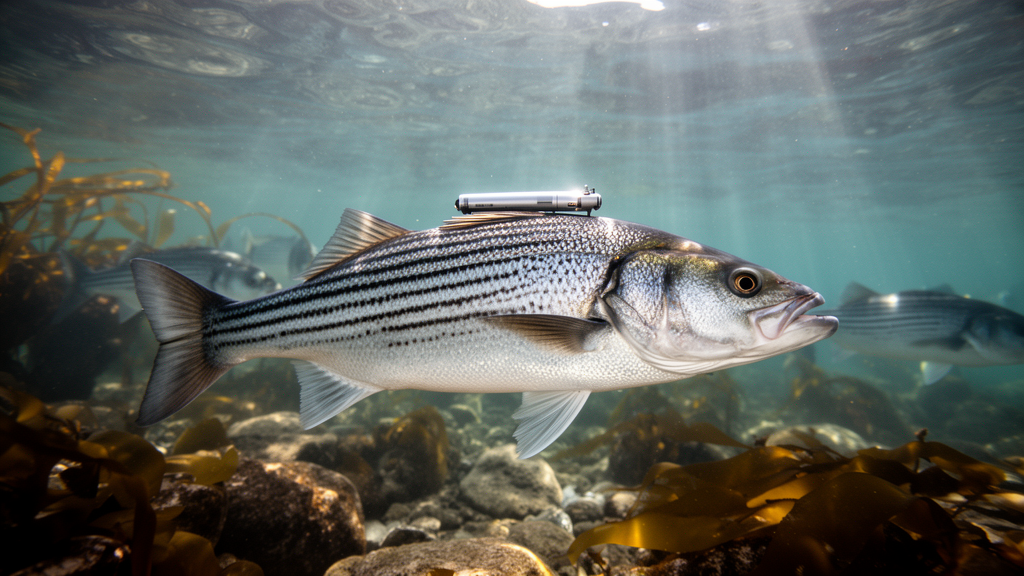
An extensive six-year acoustic telemetry investigation in California’s Sacramento–San Joaquin Delta has revealed that striped bass (Morone saxatilis) exhibit five discrete movement behavior classes within and around a key water-regulating reservoir. Clifton Court Forebay, an engineered shallow impoundment operated by the California Department of Water Resources as part of the State Water Project, has long presented a major ecological challenge because predation in the reservoir is considered a leading contributor to losses of juvenile salmonids, with mortality estimates ranging from 66 to 99 percent. By tracking 543 tagged striped bass across 10,608 month-long behavioral intervals between 2013 and 2018, researchers applied cluster analysis to evaluate how individual fish allocate their time, navigate between internal habitats, and traverse hydraulic control points. The resulting behavioral groupings demonstrated that striped bass are not a homogenous predatory body but instead diverge into distinct spatial profiles ranging from highly stationary interior dwellers to highly mobile cross-boundary commuters. This evidence provides resource managers with a quantitative framework to evaluate predator exposure, refine removal strategies, and reduce predation pressure on sensitive native fish species moving through the Delta.
The study took place within Clifton Court Forebay, an approximately 900-hectare reservoir near Tracy, California, characterized by a shallow average depth of 1.5 meters that provides operational flexibility for conveying water southward to municipal and agricultural contractors. Water enters the forebay from surrounding Delta channels through five operational radial gates positioned at the southeastern corner, flows westward across the reservoir expanse, and exits through an intake canal leading directly to the Harvey O. Banks Pumping Plant. High-velocity inflow through the radial gates has eroded a localized scour hole roughly 20 meters deep where large numbers of striped bass congregate at high densities. Downstream along the intake canal, a louver system at the John E. Skinner Fish Protective Facility intercepts salvageable small fish, while larger adult fish are prevented from entering the primary pumps. The radial gates serve as the primary migration corridor into and out of the reservoir for adult striped bass, as 99.8 percent of individuals salvaged at the Skinner facility were smaller than the tagged study cohort, which had an average fork length of 417 millimeters. Hydrodynamic velocities reaching roughly 5 meters per second during gate openings initially limit fish passage outward, but movement becomes increasingly viable as hydraulic head differentials diminish.
To monitor fish movement across this hydrologic infrastructure, researchers installed an acoustic receiver network beginning in 2013 that eventually comprised nine permanent monitoring stations. The acoustic array incorporated Hydroacoustic Technology Inc. Model 590 hydrophones paired with Model 795 beacon tags and shore-based Model 295 or 395 data loggers equipped with dedicated power supplies. Three receiver stations were placed along the intake canal (IC1, IC2, and IC3), one was positioned inside the forebay downstream of the gates (RGD1), one was anchored immediately outside the gates (RGU1), one was situated at the Old River South intersection (ORS1), and three extended northwest into West Canal (WC1, WC2, and WC3). Telemetry recordings collected from May 20, 2013, through December 31, 2018, underwent standard vendor quality control to filter false positives and acoustic artifacts. Across the entire multi-year deployment, individual stations experienced sporadic outages averaging 1.9 percent of total operating time, ranging from 0.2 percent at IC1 to 5.6 percent at ORS1. These temporary interruptions were caused by hardware complications such as severed cables, battery failures, solar charging loss, and thermal overheating, alongside software anomalies including a malware infection that corrupted raw reader files, though operational stations confirmed active beacon tag detection on every functional monitoring day.
Between March 12, 2013, and December 30, 2016, field teams captured, examined, and released 3,969 striped bass under authorization from the California Department of Fish and Wildlife. Fish sampling occurred year-round across the four quadrants of the forebay and the intake canal using variable-mesh gill nets, standard hook-and-line angling gear, and boat electrofishing trials initiated at 30 Hertz and up to 500 Volts. Collected fish were sedated with 35 milligrams per liter of AQUI-S 20E under federal investigational drug protocols, measured for weight and fork length, and scanned for passive integrated transponder tags. A total of 590 fish without prior tags were surgically implanted with combined acoustic and PIT transmitters, utilizing three transmitter sizes selected to ensure that transmitter weight remained under two percent of total fish body burden. To establish age structures, scales sampled from 222 fish were independently examined under digital microscope magnification by multiple readers, yielding an age-length key modeled via a logarithmic relationship with an adjusted R-squared of 0.95. This model generated simulated length distributions binned into two-centimeter increments to assign capture ages, after which elapsed detection weeks were tracked to project individual ages from age one through six or older.
Analytical preparation required standardizing detection histories into continuous daily records to prevent timing biases caused by logger clock drift and daylight-saving time adjustments. Each monitoring day was classified into one of three mutual states: Inside, when detections were recorded exclusively at the intake canal or interior radial gate hydrophone; Outside, when detections occurred only on receivers in outer canals; or Transit, when a fish registered detections both inside and outside the radial gates within the same day. Transition sequences across consecutive days established directional movements, with transitions between inside and outside states denoting gate exits or entries. Detection histories were screened for tag shedding or fish mortality by defining site groups of overlapping hydrophones; periods without movement exceeding the ninety-ninth percentile duration of a site group were censored, leading to the truncation of 30 inactive tags. To bridge unmonitored detection gaps, researchers applied Continuous Presence Events, extending observed states across gaps while conservatively restricting unobserved Transit states to a maximum duration of one day to prevent artificial inflation of transit durations around the acoustically noisy radial gates.
The mathematical delineation of behavioral classes relied on partitioning around medoids clustering applied to a Gower dissimilarity matrix derived from monthly summary metrics. Daily movements for each individual fish were compiled into one-month behavioral states describing residence patterns, receiver visitation frequency, spatial displacement, and traversal timing. Before clustering, metrics were evaluated using Spearman rank correlation coefficients, leading to the removal of six collinear variables with absolute correlations exceeding 0.8: outside residency duration, total receiver visits, daily receiver visit rates, daily displacement distance, monthly total distance, and overall movement count. Seventeen retained candidate variables were processed through iterative clustering across cluster counts ranging from two to eight, incorporating backward variable elimination to maximize mean silhouette width. The resulting five-class configuration attained an overall mean silhouette width of 0.77, with per-cluster values ranging from 0.73 to 0.79, indicating robust within-cluster cohesion and clear separation. Sensitivity tests applying winsorization to cap right-skewed movement variables at percentiles between the seventieth and ninety-ninth percentiles confirmed that high-movement individuals reflected biologically meaningful variation rather than statistical outliers, justifying the retention of the unmanipulated five-class model.
The five identified classes captured distinct behavioral profiles across residency, activity, and detection frequency. The largest group, designated Inside Residents–Undetected, encompassed 5,662 behavior states characterized by fish that remained within the forebay across monthly intervals without triggering peripheral hydrophones, likely occupying unmonitored central reservoir waters. The second group, Inside Sedentary, comprised 700 behavior states marked by high interior detection frequencies with a median of only three non-detection days per month, yet these fish exhibited strict localized fidelity to either the intake canal or the radial gates, averaging 20 monthly receiver visits at a median rate of only one unique receiver per day. The third group, Inside Roamers, accounted for 1,141 states and represented active forebay occupants that undertook extensive internal travel, logging 2,179 total crossings between the gates and intake canal while making only 77 exits and 78 entries through the radial gates. The fourth group, Commuters, totaled 334 states and exhibited the highest mobility across the network, regularly visiting multiple interior receivers (median of nine) and exterior stations (median of five), generating 295 exits and 145 entries. Finally, Outside Residents–Undetected accounted for 2,771 states, representing individuals residing continuously in outer Delta waterways without entering the forebay.
Evaluation of explanatory variables using design-based survey regression accounting for repeated fish measurements demonstrated that behavioral class composition varied significantly across months, water year types, and age classes (p ≤ 0.001). Inside Residents–Undetected remained the most common behavioral class throughout the entire year, ranging from 51.2 percent of observations in March to 62.4 percent in January. Conversely, Inside Sedentary behavior peaked during winter months (9.6 percent in December and 8.7 percent in January) and reached its minimum in September at 5.3 percent. Inside Roamers exhibited elevated activity in February (13.8 percent) and November (13.0 percent), with their lowest proportion recorded in August at 7.9 percent. The Commuter class displayed the sharpest seasonal peak of all groups, surging from 0.2 percent in January to 5.2 percent in February and peaking at 10.5 percent in March, before dropping back to roughly 3.3 to 3.7 percent in April and May and remaining below 2.3 percent through autumn. Hydrological conditions further altered distributions: during Critical Dry water years, which accounted for 46.9 percent of all observed states, Inside Roamer representation reached 15.9 percent and Commuters reached 4.4 percent, more than double their proportions in wetter hydrological periods.
Demographic analysis revealed pronounced ontogenetic shifts in movement behavior across five age categories. Younger striped bass exhibited higher forebay fidelity, with Inside Roamers declining from 18.8 percent among age 1–2 fish to 6.0 percent in age 6+ fish, whereas Outside Residents–Undetected increased from 8.2 percent in age 1–2 fish to 30.0 percent in fish aged 6 years and older. This shift reflects physiological maturity, as male striped bass reach sexual maturity between ages 2 and 4 and females between ages 4 and 6, prompting seasonal upstream spawning runs into exterior river systems. Operational radial gate openness differed significantly across classes (F = 3.177, p = 0.014), but mean differences were minor, spanning an absolute range of less than two percentage points from 21.4 percent for Inside Roamers to 23.2 percent for Inside Sedentary fish. In contrast, prey availability measured by a square-root transformed salmonid catch index at Mossdale exhibited strong statistical differences (F = 24.642, p < 0.001). The Commuter class displayed a markedly higher back-transformed mean catch index of 0.24 compared to 0.10 to 0.13 for all other classes, directly aligning peak commuter cross-boundary movements with pulses of outmigrating juvenile salmonids.
Analysis of directional movement timing revealed that reservoir exits were the most temporally focused event across all behavioral classes, totaling 351 observed exits with a median date of March 19, closely preceding the April 19 peak in Mossdale salmonid catch density. Reservoir entries were more dispersed throughout the year (n = 221), exhibiting an overall median date of May 31, while internal forebay crossings between the radial gates and the intake canal represented the most voluminous movement type (n = 2,492), showing a broad median date of June 12 dominated by Inside Roamers. The study authors emphasized several analytical constraints, noting that receiver coverage was concentrated around transit points rather than central pelagic open water, individual sex could not be determined, and daily time aggregation obscured sub-daily movement bouts. Nevertheless, because distinct behavioral classes demonstrate differential exposure to capture gear, these findings indicate that predator management efforts can achieve greater efficiency by concentrating targeted removals at radial gate and intake structures during the late-winter and early-spring window, precisely when active Commuters and Inside Roamers coincide with vulnerable juvenile salmonids.
Subject of Research: Acoustic telemetry and cluster analysis of striped bass movement behaviors in Clifton Court Forebay
Article Title: Identifying movement behavior states of striped bass (Morone saxatilis) in a large regulating forebay using cluster analysis
Article References: Spaulding, T., Kalmbach, A., D. Chapman, E., Bergman, P., Wilder, R. M., Hurley, P., & Brumbaugh, S. (2026). Identifying movement behavior states of striped bass (Morone saxatilis) in a large regulating forebay using cluster analysis. Animal Biotelemetry, 14(1), Article 32. https://doi.org/10.1186/s40317-026-00472-2
Image Credits: AI Generated
DOI: 10.1186/s40317-026-00472-2
Keywords: Striped Bass, Acoustic Telemetry, Cluster Analysis, Clifton Court Forebay, Fisheries Management, Predator Control, Delta Ecology, Fish Movement, Identifying, movement, behavior, states
News Source: Drew Townsend. (November 9, 2026). Acoustic Tracking Reveals Five Distinct Behavioral Classes Among Striped Bass Predators. Scienmag.