The study, published in Microbial Biotechnology, focuses on the continuous photofermentative valorization of process water (PW) derived from hydrothermal carbonization. By combining a specific genetic modification with continuous cultivation, the team achieved average hydrogen yields of 178.22 mL per gram of chemical oxygen demand (COD) consumed, significantly outperforming traditional dark fermentation methods that typically yield between 20 and 40 mL H2 per gram COD for the same substrate.
The research addresses a dual challenge in sustainable energy and waste management. Global energy systems still rely heavily on fossil fuels, leading to greenhouse gas emissions and resource depletion. Hydrogen is considered a strategic energy carrier due to its high energy density of 122 kJ per gram, which is approximately 2.7 times higher than gasoline, and its carbon-free combustion. However, nearly 90% of global hydrogen is currently produced from fossil fuels, resulting in ‘grey hydrogen’ and associated carbon emissions. Biological production, or biohydrogen, offers a sustainable alternative, but many existing systems rely on pure carbon sources that limit economic feasibility at large scales.
To overcome these limitations, the researchers utilized process water from the hydrothermal carbonization of mixed food waste, including fruits and vegetables such as tomato, apple, and lettuce. Hydrothermal carbonization operates at relatively low temperatures without requiring prior drying of the feedstock. While this process produces a carbon-rich solid known as hydrochar, it also generates a liquid fraction termed process water. This PW is characterized by a high chemical oxygen demand of 60.7 g/L, an acidic pH of 3.9, and a significant nutrient load, including soluble carbohydrates and proteins. Although PW poses an environmental challenge due to its organic load and potentially inhibitory compounds, its composition provides a substantial reservoir of organic carbon suitable for biological valorization.
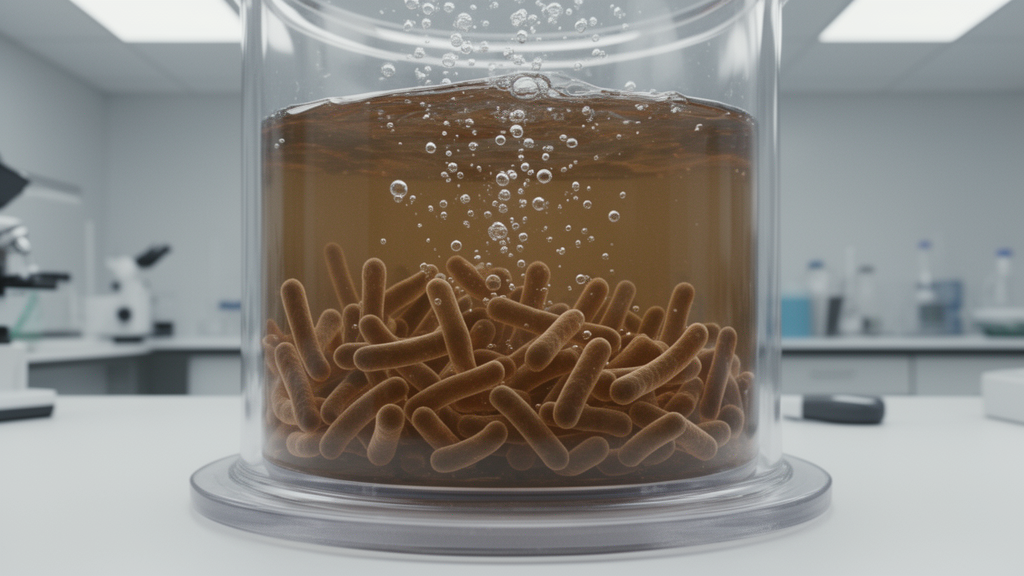
The study employed two strains of Rhodobacter capsulatus: the wild-type SB1003 and a derivative mutant designated ΔhupAB. The ΔhupAB strain is a targeted deletion mutant lacking the hupA and hupB genes, which encode the subunits of uptake hydrogenase. Uptake hydrogenase typically reoxidizes hydrogen, so its deletion prevents this reoxidation and increases net hydrogen yields. The bacteria were cultivated under phototrophic, anaerobic conditions at 30°C using infrared illumination. The experimental design involved an initial batch phase to evaluate substrate suitability and strain performance, followed by a prolonged continuous cultivation phase in a 3 L jacketed glass photobioreactor.
In the batch experiments, the ΔhupAB mutant exhibited robust hydrogen production, reaching approximately 120 mL H2 per gram COD in the synthetic RCV− medium after 94 hours. In contrast, the wild-type strain produced less than 15 mL H2 per gram COD across all conditions. When process water was used as the carbon source, hydrogen production was initially delayed due to the presence of residual ammonium, which represses nitrogenase activity. However, once the ammonium was depleted, the cultures in PW-based media showed rapid hydrogen accumulation. The researchers found that supplementing the PW with only phosphate buffer (PW + PB) was sufficient to support growth and hydrogen production, eliminating the need for more complex synthetic medium components.
The continuous photofermentation experiments were conducted for more than 600 hours, divided into a batch start-up phase and a stable continuous operational period. During the stable phase, which lasted from approximately 100 to 350 hours, the reactor was operated with a hydraulic retention time of 3.5 days. The ΔhupAB mutant maintained sustained biomass formation, although volatile suspended solids levels were lower in the PW + PB condition (1.87 ± 0.88 g/L) compared to the synthetic RCV− medium (4.98 ± 1.15 g/L). Despite the lower biomass concentration, carbon utilization remained effective, with average soluble COD removal of 43% ± 6% in the PW condition.
Hydrogen production profiles revealed distinct advantages for the PW + PB condition during continuous operation. The average yield was 178.22 ± 188.60 mL H2 per gram COD consumed, compared to 26.14 ± 24.20 mL H2 per gram COD in the RCV− medium. Cumulative hydrogen production surpassed 1,000 mL per liter by 400 hours and approached 1,500 mL per liter after 650 hours. These results indicate that continuous cultivation enables physiological adaptation to the complex composition of the process water, overcoming the limitations observed under batch conditions. The high variability in yields is attributed to the heterogeneous nature of the PW, which contains a diverse mixture of organic compounds that can transiently influence substrate availability and metabolic activity.
Analysis of carbon partitioning provided insight into the metabolic mechanisms driving the high hydrogen yields. In the synthetic medium, inorganic carbon accumulation was higher, indicating a greater extent of complete carbon oxidation. In contrast, under PW feeding, inorganic carbon formation was lower, while hydrogen production was enhanced. This suggests that carbon and reducing equivalents are preferentially redirected towards nitrogenase-dependent hydrogen production rather than biomass synthesis or complete oxidation. The transient accumulation of volatile fatty acids, such as acetate and butyrate, was observed during early stages but was subsequently consumed, reflecting dynamic imbalances in intracellular redox balance rather than primary drivers of hydrogen production.
To ensure the stability of the culture, the researchers performed full-length 16S rRNA gene sequencing on samples collected at mid and late stages of operation. All sequences were assigned to the genus Rhodobacter, with the dominant sequence showing 98.9% identity to Rhodobacter capsulatus SB1003. This confirmed that the long-term hydrogen production was not associated with microbial contamination or community shifts. Gas composition analyses further revealed very low carbon dioxide production, resulting in an almost pure hydrogen stream. This high purity is a significant advantage over dark fermentation, where hydrogen is typically co-produced with substantial amounts of carbon dioxide, requiring additional separation steps.
The study highlights the potential of integrating waste valorization with renewable energy production. By using a minimally supplemented waste-derived substrate, the process simplifies medium formulation and reduces operating costs compared to conventional synthetic media. The findings demonstrate that the combination of continuous cultivation and targeted genetic strategies can unlock the hydrogen-producing potential of complex waste streams. However, the researchers note that the continuous experiments were conducted as single long-term runs, so the results demonstrate feasibility rather than definitive reproducibility. Future studies will need to evaluate process robustness across different PW compositions and address engineering challenges related to photobioreactor design and light distribution for large-scale implementation.
The process water used in this study was generated from mixed food waste, specifically fruits and vegetables such as tomato, lettuce, apple, orange, leek, cabbage, and grapes. The waste was homogenized to a moisture content of 91.5% and subjected to hydrothermal carbonization in a stainless steel reactor at 180°C for one hour. This thermal treatment converts wet biomass into a solid carbon-rich material called hydrochar and a liquid fraction known as process water. The resulting liquid contained a high concentration of soluble organic compounds, with soluble carbohydrates reaching 34.0 g/L and soluble proteins at 5.7 g/L. Additionally, the water contained low-molecular-weight compounds like glucose and lactate, along with ammonium and various macro- and micronutrients. This chemical complexity means the water is not a simple substrate but a heterogeneous mixture that requires careful management to support microbial growth effectively.
During the continuous operation, the researchers monitored the dynamics of volatile fatty acids to understand metabolic fluctuations. In the synthetic medium, no significant accumulation of these acids was detected, indicating direct assimilation of simple substrates. In contrast, the process water initially contained 40–60 mg/L of volatile fatty acids, predominantly acetate, which was rapidly consumed during the early batch phase. As the continuous operation progressed, sporadic peaks of acetate and butyrate were observed, coinciding with decreases in optical density and increases in soluble chemical oxygen demand. In the late phase of the experiment, a progressive accumulation of various fatty acids, including propionate, was detected, reaching total concentrations of approximately 300 mg/L. These fluctuations suggest intermittent imbalances between substrate uptake and metabolic processing, reflecting the dynamic nature of the microbial community as it adapts to the complex feedstock.
The study also examined the relationship between optical density and volatile suspended solids to assess biomass indicators. The ratio of optical density at 600 nm to volatile suspended solids was higher in the process water condition than in the synthetic medium, indicating that optical measurements cannot be directly interpreted as a comparable proxy for biomass across different media. This discrepancy likely reflects variations in cellular pigmentation, such as bacteriochlorophyll content, or other optical properties under process water-based cultivation. Despite these differences in biomass indicators, the overall carbon utilization remained largely unaffected by the switch from synthetic to waste-derived substrates. The sustained removal of soluble chemical oxygen demand and total organic carbon demonstrates that stable carbon conversion can be maintained in a simple continuous stirred tank reactor, even when treating a chemically complex effluent over extended periods.
Comparisons with other biological hydrogen production systems highlight the competitive nature of this approach. While higher hydrogen yields have been reported for defined substrates under optimized laboratory conditions, the continuous photofermentative valorization of real process water achieved in this study compares favorably with previously reported wastewater-based systems. For instance, dark fermentation of the same substrate typically yields between 20 and 40 mL of hydrogen per gram of chemical oxygen demand, whereas the photofermentation process achieved an average of 178.22 mL per gram. This significant difference underscores the potential of photofermentation as a more effective route for converting process water into hydrogen, particularly when combined with targeted genetic modifications that enhance nitrogenase activity and prevent hydrogen reoxidation.
Despite the promising performance, several challenges remain for large-scale implementation. The scalability of photobiological hydrogen production is strongly dependent on photobioreactor design, particularly regarding light distribution and energy requirements for illumination. Additionally, the intrinsic variability of process water composition, which depends on feedstock characteristics and operating conditions, poses a challenge. The water may contain phenolic compounds, furan derivatives, and other recalcitrant organics that could interfere with photosynthetic metabolism or nitrogenase activity. Although stable operation for more than 600 hours suggests that the specific process water used did not exert major inhibitory effects, future studies should evaluate process robustness across different compositions and identify potential inhibitory thresholds under continuous operation. Addressing these engineering and physiological challenges will be essential for translating the laboratory-scale feasibility demonstrated here into robust industrial photofermentative biorefineries.
Subject of Research: Continuous photofermentative production of hydrogen from hydrothermal carbonization process water using engineered Rhodobacter capsulatus
Article Title: High Hydrogen Yields During Continuous Photofermentative Valorization of Hydrothermal Carbonization Process Water by Engineered Rhodobacter capsulatus
Article References: Barahona, E., Díez, M. P., Valverde, Á., Cuesta, D., Vilaró, M. G., Cicimov, V., Prado, A., Melero, J. A., de la Rubia, M. Á., Mohedano, Á. F., Diaz, E., & Puyol, D. (2026). High Hydrogen Yields During Continuous Photofermentative Valorization of Hydrothermal Carbonization Process Water by Engineered Rhodobacter capsulatus. Microbial Biotechnology, 19(11), Article e70446. https://doi.org/10.1111/1751-7915.70446
Image Credits: AI Generated
Keywords: biohydrogen, Rhodobacter capsulatus, hydrothermal carbonization, process water, photofermentation, waste valorization, sustainable energy, genetic engineering, photobioreactor, circular economy, High, Hydrogen
News Source: Gregory Coleman. (November 9, 2026). Engineered Bacteria Convert Food Waste Water Into High-Yield Hydrogen. Scienmag.