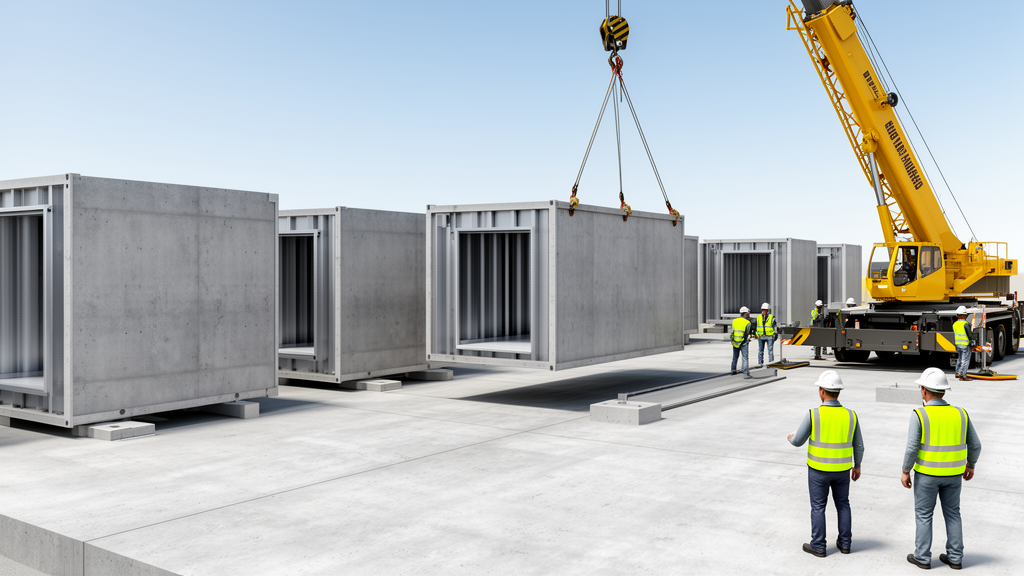
A newly formulated activity-based costing framework bridges the operational divide between legally mandated safety budgets and the rapid, hazard-intensive sequence of modular building installation. While modular construction moves a substantial proportion of structural fabrication into off-site factory environments, on-site installation remains a demanding operational interface where heavy three-dimensional modules must be received, rigged, hoisted, aligned, stabilized, and permanently joined in rapid, repeated cycles. Under statutory frameworks such as Article 72 of the Korean Occupational Safety and Health Act, general contractors must earmark an occupational safety and health management cost ledger to satisfy mandatory expenditure rules, authorized purchase categories, project timeframes, and voucher documentation. However, conventional accounting structures capture these expenditures only as aggregate financial line items or project-level totals, providing no direct mechanism to determine which specific operational hazard consumed a safety resource or which on-site task dictated a budget fluctuation. To resolve this structural limitation, the newly developed framework integrates the legally controlled expenditure ledger with a managerial activity ledger, tracking statutory funds across clearly defined site installation stages without altering established statutory accounting requirements.
During assembly, site crews confront crane and load movement, falling-object risks, temporary instability, tight staging areas, work-at-height challenges, dynamic wind forces, and complex inter-team communication demands during compressed work shifts. Academic investigations and field evaluations consistently indicate that lifting, landing, temporary alignment, and joint connections represent primary drivers of operational risk on modular jobsites. Concurrently, these operational tasks govern the demand for statutory safety provisions, including signaling crews, exclusion-zone physical barriers, structural inspection personnel, wind monitoring apparatus, personal fall protection equipment, and emergency medical readiness. Under conventional lump-sum tracking, a single lifting activity may draw upon multiple statutory expense categories, while shared safety resources like dedicated site supervisors or perimeter sensors support several distinct installation tasks. When contractors evaluate safety expenditures solely through broad statutory classifications, they cannot systematically trace why a particular control was funded, whether safety measures were operational before heavy module lifts commenced, or how schedule delays altered resource consumption.
To establish an empirical and operational foundation, the framework was constructed through a structured synthesis of three statutory and official regulatory documents alongside twenty-seven peer-reviewed investigations across modular safety, construction engineering, work breakdown structures, and cost accounting. Rather than analyzing empirical commercial jobsite expenditure, the evidence base focused on codifying regulatory eligibility constraints, identifiable hazard transitions, resource consumption relationships, organizational responsibility interfaces, and verification closure requirements. Complementary international studies introduced functional prevention and control categories, yet these approaches omitted the strict eligibility criteria governing Korean earmarked accounts. Furthermore, existing activity-based costing implementations in construction had historically targeted manufacturing plant overhead, company-wide quality management, or general contractor home-office health and safety administrative costs allocated down to regional projects. The new framework instead positions the modular installation front itself as the primary cost object, addressing the complete operational window from initial flatbed delivery to permanent connection and crane release.
The resulting architecture is organized around three foundational classifications comprising five sequential work packages, eight statutory resource pools, and fourteen distinct safety activities. Work packages were derived using six objective criteria: an observable start and finish, a unified hazard-control objective, measurable operational workload, an explicit pre-work hold or release point, an organizational responsibility interface, and administrative evidence closure. These boundaries divide installation into arrival and laydown, rigging and pre-lift preparation, lifting and load transfer, landing and temporary stabilization, and permanent connection accompanied by final crane release. Upstream factory fabrication and long-distance transport are excluded, except for physical interface checks required at site delivery. Following statutory eligibility screening, expenditures are grouped into eight distinct resource pools to separate inputs with divergent consumption behaviors: safety-management labor, signaling personnel, temporary safety facilities, personal protective equipment and consumables, worker safety training, monitoring equipment, emergency support services, and specialized technical inspection. Items lacking identifiable operational drivers are segregated into dedicated exception accounts rather than distributed arbitrarily across production teams.
Within the operational activity ledger, fourteen safety activities serve as the core building blocks connecting resource pools to corresponding installation packages. Activities were defined by merging overlapping administrative tasks that share identical hazard decisions or resource dynamics, thereby avoiding duplicate accounting. For example, general risk assessments, daily toolbox meetings, and specialized task briefings were consolidated under a single preparatory activity, while module documentation verification, lifting-point checks, rigging gear inspection, and pre-lift sign-offs were gathered under one comprehensive inspection activity. Guiding, signaling, and radio communication routines were similarly unified, as were emergency medical services, rescue readiness, and occupational health preparedness. Conversely, wind and microclimate weather monitoring was preserved as an independent activity due to its unique event-driven measurement metric, independent lift-hold decision authority, and discrete instrument logging criteria. Every individual activity is permanently assigned an operational driver, an accountable managerial owner who controls the release decision, an explicit operational due point occurring before work begins, and a mandatory evidentiary verification bundle.
The mathematical allocation logic operates through two sequential calculation stages governed by four formal allocation equations that preserve mathematical consistency across all ledgers. In the initial stage, eligible costs from each statutory resource pool are distributed across the fourteen safety activities using non-negative resource-allocation coefficients derived from observed resource-driver quantities. In the second stage, activity-unit rates are established by dividing total activity cost by corresponding activity-driver quantities, which are subsequently allocated to installation work packages based on the specific driver quantities consumed by each package. Because total activity-driver demand equals the sum of driver quantities distributed across all work packages, the aggregate cost assigned across all work packages precisely matches total activity expenditure and original statutory pool appropriations. The framework operates on the strict condition that all costs entering the system have already satisfied upstream legal eligibility criteria. Crucially, the activity ledger functions strictly as an internal management register and traceability tool; it does not replace, alter, or duplicate the statutory accounting register required for legal and regulatory compliance.
Operational governance within the system ties monetary expenditure directly to managerial accountability, execution timing, and physical documentation. The assigned activity owner is defined as the specific organizational party exercising authority over the operational release decision who also bears responsibility for compiling or verifying evidentiary records. This managerial assignment clarifies jobsite governance without altering statutory employer liabilities or contractual legal obligations established under national legislation. Furthermore, activity drivers were selected against four rigorous rules: each driver must exhibit a plausible causal relationship with task workload, remain measurable from standard jobsite documentation, operate monotonically across its operational range, and prevent duplicate counting of identical costs. Continuous lifting tasks utilize monitored crane lift-hours because duration dictates signaling labor, zone exclusion, and observation gear, whereas module counts alone cannot reflect unexpected hoisting delays. Other specialized drivers include delivered module units for landing and closeout tasks, physical connection points for structural bolting or welding, work-at-height hours for fall-arrest gear, and cumulative work shifts for recurring safety briefings.
To illustrate implementation, the researchers documented an operational traceability pathway for an eligible temporary safety barrier erected on site. Following project-level statutory screening, the barrier expenditure voucher is recorded in the statutory ledger, while the operational ledger simultaneously assigns the item to resource pool three for temporary safety facilities and activity five for exclusion-zone establishment and access control. Resource consumption is recorded in equipment quantity-hours, while controlled crane lift-hours serve as the primary operational activity driver. Activity five is consumed jointly by work package two for rigging and work package three for lifting and load transfer. The modular installation contractor serves as the accountable activity owner, with safety barrier verification required prior to commencing crane hoisting. The supporting evidentiary bundle combines the engineering-approved zone perimeter layout, date-stamped photographic installation logs, designated safety observer logs, crane operation logs, and statutory payment vouchers. This unified coding structure provides end-to-end traceability linking legal compliance, causal field demand, assigned work packages, responsible supervisors, inspection deadlines, and final accounting settlements.
Internal mathematical verification was conducted using a normalized reference case wherein synthetic eligible costs were scaled to a dimensionless baseline total of 100.0. This synthetic model incorporated five work packages, five safety briefings, five shifts, twenty delivered modules, twenty crane lifts, twelve lift-hours, twenty work-at-height hours, twenty structural stability inspections, and eighty connection points, utilizing fixed non-uniform synthetic activity rates. The baseline calculation conserved total expenditure perfectly across resource, activity, and work package views, resulting in an exact absolute and relative reconciliation error of 0.0. The second-stage allocation distributed the 100.0 total across work packages, yielding 7.8 for arrival and laydown, 14.0 for rigging, 28.0 for lifting, 26.8 for landing and stabilization, and 23.4 for permanent connection and release. Across four deterministic scenario stress tests that modified module counts, hoisting durations, connection volumes, and shift numbers, calculated cost adjustments propagated exclusively to explicitly linked activities, while costs for unaffected safety activities remained strictly at 0.0, confirming complete calculation selectivity and monotonicity.
While internal verification confirms the mathematical validity, structural conservation, field completeness, and selectivity of the calculation model under controlled baseline assumptions, the researchers emphasized that the framework has not yet been calibrated against empirical field accounting records. The synthetic reference case does not represent an observed industrial expenditure profile, an economic optimum, or a standardized spending recommendation, nor does it demonstrate reduced accident frequencies or lowered administrative overhead. Full external validation will require pairing statutory ledgers and corporate financial vouchers with actual jobsite production metrics, including verified module delivery schedules, crane logs, connection tallies, and labor timesheets across multiple operational projects. Such empirical research will be essential to establish realistic activity rates, evaluate the administrative burden imposed by running parallel managerial ledgers, assess inter-rater reliability among safety auditors, and determine whether granular activity-based tracking measurably improves safety compliance, hazard mitigation, and budget forecasting on complex modular construction sites.
Subject of Research: Activity-based costing framework for occupational safety and health management costs in modular building installation
Article Title: An Activity-Based Costing Framework for Occupational Safety and Health Management Costs in Modular Building Installation
Article References: Lee, J.-H. (2026). An Activity-Based Costing Framework for Occupational Safety and Health Management Costs in Modular Building Installation. Architectural Research, 28(1), Article 31. https://doi.org/10.1007/s44515-026-00034-w
Image Credits: AI Generated
DOI: 10.1007/s44515-026-00034-w
Keywords: modular construction, activity-based costing, occupational safety, construction management, cost allocation, work packages, safety engineering, regulatory compliance, Activity-Based, Costing, Framework, Occupational
News Source: Denise Maddox. (November 9, 2026). Activity Costing Framework Traces Statutory Safety Expenses in Modular Building Assembly. Scienmag.