A research team has demonstrated an efficient manufacturing strategy to fabricate high-performance humidity-responsive soft actuators by combining ultraviolet laser induction with oxygen plasma treatment. Reporting in the Journal of Materials Science, the authors developed the technique to address traditional soft actuator fabrication methods, which frequently require complex and time-consuming processing steps while offering limited design flexibility. The reported actuator design is targeted for potential utility in soft robotics and adaptive systems, where rapid and reliable mechanical movement in response to environmental moisture changes is desired.
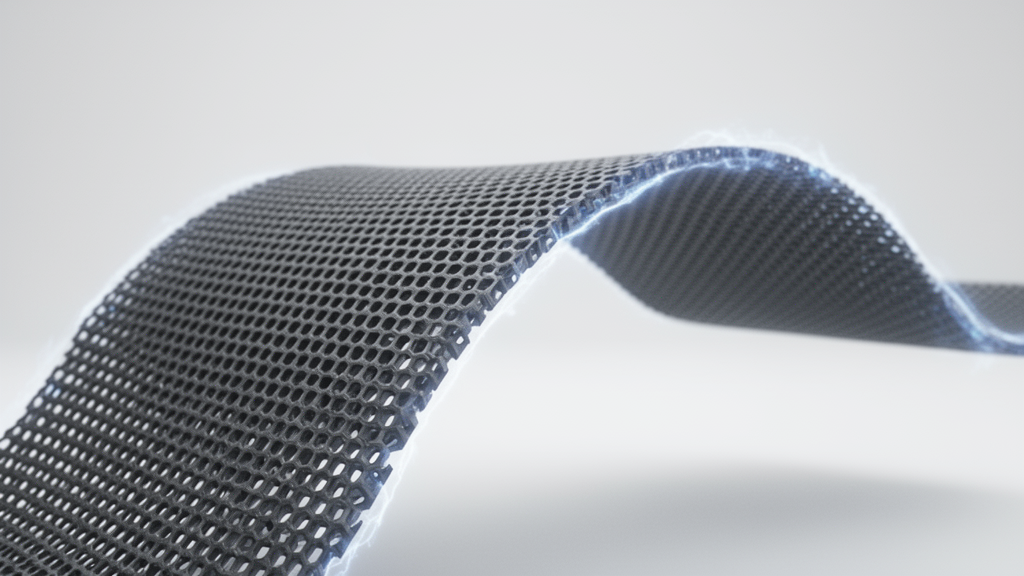
The fabrication workflow begins with a polyimide film upon which a laser-induced graphene layer is directly patterned using an ultraviolet laser. Following this initial patterning step, the carbon surface undergoes oxygen plasma functionalization, which converts the laser-induced graphene into laser-plasma-induced graphene oxide. This conversion establishes a distinct bilayer architecture consisting of a functionalized graphene oxide top layer supported by the underlying polyimide base. By systematically adjusting laser operating parameters alongside oxygen plasma conditions, the investigators established a comprehensive processing-structure-property relationship governing the resulting bilayer composite.
In experimental evaluations, the optimized bilayer actuator demonstrated a rapid, reversible bending actuation response. Upon exposure to an atmosphere of 85 percent relative humidity, the actuator achieved a bending angle change of 70 degrees within 5.5 seconds. The device also exhibited stable performance across cyclic operation, maintaining reproducible deformation over repeated exposure cycles. Furthermore, quantitative characterization revealed a high humidity sensitivity of 0.0075 inverse centimeters per percent relative humidity, confirming that the mechanical curvature of the bilayer responds sensitively to changes in ambient moisture levels.
To elucidate the physical mechanism responsible for this actuation, the researchers carried out multiscale computational simulations integrating molecular dynamics with finite element analysis. Their modeling demonstrated that the adsorption of water molecules into the material leads to an expansion of approximately 60 percent in the interlayer spacing of the laser-plasma-induced graphene oxide. Because this moisture-induced interlayer expansion is confined to the functionalized carbon layer while the polyimide substrate remains structurally stable, it produces a pronounced interfacial strain mismatch across the bilayer junction that translates into macroscopic mechanical bending.
Capitalizing on the intrinsic programmability of the ultraviolet laser patterning technique, the research team demonstrated that actuators can be engineered to exhibit complex deformation modes beyond straightforward bending motions. The authors conclude that integrating laser induction with plasma treatment offers a simple, fast, and flexible manufacturing route for the development of intelligent soft actuators. The study, conducted by Yixiao He, Jincong Chen, Jiayun Pei, Xingjian Hu, Abdulrahman Al-Ahmari, Mohammed Alkahtani, and Haiyan Zhao, establishes a material and computational framework for programmable, moisture-driven soft actuation.
Subject of Research: Humidity-responsive graphene oxide soft actuators
Article Title: Laser-induced and oxygen plasma-treated graphene oxide for high-performance humidity-responsive actuators
Article References: He, Y., Chen, J., Pei, J., Hu, X., Al-Ahmari, A., Alkahtani, M., & Zhao, H. (2026). Laser-induced and oxygen plasma-treated graphene oxide for high-performance humidity-responsive actuators. Journal of Materials Science. https://doi.org/10.1007/s10853-026-14015-w
Image Credits: AI Generated
DOI: 10.1007/s10853-026-14015-w
Keywords: soft actuators, laser-induced graphene, graphene oxide, polyimide, humidity sensitivity, molecular dynamics, finite element analysis, soft robotics, Laser-induced, oxygen, plasma-treated, graphene
News Source: Neil Sanderson. (November 9, 2026). Laser Patterning and Plasma Treatment Yield Responsive Graphene Soft Actuators. Scienmag.