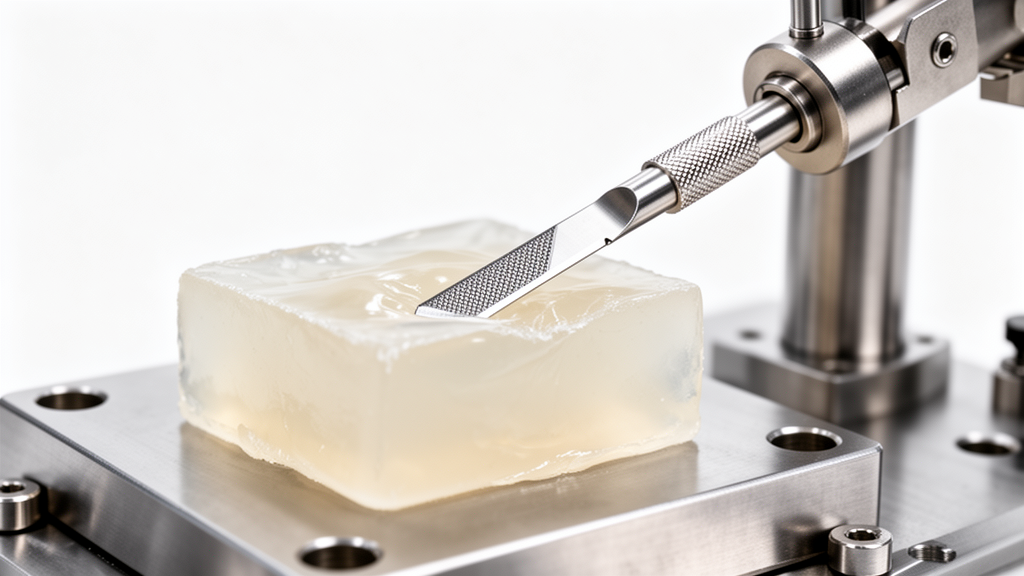
A new surgical instrument designed to reduce the risk of accidental nerve damage during orthopedic procedures demonstrated significantly lower cutting forces compared to conventional scissors in a biomechanical study published in BMC Biomedical Engineering. The device, developed by a team of biomedical engineers and orthopedic surgeons, functions as a modified surgical forceps with a deployable scalpel blade that runs along a groove on the forceps. This design aims to protect surrounding anatomical structures while allowing for fast dissection and cutting of fascial layers, addressing a common source of iatrogenic injuries in surgeries such as carpal tunnel and ulnar nerve decompression.
The study, led by Zach Spears and colleagues, sought to address the persistent issue of iatrogenic nerve injuries, which are caused by medical intervention and can lead to significant physical and mental consequences for patients, including sensory loss, paralysis, and pain. These injuries often result from direct damage to surrounding tissues by surgical instruments whose designs have remained largely unchanged for decades. The research team introduced the novel device as a potential solution, combining the utility of scissors for blunt dissection with the sharpness of a scalpel for precise cutting, while incorporating safety features to limit inadvertent damage.
The development process for the novel instrument involved computer-aided design modeling, 3D printing for prototyping, and the fabrication of an aluminum prototype. The team used SolidWorks software to create a 3D model of the device, which was then converted for manufacturing. The final prototype consisted of a right and left tine, a scalpel handle, and a scalpel housing, with the tines united by a stainless-steel shoulder screw. This collaborative approach between engineering and surgical departments highlighted the potential for innovation in medical technology through interdisciplinary cooperation.
To evaluate the performance of the new device, the researchers conducted biomechanical testing using an MTS Static Materials Test System. Four instruments were compared: the novel instrument, a #10 scalpel, bandage scissors, and iris scissors. The testing materials included Ace™ bandage, stockinette, and gauze, chosen for their varying elasticity and strength to simulate different tissue properties. Each material was affixed to a uniaxial testing machine and preloaded to a specific tension before trials began. This setup allowed for the measurement of peak force, number of cut attempts, and percentage cut on the first attempt.
The results indicated that the novel surgical instrument required significantly less force to cut through the Ace™ bandage, stockinette, and gauze compared to both bandage and iris scissors, with p-values less than 0.01 for each combination. When compared to the scalpel, the novel device required significantly less force for cutting stockinette, though no significant difference was observed for gauze and the Ace™ bandage. The scalpel itself required significantly less force than the scissors for all three materials, underscoring the efficiency of a sharp blade in reducing the physical effort needed for transection.
In terms of cutting efficiency, the #10 scalpel blade consistently transected each material with a single stroke, requiring the fewest cuts. The bandage scissors averaged 1.0 cut for the stockinette and Ace™ bandage, and 1.2 cuts for the gauze. The novel instrument averaged 1.0 cut for the stockinette, 1.4 for the Ace™ bandage, and 1.6 for the gauze. The iris scissors required the most attempts, particularly for gauze, where 3.6 attempts were needed on average, a figure significantly greater than the cuts required by the other instruments.
The percentage of material cut in a single pass was also analyzed to reflect the working length and effectiveness of each instrument. The scalpel, bandage scissors, and iris scissors cut through the Ace™ bandage in one pass for every trial, while the novel device achieved this in most cases, with two instances where it cut 75–99% of the bandage. For the stockinette, the scalpel, bandage scissors, and novel device cut through in one pass for every trial. The iris scissors showed lower performance, with two instances where the first pass cut less than 100% of the stockinette. For gauze, the novel device cut through completely in two instances, 75–99% in two others, and 50–75% in one instance, whereas the iris scissors only cut 25–50% in all trials.
The discussion highlighted that the novel device’s design ensures that only the area of interest is cut in a controlled manner, as the blade follows a groove on the tine. This feature prevents the blade from dulling and allows for a consistently sharp cut at a fixed and protected depth. The researchers noted that while the scalpel is effective, its use adjacent to vital structures can be dangerous due to the risk of plunges and slips, particularly in less experienced hands. The novel instrument mitigates this risk by providing a guided cutting mechanism that limits the depth and direction of the cut.
The novel device is larger than a free scalpel, which may decrease maneuverability and flexibility during surgery. The scalpel is constrained by a slider holder, limiting its orientation to cut only along the modified right tine, which means it cannot be maneuvered as freely as a traditional scalpel. Consequently, the device is limited to open surgeries and would not be useful for minimally invasive procedures. The study also noted that the increased height of the device would not impact the spreading-related motion, which is a key function of the forceps component.
The statistical analysis employed Welch’s t-tests for the force and number of cuts data, and Fisher’s exact tests for the categorical percentage cut data. The small sample sizes, with five trials for each device and material combination, were considered in the selection of these statistical methods. The use of disposable instruments for the testing ensured a new and consistent manufactured edge for each variable, allowing for reproducibility. However, the researchers acknowledged that the forces observed in the bandage and iris scissors might be spuriously elevated due to the quality of the disposable instruments compared to surgical-grade tools.
This proof-of-concept biomechanical study demonstrates that the novel surgical instrument can match the cutting ability of a scalpel blade while offering a design that limits iatrogenic injury. The team’s work underscores the value of collaboration between biomedical engineering and orthopedic surgery in developing new technologies with improved design and functionality. By providing a safer alternative to traditional instruments, the novel device has the potential to reduce the incidence of nerve injuries during procedures that require layer-by-layer dissection, ultimately improving patient outcomes and reducing the costs associated with medical liability proceedings.
Carpal tunnel syndrome, the most common peripheral nerve injury, affects approximately 3% of all adults in the United States and is characterized by numbness or tingness in the wrist due to compression of the median nerve. While nonsurgical treatments such as physical therapy and corticosteroid injections are often the first line of defense, about 20% of patients do not respond to these methods and require surgical intervention. In these cases, an orthopedic surgeon decompresses the median nerve by cutting the fascia constricting it. This procedure has an annual incidence of 400,000 to 600,000 in the United States alone, yet it carries a 0.49% incidence of iatrogenic nerve injury. Similar risks exist for ulnar nerve decompression, which involves comparable surgical steps and risk factors.
The financial and personal costs of these injuries are substantial. Iatrogenic nerve injuries can lead to permanent deficits that encompass functional, psychological, and socioeconomic ramifications for patients. Hospitals and surgeons also face significant costs, as these injuries account for approximately 3.3% of medical liability proceedings. The study notes that conventional surgical instruments, such as scalpels and scissors, have remained largely unchanged in design over the past few decades. While effective, these tools present specific drawbacks; for instance, the cutting edge of surgical scissors gradually dulls with each use, increasing the chance of inadvertent damage to surrounding tissue. It is estimated that surgical scissors can be used in up to 40 procedures before needing repair and can be repaired up to 9 times before disposal, with an estimated cost of $1.80 per use.
Scalpels offer a reliably sharp edge as single-use instruments, but their use adjacent to vital structures can be dangerous. Plunges and slips can occur, resulting in damage to surrounding tissue, particularly in less experienced hands such as those in academic settings. The novel device described in this study was designed to capture the utility of scissors for blunt dissection and the sharpness of a scalpel while improving safety. The device resembles forceps, allowing tissue planes to be spread and separated so tissue can be easily cut under tension. A channel and central groove along one arm house a modified scalpel handle and blade, ensuring that only the area of interest is cut in a controlled manner. This design aims to provide a fixed and controlled cut superficial to the tine, making the slide cut an ideal application for the device.
Subject of Research: Comparing scissors and scalpels to a novel surgical instrument: a biomechanical sectioning study
Article Title: Comparing scissors and scalpels to a novel surgical instrument: a biomechanical sectioning study
Article References: Spears, Z., Paras, M., Fitzsimmons, L., De Lacy, L., Wawrzyn, P., Conway, S., Gopalan, S., Muckenhirn, K., & Puccinelli, J. (2024). Comparing scissors and scalpels to a novel surgical instrument: a biomechanical sectioning study. BMC Biomedical Engineering, 6(1), Article 10. https://doi.org/10.1186/s42490-024-00085-x
Image Credits: AI Generated
DOI: 10.1186/s42490-024-00085-x
Keywords: Comparing, scissors, scalpels, novel, surgical, instrument, biomechanical, sectioning, scientific research
News Source: Denise Maddox. (November 9, 2026). Novel Surgical Instrument Reduces Cutting Force in Biomechanical Study. Scienmag.