A rigorous four-round Delphi consensus study investigating endovascular treatment strategies for peripheral artery disease has demonstrated that expert clinical opinion diverges most sharply regarding atherectomy device selection and the procedural necessity of embolic filter wires. Conducted by an international team of interventional radiologists, the investigation utilized the structured Delphi methodology to evaluate where clinical alignment currently exists and where persistent disagreement highlights vital gaps in the contemporary scientific literature. Rather than achieving seamless harmony across every clinical scenario, the iterative consultative process revealed that experienced practitioners remain divided on fundamental procedural choices concerning arterial vessel preparation. The authors observed that while traditional Delphi studies seek consensus convergence, observing a marked reduction in agreement across sequential rounds serves as a powerful and direct indicator of areas requiring urgent prospective research. By highlighting topics where consensus actively fractured, the project established clear priorities for future investigative trials in lower extremity revascularization.
The clinical imperative for identifying targeted research priorities is underscored by the immense and expanding global footprint of peripheral artery disease, which currently afflicts an estimated 130 million individuals worldwide. Epidemiological forecasts project that this patient population will triple over the coming twenty-five years, placing an escalating operational and financial burden on national healthcare infrastructures charged with preventing chronic limb-threatening ischaemia and lower extremity amputations. Endovascular specialists, collaborating closely with colleagues across vascular surgery and angiology, are required to master an extensive and technically demanding spectrum of catheter-based interventions to manage diverse arterial pathologies. Although cutting-edge research remains essential for refining therapeutic modalities and optimizing clinical outcomes, the rapid proliferation of newly marketed endovascular devices alongside traditional techniques creates substantial challenges in determining which clinical questions most urgently warrant controlled scientific evaluation. The Delphi methodology provided an established, systematic framework to distill expert perspectives into defined investigative directives.
To initiate the multi-round consultative evaluation, an expert group comprising senior interventional radiologists formulated seventeen baseline statements designed to capture areas of active clinical controversy across peripheral arterial disease management. Candidate topics were derived through two structured brainstorming rounds without relying on predefined or formalized selection criteria, and the final statement slate was formally approved by unanimous consensus within the steering panel. The resulting statements spanned five distinct clinical categories: atherectomy and lesion preparation, atherectomy techniques and devices, specific arterial segments and treatments, general peripheral artery disease management, and clinical practice operations.
To assemble a highly qualified panel of evaluators, invitations were distributed to all specialists holding the European Board of Interventional Radiology Endovascular Specialist qualification, alongside active members of the Cardiovascular and Interventional Radiological Society of Europe Endovascular Subcommittee. Fifty-two of the seventy-one invited physicians accepted the invitation, establishing a multidisciplinary panel of interventional radiologists representing nineteen countries, including four non-European nations. In the opening round, conducted via the online survey platform Alchemer, panel members evaluated all seventeen candidate statements using a standard five-point Likert scale ranging from strongly disagree to strongly agree. Consensus was mathematically quantified using two distinct criteria: certainty, defined as the proportion of responses that were not neutral, and concordance, defined as the proportion of non-neutral answers converging toward a unified outcome of collective agreement or collective disagreement. Statements failing to achieve concordance exceeding 75 percent or certainty exceeding 60 percent were earmarked for subsequent deliberative rounds.
The initial round of scoring revealed immediate and overwhelming alignment on several foundational clinical practices, with five of the seventeen statements attaining concordance scores above 95 percent, including three statements that secured 100 percent agreement among the fifty-two panellists. However, to fulfill the primary study objective of uncovering evidence gaps, researchers isolated six statements exhibiting consensus scores at or below the predefined thresholds. Two statements that met inclusion criteria were purposefully excluded from further evaluation: statement thirteen, addressing management strategies for desert foot, was removed due to excessive topic complexity, while statement eight, evaluating filter wire usage during common femoral artery atherectomy, was eliminated to prevent redundancy with statement four. Four remaining statements addressing atherectomy patient selection, filter wire utilization, device outcome impacts, and intravascular lithotripsy comparability, alongside two statements concerning occluded stent interventions and below-the-knee vessel revascularization targets, advanced directly into detailed qualitative review.
In round two of the process, forty-five panellists submitted detailed written rationales explaining the specific clinical reasoning supporting their individual Likert ratings, representing an 86 percent response rate, while non-responding physicians were disqualified from further participation. Qualitative analysis revealed that panellists who selected disagree, strongly disagree, or neutral for four contentious statements consistently cited an acute absence of high-quality comparative trials and formal clinical practice guidelines. Round three convened thirteen panel members in an online discussion format where aggregated ratings and anonymized argument summaries were presented under balanced moderation without conducting formal pre-meeting literature reviews. During this deliberative session, participants highlighted interpretive ambiguities surrounding statements three and twelve; although consensus interpretations were clarified during open discussion, the authors maintained original statement phrasing completely unaltered across all rounds to safeguard longitudinal methodological consistency and ensure strict statistical comparability in subsequent quantitative evaluations.
The final Delphi round invited panellists to reassess their positions using individualized forms displaying their baseline round-one ratings, yielding thirty-six completed reassessments and an 80 percent response rate among qualified participants. Quantitative analysis revealed that certainty scores remained remarkably stable across all four rounds, exhibiting minimal overall fluctuation; the largest documented shifts were a 9 percent increase for statement seven and a 9 percent decrease for statement eleven. Certainty increased marginally for four statements and decreased for two, indicating that while expert conviction regarding evidentiary insufficiency remained steady, opinions regarding procedural mandates continued to evolve.
In contrast to the stability observed in certainty metrics, concordance exhibited substantial movement between the first and fourth rounds, ranging from a modest 4 percent shift for statement seven to a 26 percent surge for statement twelve. Concordance increased across four evaluated statements, driven primarily by interpretive alignment; for statement twelve, nine of ten panellists who adjusted their scores shifted toward disagree after adopting a literal interpretation regarding specific vessel counts in below-the-knee revascularization. Similarly, for statement three, panellists shifted toward disagree after concluding that the term clearly defined was overly rigid, despite recognizing calcification as an atherectomy indication. Conversely, concordance declined notably for statements four and six, where 36 percent and 30.6 percent of participants changed their ratings, respectively. Negative shifts predominated for both statements, with twelve of thirteen panellists moving toward disagree regarding mandatory filter wires, and nine of eleven shifting toward disagree regarding device outcome impacts.
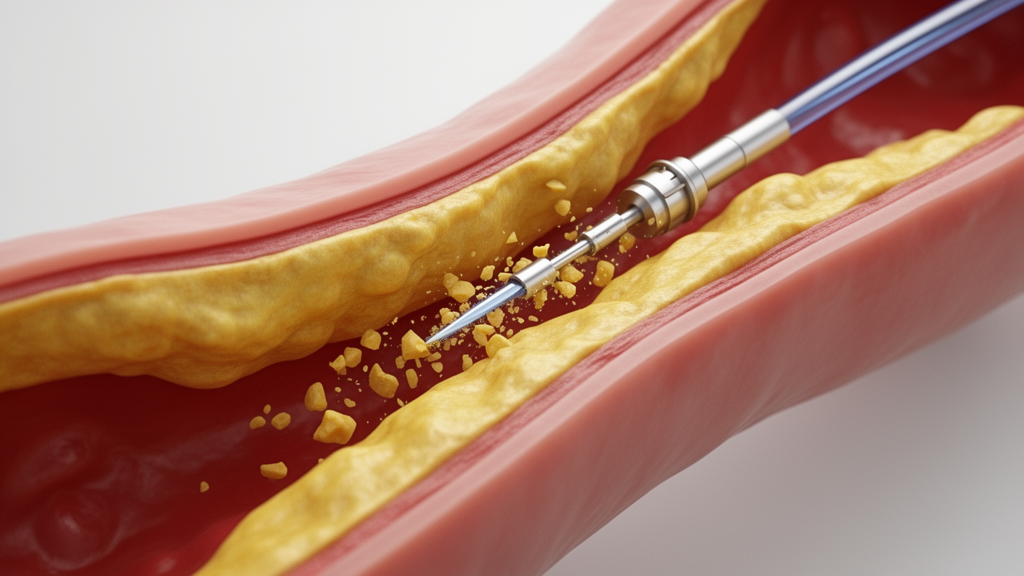
The deliberative discussions surrounding atherectomy devices and filter wires exposed deep technical complexities rooted in substantial device heterogeneity across orbital, rotational, directional, and laser systems. Panellists emphasized that these diverse technologies operate through fundamentally distinct mechanical actions, and several commercially available devices cannot physically accommodate embolic protection wires, rendering sweeping clinical recommendations impractical. These clinical uncertainties mirror severe deficits in the published medical literature. A cited Cochrane systematic review identified only seven studies comprising 527 participants comparing atherectomy against balloon angioplasty with or without primary stenting, rating the certainty of evidence as very low, while only a single prospective clinical trial comparing different atherectomy technologies has been published to date.
Beyond revealing pronounced divisions over atherectomy techniques, the Delphi process documented strong panel consensus regarding clinical practice operations, demonstrating widespread agreement that comprehensive peripheral artery disease management extends well beyond the procedural catheterization laboratory to include organized outpatient clinics, structured ward rounds, and dedicated follow-up pathways. Acknowledging study limitations, the authors highlighted potential selection bias arising from an expert steering committee rather than a formal literature review defining baseline statements, alongside panel attrition across successive rounds and semantic ambiguities in initial statement phrasing. Contemporary guidance, including the 2019 Global Vascular Guidelines on chronic limb-threatening ischaemia, continues to emphasize individualized decision-making in the absence of high-level comparative data for atherectomy. The investigators concluded that prospective randomized trials and rigorous observational studies evaluating diverse clinical presentations are urgently required to resolve persistent controversies, support standardized multidisciplinary clinical guidelines, and ultimately improve outcomes for patients suffering from peripheral artery disease.
Subject of Research: Delphi consensus on research priorities and evidence gaps in peripheral artery disease treatment
Article Title: Identifying research areas in peripheral artery disease treatment—a Delphi consensus approach
Article References: Müller-Hülsbeck, S., Reiter, F., Mahnken, A. H., Kaufmann, N., & Morgan, R. A. (2026). Identifying research areas in peripheral artery disease treatment—a Delphi consensus approach. CVIR Endovascular, 9(1), Article 109. https://doi.org/10.1186/s42155-026-00762-z
Image Credits: AI Generated
DOI: 10.1186/s42155-026-00762-z
Keywords: peripheral artery disease, atherectomy, Delphi consensus, interventional radiology, filter wires, endovascular therapy, chronic limb-threatening ischaemia, vascular guidelines, Identifying, research, areas, peripheral
News Source: Ophelia Keating. (November 9, 2026). Delphi Expert Panel Highlights Evidence Gaps in Peripheral Artery Disease Atherectomy. Scienmag.