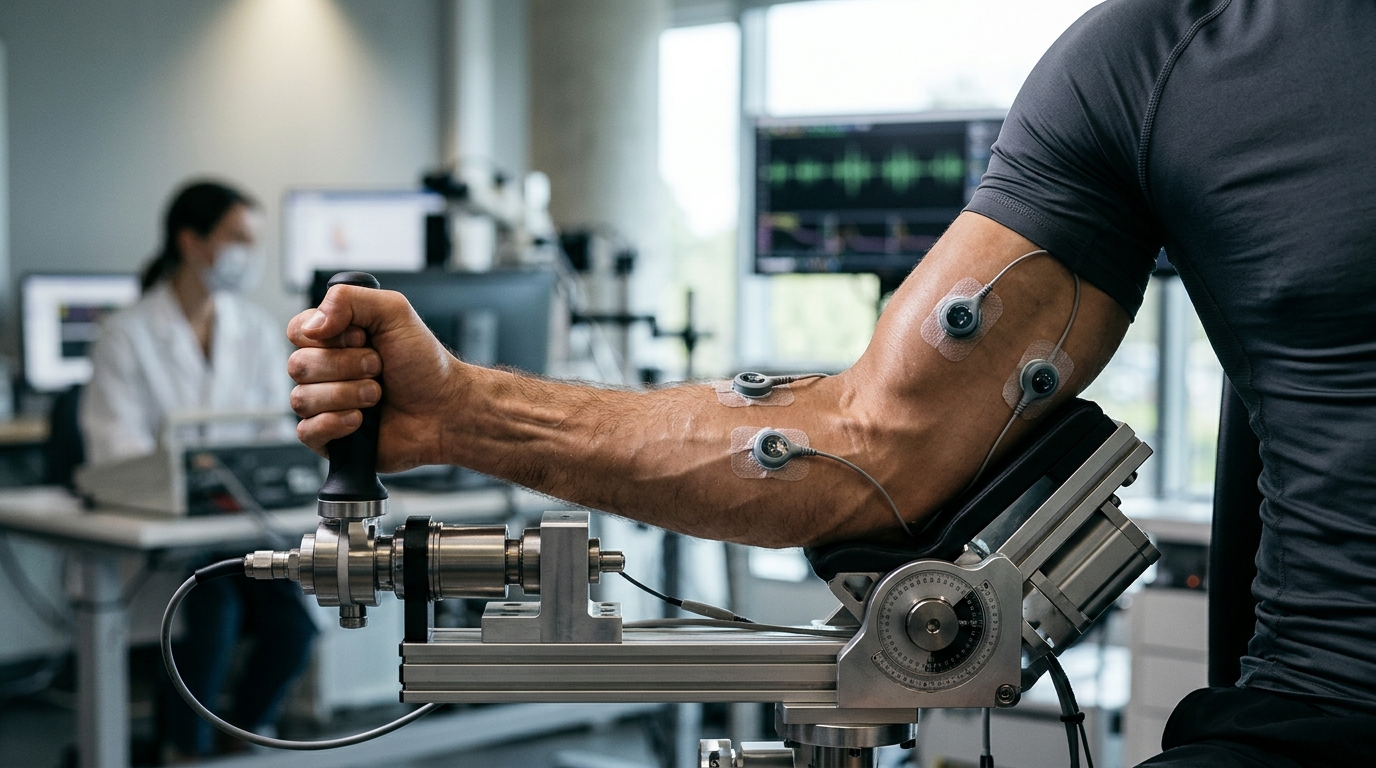
Maximal voluntary isometric elbow-flexion torque is governed by both elbow angle and forearm rotation, exhibiting notable interaction effects alongside distinct muscle-specific and posture-dependent electrical activation responses in the primary flexor muscles. In a physiological study investigating the biomechanics of upper-limb force generation, researchers evaluated how joint configuration influences mechanical torque and surface electromyography root mean square amplitudes recorded from the biceps brachii and brachioradialis.
To examine these relationships, the researchers tested forty healthy young adults who completed maximal voluntary isometric elbow flexions across twelve distinct posture combinations. The testing protocol evaluated four elbow flexion angles of 60°, 75°, 90°, and 105° paired with three forearm positions comprising pronation, neutral, and supination. During these maximal contractions, investigators recorded peak torque, average torque, and surface electromyographic root mean square amplitudes from the biceps brachii and brachioradialis muscles.
Data were evaluated using heteroscedastic linear mixed-effects models that treated each participant as a random effect. Model evaluations included marginal F tests followed by model-based two-sided t tests of estimated marginal means. Statistical reporting incorporated Holm-adjusted p values, Bonferroni simultaneous 95% confidence intervals for pairwise contrast estimates, and approximate partial eta squared effect sizes with corresponding 95% confidence intervals. The statistical analyses demonstrated significant main and interaction effects across both measured mechanical torque parameters, with peak torque and average torque displaying closely aligned patterns of variation.
Elbow angle exerted a significant effect on peak torque, yielding a partial eta squared of 0.143 with a 95% confidence interval of 0.067 to 0.224, and on average torque, with a partial eta squared of 0.141 and a 95% confidence interval of 0.065 to 0.221. Forearm rotation also exerted a significant effect on peak torque, producing a partial eta squared of 0.148 with a 95% confidence interval of 0.073 to 0.231, and on average torque, yielding a partial eta squared of 0.146 and a 95% confidence interval of 0.071 to 0.229. Furthermore, the models identified a significant angle-by-rotation interaction for peak torque, with a partial eta squared of 0.055 and a 95% confidence interval of 0.005 to 0.110, and for average torque, with a partial eta squared of 0.059 and a 95% confidence interval of 0.006 to 0.115, with all adjusted p values falling below 0.001.
Pairwise evaluations showed that torque recorded at 60° of elbow flexion was generally lower than torque measured across 75° to 105°. In addition, at each tested elbow angle, peak torque and average torque demonstrated an identical hierarchy across forearm orientations: torque values were consistently highest in the neutral forearm position, intermediate in supination, and lowest in pronation. In contrast to this uniform mechanical hierarchy, surface electromyography root mean square amplitudes demonstrated divergent responses between the two monitored flexor muscles.
Forearm rotation significantly affected root mean square amplitudes for both muscles, yielding a partial eta squared of 0.324 with a 95% confidence interval of 0.226 to 0.414 for the biceps brachii, and a partial eta squared of 0.236 with a 95% confidence interval of 0.143 to 0.327 for the brachioradialis. For the biceps brachii, root mean square amplitude in pronation was lower than in neutral and supination, and biceps brachii amplitude showed no detectable angle effect. Conversely, the brachioradialis exhibited a significant main effect of elbow angle, with a partial eta squared of 0.036 and a 95% confidence interval of 0.001 to 0.093, as well as a significant angle-by-rotation interaction, with a partial eta squared of 0.093 and a 95% confidence interval of 0.024 to 0.164.
Analysis of the brachioradialis-to-biceps brachii root mean square ratio revealed a significant effect of forearm rotation, producing a partial eta squared of 0.070 with a 95% confidence interval of 0.017 to 0.143, alongside a significant angle-by-rotation interaction, yielding a partial eta squared of 0.045 with a 95% confidence interval of 0.000 to 0.099. Contrast tests revealed that this ratio was significantly higher in pronation at 60° and 75°, as well as at 90° relative to the neutral forearm position, whereas no rotation differences were detected at 105° of flexion.
Subject of Research: Postural effects on elbow flexion torque and electromyographic activity
Article Title: Effects of elbow angle and forearm rotation on elbow flexion torque and elbow-flexor surface electromyographic amplitudes
Article References: Chen, Y., Shen, P., Dong, G., Zou, M., Huang, S., Zhang, Z., Liu, C., & Shi, Z. (2026). Effects of elbow angle and forearm rotation on elbow flexion torque and elbow-flexor surface electromyographic amplitudes. Frontiers in Physiology, 17, Article 1741384. https://doi.org/10.3389/fphys.2026.1741384
Image Credits: AI Generated
DOI: 10.3389/fphys.2026.1741384
Keywords: elbow flexion, isometric torque, biceps brachii, brachioradialis, surface electromyography, forearm rotation, joint angle, biomechanics, Effects, elbow, angle, forearm
News Source: Drew Townsend. (November 9, 2026). Elbow Angle and Forearm Posture Shape Flexion Torque and Muscle Activation. Scienmag.