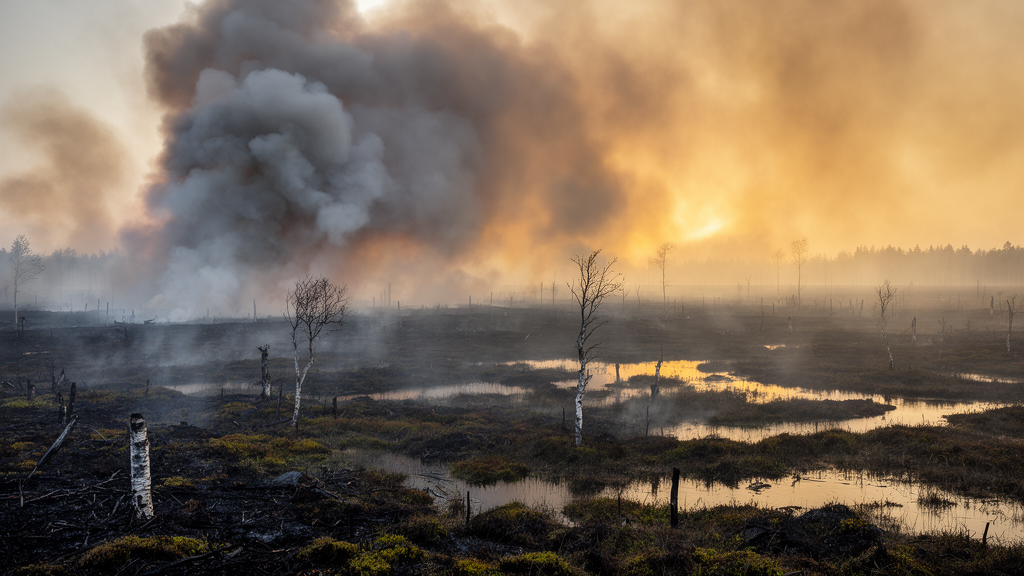
An anomaly-aware deep learning framework has demonstrated superior accuracy in short-term fine particulate matter (PM2.5) forecasting during catastrophic wildfire and peatland smoke events in West Kalimantan, Indonesia. By coupling ground-based multi-pollutant chemical signatures with deep recurrent sequence learning, the investigation establishes a highly reliable and computationally efficient decision support system designed to provide real-time hazard warnings and strengthen regional public health protection.
Wildfire-induced biomass burning and smoldering tropical peatland smoke represent catastrophic public health hazards that produce acute respiratory and cardiovascular morbidity among exposed populations. However, standard machine learning frameworks frequently suffer from severe under-prediction plateaus when confronted with extreme PM2.5 episodes.
To establish a more robust atmospheric forecasting architecture, the investigators focused their study on West Kalimantan, Indonesia, recognized as a critical global epicenter for smoldering tropical peat combustion. The research team compiled and evaluated an extensive multi-year atmospheric telemetry dataset consisting of 80,400 hourly observations gathered between January 2021 and August 2025.
The research team implemented an Isolation Forest preprocessing pipeline to systematically filter structural sensor noise across the multi-station monitoring network.
A critical phase of the investigation centered on multi-pollutant feature assessment to determine the primary chemical drivers of smoldering peatland haze. Utilizing tree-based ensemble methods, the researchers assessed the relative predictive importance of co-occurring air pollutants tracked across the eight ground monitoring stations. This empirical feature assessment established Carbon Monoxide (CO) as the primary chemical tracer for smoldering tropical peat smoke, exhibiting an approximate 69 percent predictive contribution to the model.
In comparative performance benchmarking, the proposed Deep Long Short-Term Memory (LSTM) architecture demonstrated substantial advantages over conventional predictive methods. Standard statistical approaches, specifically Linear Regression and Random Forest models, failed to track elevated smoke accumulations due to rigid prediction plateaus that capped estimated particulate concentrations during intense haze events. In contrast, the deep recurrent LSTM network effectively captured non-linear accumulation dynamics across severe haze levels where PM2.5 concentrations exceeded an ISPU index value of 150, achieving superior overall accuracy with an R-squared of 0.89, a mean absolute error (MAE) of 8.12, and a root mean square error (RMSE) of 11.93.
By accurately predicting extreme PM2.5 spikes without suffering from the under-prediction plateaus typical of linear and ensemble baselines, the anomaly-aware deep learning framework delivers a dependable decision support tool for regional authorities.
Subject of Research: Deep learning forecasting of wildfire-induced PM2.5 air pollution during extreme peatland smoke episodes
Article Title: Wildfire-Induced air pollution forecasting: Multi-Pollutant feature assessment and deep recurrent sequence learning for extreme smoke episodes
Article References: Pratama, A., Primanda, D., Prayitno, W., & Gudiato, C. (2026). Wildfire-Induced air pollution forecasting: Multi-Pollutant feature assessment and deep recurrent sequence learning for extreme smoke episodes. Air Quality, Atmosphere & Health, 19(11), Article 264. https://doi.org/10.1007/s11869-026-02155-6
Image Credits: AI Generated
DOI: 10.1007/s11869-026-02155-6
Keywords: Air Quality, PM2.5, Wildfire Smoke, Deep Learning, LSTM, Peatland Combustion, Indonesia, Atmospheric Forecasting, Wildfire-Induced, pollution, forecasting, Multi-Pollutant
News Source: Russell Cooper. (November 9, 2026). Deep Recurrent Sequence Learning Forecasts Extreme Peatland Wildfire Smoke Episodes. Scienmag.