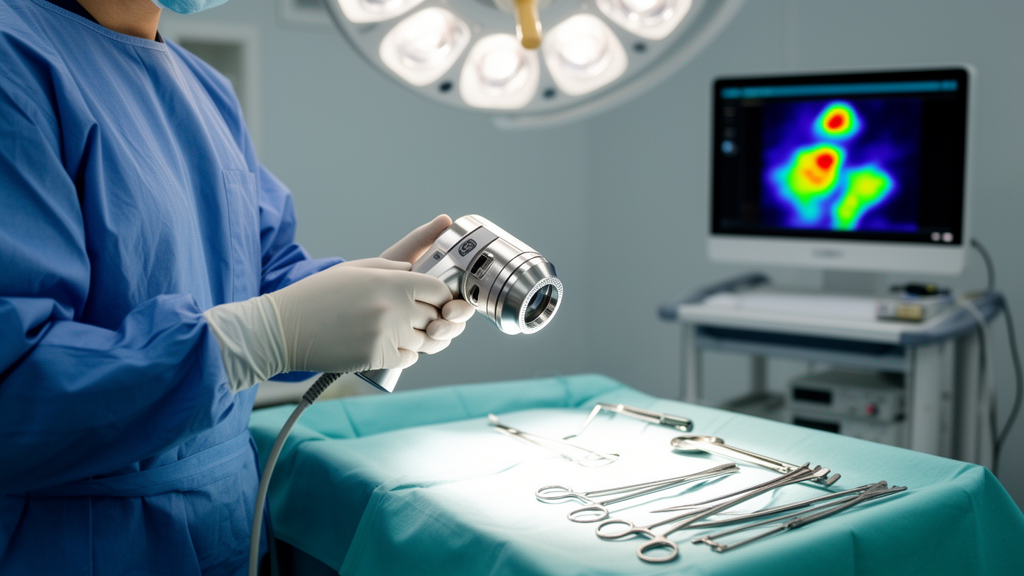
A newly developed position-sensitive silicon photomultiplier-based gamma camera has demonstrated millimeter-scale spatial resolution and dependable sensitivity during rigorous performance evaluations for intraoperative radio-guided surgery. Researchers evaluated the detector across distinct hardware configurations to characterize its core physical parameters and establish its operational readiness for clinical environments.
The development of the POSiCS system focuses on enhancing surgical precision during radio-guided operative interventions, with sentinel lymph node biopsy serving as the primary benchmark application. Constructed to function as a highly maneuverable tool, the entire detector weighs approximately 350 grams, enabling straightforward manipulation in close contact with patient tissue. By facilitating intraoperative visualization immediately adjacent to the operative field, the instrument is intended to improve lesion localization accuracy while simultaneously decreasing operative times. Furthermore, the ability to clearly visualize labeled lymph nodes and target tissues during surgery aims to reduce overall surgical invasiveness and help minimize post-operative complications for individuals undergoing radio-guided procedures.
To satisfy varying clinical requirements encountered during surgery, the investigators designed and tested two distinct hardware configurations: a high-sensitivity mode and a high-resolution mode. The comprehensive laboratory evaluation rigorously examined the primary operational metrics across both configurations, including extrinsic spatial resolution, energy resolution, overall system sensitivity, collimator shielding effectiveness, and detector response across diverse gamma-ray emission energies.
The experimental protocols incorporated dedicated radioisotope sources to systematically characterize the physical behavior of the camera under standardized laboratory conditions. In complementary trials, the researchers determined the detector’s extrinsic spatial resolution and evaluated lateral collimator penetration using a cobalt-57 point source.
The quantitative spatial resolution measurements confirmed that the POSiCS camera achieves precise millimeter-scale localization when operating in direct contact with radioactive sources. Under direct contact conditions, the detector exhibited an extrinsic spatial resolution of 1.9 ± 0.1 millimeters when equipped with the high-sensitivity collimation configuration. When switched to the high-resolution hardware setup, the system achieved a finer extrinsic spatial resolution of 1.4 ± 0.1 millimeters.
System sensitivity evaluations demonstrated the distinct performance characteristics and trade-offs inherent in the two interchangeable hardware arrangements. When positioned at a standardized source-to-detector distance of 2 centimeters, the camera recorded an extrinsic sensitivity of 481 ± 14 counts per second per megabecquerel in its high-sensitivity operational mode. Conversely, when configured for high-resolution operation at the identical 2-centimeter distance, the measured system sensitivity was 134 ± 8 counts per second per megabecquerel.
Spectral characterization demonstrated consistent energy measurement capabilities across both tested hardware configurations. Despite achieving comparable spectral resolution values, the two setups exhibited notable differences regarding radiation scatter. The high-resolution collimator displayed an elevated amount of scattered radiation during testing, an effect directly attributed to the larger quantity of tungsten incorporated into its collimator structure.
In addition to standard evaluations using technetium-99m, the study explored the camera’s imaging capabilities with lutetium-177, a radionuclide seeing expanding clinical use within theranostics. The authors evaluated the reconstruction performance of POSiCS across different gamma-ray emissions by imaging an experimental cavity loaded with the radionuclide. The tests demonstrated that intraoperative imaging of lutetium-177 is achievable with the system, though successful image reconstruction was constrained specifically to photon interactions occurring at the 55 kiloelectronvolt and 113 kiloelectronvolt photopeaks rather than across its entire emission spectrum.
The study authors concluded that the POSiCS camera successfully integrates lightweight compactness, user-friendly wireless operation, and dependable measurement performance, rendering it highly suitable for radio-guided surgical interventions. The availability of interchangeable hardware setups offers practical flexibility, enabling clinicians to balance detection sensitivity against spatial resolution according to specific surgical needs. With millimeter-scale spatial resolution and adequate sensitivity validated for technetium-99m, alongside confirmed feasibility for defined lutetium-177 photopeaks, the results support the device’s potential for wider clinical translation and future advances in intraoperative nuclear medicine instrumentation.
Subject of Research: Performance evaluation of a handheld position-sensitive gamma camera for radio-guided surgery
Article Title: Performance evaluation of a position-sensitive SiPM-based gamma camera for intraoperative imaging
Article References: Raiola, A., Acerbi, F., Alispach, C., della Volpe, D., Arabi, H., Gola, A., & Zaidi, H. (2026). Performance evaluation of a position-sensitive SiPM-based gamma camera for intraoperative imaging. EJNMMI Physics. https://doi.org/10.1186/s40658-026-00931-y
Image Credits: AI Generated
DOI: 10.1186/s40658-026-00931-y
Keywords: gamma camera, radio-guided surgery, silicon photomultipliers, sentinel lymph node biopsy, intraoperative imaging, technetium-99m, lutetium-177, medical physics, Performance, evaluation, position-sensitive, SiPM-based
News Source: Ophelia Keating. (November 9, 2026). Compact SiPM Gamma Camera Evaluated for Intraoperative Surgical Guidance. Scienmag.