Researchers have developed a real-time electrical resistivity-based framework to quantify the effectiveness of concrete curing, addressing a critical gap in current industry practices. Published in the journal Discover Concrete and Cement, the study demonstrates that continuous monitoring of electrical resistivity can determine whether curing delays cause permanent microstructural damage. The work was conducted by a team including Lichun Chen, Mohammad J. Uddin, Niloofar Parastegari, Marllon Cook, and M. Tyler Ley. The study aims to provide quantitative tools for assessing curing effectiveness, as current concrete specifications often provide only qualitative guidance on when to begin curing.
Curing is crucial for maintaining moisture and temperature after pouring to promote hydration. Failure to cure promptly affects the hardening and durability of concrete. The primary role of curing is to maintain moisture and temperature to facilitate continued hydration, which reduces porosity and permeability while improving both strength and durability. Insufficient curing speeds up surface drying, hinders hydration, and leads to cracking, thereby compromising mechanical properties and long-term durability. Exposed concrete elements such as floor slabs and bridge decks are particularly vulnerable due to their high surface-area-to-volume ratios, which increase the risk of rapid moisture loss.
Wet curing is widely adopted as an external curing method for exposed structures, involving keeping the concrete surface moist by providing a continuous water supply or covering it with wet burlap. The efficacy of wet curing relies on the timing of application based on the evaporation rate at the concrete surface. Current industry standards, such as ACI 305R-20 and ACI 308R, require curing to begin immediately upon concrete placement if the evaporation rate exceeds the bleeding rate of the concrete. However, these standards do not quantify the impact of curing delays on microstructural and transport properties, and traditional assessment methods like compressive strength tests are typically performed at later ages, providing no real-time feedback.
The study used three environmental exposure levels with evaporation rates of 0.15, 0.55, and 0.85 kg/m²/h. Concrete and mortar samples were tested for electrical resistivity, internal temperature, and porosity. The experiments compared continuous wet curing, wet curing with delays of 2 to 10 hours after placement, and air curing. The concrete mixtures were prepared with a constant water-to-cement ratio of 0.45 using ASTM C150 Type I Portland cement. No chemical admixtures were used to avoid unintended influences on evaporation rate, moisture loss, and the development of electrical resistivity during early-age curing.
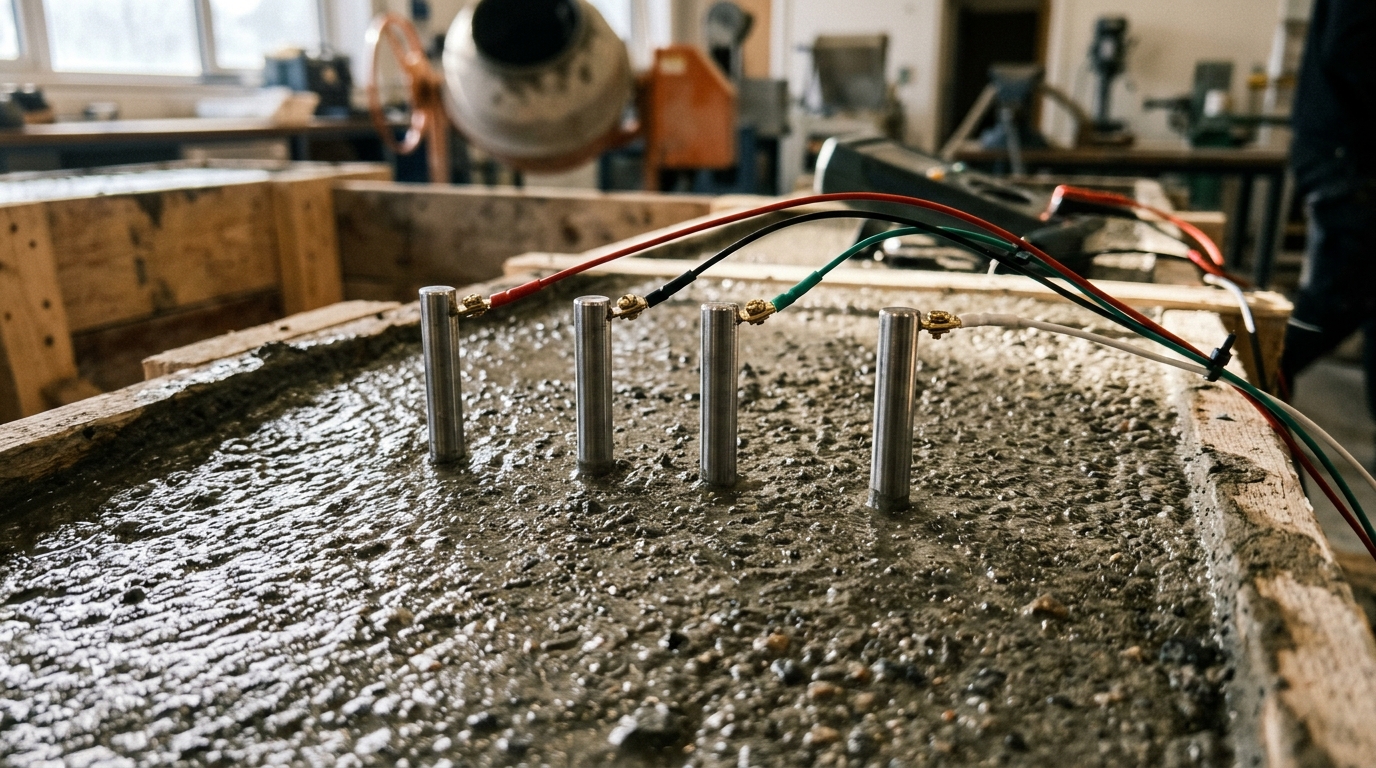
Electrical resistivity measurements were taken at various depths within the concrete samples every 10 minutes over 72 hours. The method relies on the fact that changes in resistivity are associated with the formation of hydration products, development of pore structure, changes in pore connectivity, degree of saturation, and moisture content. When mixture design parameters are held constant, variations in resistivity arise mainly from the development of the pore structure during hydration and from the moisture state. In drying environments, these localized moisture and microstructural changes manifest physically as a spatial resistivity gradient throughout the material.
The results demonstrated that the curing method significantly affected the temperature within the concrete. The air-cured sample had the highest measured temperature of 43 °C at a depth of 13 mm from the surface, while the continuous wet curing process reduced the temperature by approximately 15 °C compared to the air-cured sample. The sample initially exposed to the environment for the first 6 hours matched the air-cured sample, and then the temperature dropped once the wet burlap was placed on the surface, becoming similar to the temperatures measured in the continuous wet-curing sample. This indicates that even after a 6-hour delay in applying wet curing, the internal temperature of the concrete can be reduced to levels comparable to those achieved through continuous wet curing.
Electrical resistivity profiles showed that when wet curing was applied to specimens exposed to low and medium evaporation rates, the resistivity decreased rapidly and converged with that of continuously wet-cured concrete. This observation indicates that, despite the prior drying period, wet curing is sufficient to restore the resistivity characteristic of continuously cured samples when the evaporation rate is equal to or lower than the medium evaporation rate of 0.55 kg/m²/h. However, this behavior was not observed in the high evaporation rate. When wet curing was delayed by 4 hours or longer, the concrete did not regain the resistivity of the continuously wet-cured specimen, indicating that such delays at 0.85 kg/m²/h cause a permanent increase in resistivity.
Porosity measurements revealed differences in the total pore volume among different cured samples after 72 hours of hydration. When a sample is well cured, the porosity is approximately 19% for this mixture; however, when curing is less effective, the porosity increases. For the samples with the lowest evaporation rate, there is no difference in measured porosity when wet curing is delayed up to 6 hours. However, if wet curing is delayed by 9 hours or not applied at all, a measurable difference in surface porosity is observed. This indicates that delays in applying wet curing are not sensitive when evaporation rates are low.
Similar trends were observed for medium and high evaporation rates, but the allowable delay in applying wet curing is reduced. For the medium drying rate, the allowable delay is 3 hours, and for the high evaporation rate, the allowable delay in applying the wet curing is less than 2 hours. The reason a specific time is not given for the high rate is that 2 hours was the shortest time measured for these experiments. This difference in surface porosity is likely caused by surface evaporation, which reduces the water available for hydration, leading to increased near-surface porosity.
The electrical resistivity gradient, calculated between the near-surface region and the interior region, is strongly correlated with the porosity measured at 20 mm depth. The high coefficient of determination confirms the strong correlation between the resistivity gradient and porosity at a depth of 20 mm. Thus, the resistivity gradient shows promise as a real-time measurement tool for evaluating concrete curing under the three different evaporation rates. By using the gradient, the method also removes any bias caused by concrete with different resistivity values, making the method more applicable for field use.
The study highlights that the specific curing delay thresholds reported are dependent on the mixture investigated. The proposed resistivity-based framework is general in nature and has the potential to be extended to other concrete systems through appropriate mixture-specific calibration. The methodology offers an inexpensive, real-time means of quantifying evaporation conditions and assessing the impact of delayed curing on concrete porosity. As a result, curing practices can be adjusted according to the actual placement environment while maintaining adequate protection against undesirable porosity development.
Limitations of the study include the use of a single concrete mixture with a w/c ratio of 0.45 and ASTM Type I cement. Supplementary cementitious materials and chemical admixtures were not included, and all experiments were performed under controlled laboratory conditions. These conditions may not fully represent field environments with varying wind speed, solar radiation, and weather conditions. Consequently, the proposed curing-delay limits should be considered specific to the materials and exposure conditions investigated. Future studies should evaluate the proposed resistivity-based framework using a wider range of concrete mixtures and field conditions. Direct microstructural characterization was also not performed; therefore, interpretations of microstructural damage are based on resistivity, internal temperature, and porosity measurements.
Subject of Research: Real-time assessment of concrete curing effectiveness using electrical resistivity
Article Title: A real-time electrical resistivity-based framework for assessing the effectiveness of concrete curing
Article References: Chen, L., Uddin, M. J., Parastegari, N., Cook, M., & Ley, M. T. (2026). A real-time electrical resistivity-based framework for assessing the effectiveness of concrete curing. Discover Concrete and Cement, 2(1), Article 59. https://doi.org/10.1007/s44416-026-00100-5
Image Credits: AI Generated
DOI: 10.1007/s44416-026-00100-5
Keywords: concrete curing, electrical resistivity, hydration, porosity, evaporation rate, microstructure, durability, nondestructive testing, real-time, electrical, resistivity-based, framework
News Source: Denise Maddox. (November 9, 2026). Electrical Resistivity Tracks Concrete Curing Effectiveness in Real Time. Scienmag.