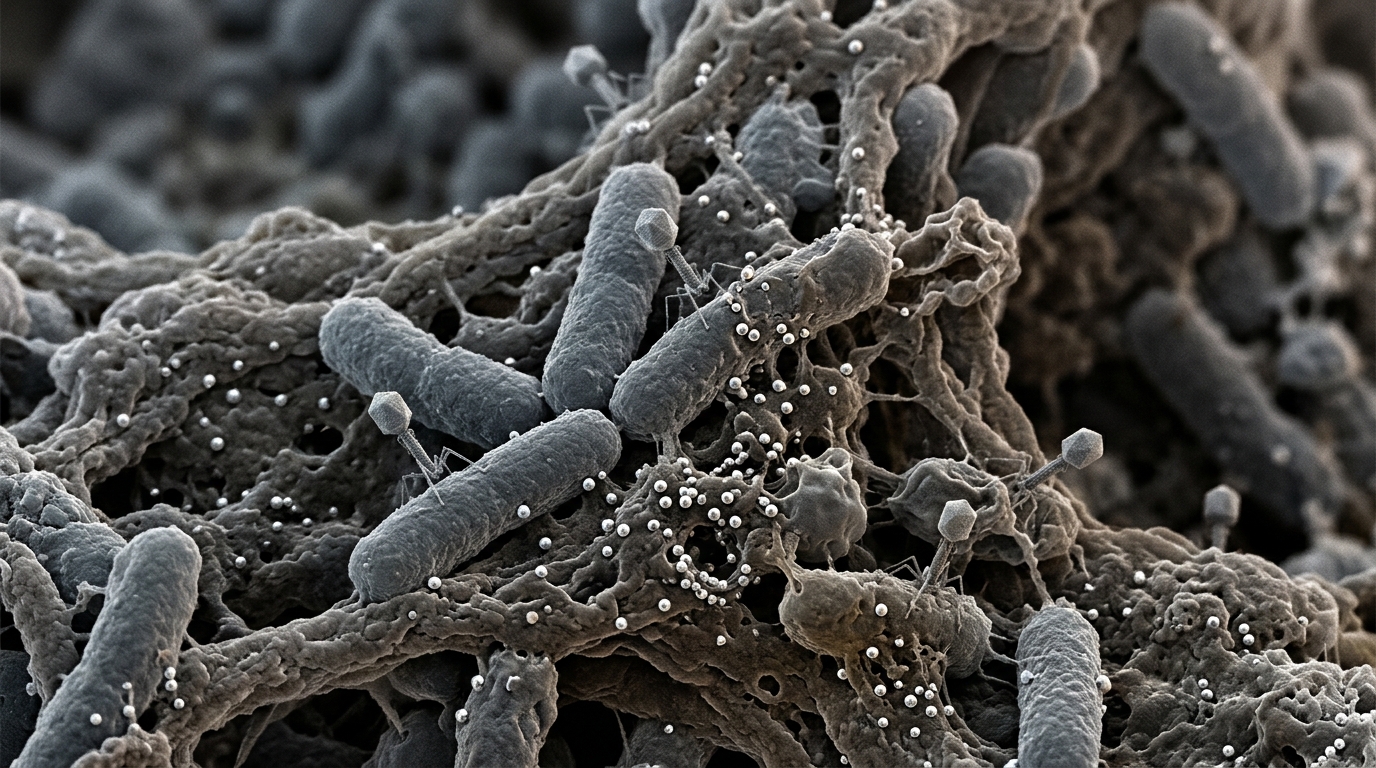
Published in the journal Bioscience Nanotechnology, the study reveals that this synergistic approach is more effective than using either phages or nanoparticles alone. The findings suggest a potential alternative strategy for managing multidrug-resistant infections, particularly those involving persistent biofilms on medical devices.
The study focused on the urgent need for novel therapeutics to combat antibiotic-resistant biofilm infections, which have become a formidable challenge in healthcare settings. Traditional antibiotics often fail to eradicate biofilms because the extracellular polymeric substance matrix shields bacterial cells from immune responses and drug penetration. The research team aimed to illustrate the synergistic effect of phages and nanoparticles against carbapenem-resistant E. coli and their associated biofilms, leveraging the complementary mechanisms of both agents.
Two lytic phages, UGKSEcP1 and UGKSEcP2, were used in the experiments. These phages were previously isolated from hospital effluents and are known to infect diarrheagenic E. coli and uropathogenic E. coli. The study also utilized silver nanoparticles that had been green-synthesized and characterized in prior research. To create a more stable and effective delivery system, the team formulated chitosan nanoparticles and silver-chitosan nanohybrids using the ionic gelation approach. Chitosan, a biocompatible polysaccharide, was chosen for its ability to stabilize silver nanoparticles and enhance biofilm penetration.
Characterization of the nanomaterials involved several advanced analytical techniques. Dynamic light scattering analysis showed that chitosan nanoparticles and silver-chitosan nanohybrids had surface charges of 22.2 ± 0.44 mV and 54 ± 0.7 mV, respectively. X-ray diffraction patterns revealed characteristic peaks for chitosan nanoparticles at 2θ = 19.5° and for the nanohybrids at 19.7°. High-resolution transmission electron microscopy estimated the average particle sizes to be approximately 50 nm for chitosan nanoparticles and 45 nm for the nanohybrids, indicating a spherical morphology suitable for biomedical applications.
Before evaluating the combined effects, the researchers assessed the impact of the nanomaterials on phage viability. Silver nanoparticles at concentrations of 5, 10, 15, and 20 µg/ml significantly reduced phage titers, although the activity was not completely abolished after 24 hours. In contrast, chitosan nanoparticles exhibited no toxic effects on the phages, with phage activity remaining identical to the control. The silver-chitosan nanohybrid also reduced phage activity, but the remaining viable phages retained potent antimicrobial effects. Consequently, higher phage titers were used in subsequent combination tests to ensure sufficient infectivity.
In planktonic bacterial growth assays, the combination of phages and silver nanoparticles markedly suppressed bacterial growth more effectively than either component alone. At lower multiplicities of infection and silver nanoparticle concentrations that were ineffective individually, the combined treatment reduced bacterial density from approximately 11 log10 CFU/mL to below the limit of detection. This synergistic effect was attributed to the ability of silver nanoparticles to disrupt bacterial cell walls and membranes, making the bacteria more susceptible to phage infection and lysis.
The study also evaluated the efficacy of these combinations in treating established biofilms and inhibiting their formation. In biofilm treatment assays, a cocktail of phages and silver nanoparticles was significantly more efficacious than other treatments in eradicating bacteria from the top layer of the biofilm. The bacterial population density was reduced from about 11 log10 CFU/ml to below the limit of detection. Chitosan nanoparticles alone did not show significant antibacterial activity, suggesting that the silver component was the primary driver of antimicrobial efficacy within the nanohybrid.
In biofilm inhibition assays, where nanomaterials were coated on the surface of well plates, the combinations of phages and nanomaterials produced statistically comparable effects, reducing the bacterial population from 12.5 log10 CFU/ml to 2.5 log10 CFU/ml. These reductions were significantly greater than those achieved by phages alone, which only decreased the load to 5 log10 CFU/mL. The results indicate that the synergistic cocktail is more effective in preventing biofilm formation than in treating established biofilms, highlighting its potential as a preventive intervention for indwelling medical devices.
The researchers noted that the absence of silver peaks in the X-ray diffraction patterns of the silver-chitosan nanohybrid suggests that the silver nanoparticles are highly encapsulated by the chitosan matrix. This encapsulation may lead to a gradual release of silver nanoparticles, which could explain why the nanohybrid was less effective than bare silver nanoparticles in some treatment assays. However, the combination of phages with the nanohybrid still demonstrated excellent antibiofilm activity, comparable to the combination of phages with bare silver nanoparticles.
The study underscores the importance of synergistic approaches in overcoming the limitations of single-agent therapies. Phages offer high specificity and the ability to self-replicate at the site of infection, while nanoparticles provide broad-spectrum antibacterial activity and enhanced biofilm penetration. By combining these agents, the researchers were able to achieve bacterial growth inhibitory effects greater than the sum of each individual component. This approach could provide a robust alternative strategy for mitigating biofilm-resistant infections.
The findings have implications for the design of bioactive medical devices. Coating indwelling devices such as urinary catheters and implants with nanomaterials like silver nanoparticles or silver-chitosan nanocomposites could prevent biofilm infections. The study suggests that such coatings, potentially combined with phage therapy, could offer a cheap and effective therapeutic intervention to manage multidrug-resistant infections. The use of locally available materials for chitosan production and green synthesis methods for silver nanoparticles further supports the feasibility of this approach in resource-limited settings.
Despite the promising results, the study has certain limitations. The experiments were conducted in vitro, and further translational studies are needed to evaluate the efficacy and safety of these combinations in vivo. The optimal concentrations and ratios of phages and nanomaterials for clinical application also require further optimization. Nevertheless, the study provides a strong foundation for future research into the synergistic use of phages and nanomaterials for biofilm control.
In conclusion, the synergistic action of phages and silver-chitosan-based nanomaterials presents a promising approach for controlling resistant bacteria and their biofilms. The study demonstrates that this combination is substantially more effective in inhibiting biofilm formation than in eliminating established biofilms, underscoring its potential as a preventive strategy. As antimicrobial resistance continues to rise, such innovative approaches may play a crucial role in the fight against persistent and difficult-to-treat infections.
Preparation of the nanostructures followed an ionotropic gelation protocol using shrimp shell chitosan dissolved in a 1% acetic acid aqueous solution stirred for 24 hours at room temperature. The non-ionic surfactant Tween was added to prevent agglomeration, with the acidity adjusted to a pH between 4.6 and 4.8. Sodium tripolyphosphate solution was subsequently introduced dropwise at 800 revolutions per minute in a 2.5 to 1 volume ratio. This triggered gelation through electrostatic attraction between positively charged protonated amine groups on chitosan and negatively charged phosphate anions. After centrifuging the opalescent suspension at 12,000 times gravity for 30 minutes, the collected pellet was resuspended in deionized water and freeze-dried. For the nanohybrids, a 0.02 milligram per milliliter silver nanoparticle solution was incorporated into the chitosan and tripolyphosphate mixture at a 1 to 2.5 to 1 ratio.
Optical and crystallographic analyses provided precise structural verification of the synthesized nanomaterials. Ultraviolet-visible spectroscopy of the biosynthesized silver nanoparticles recorded a pronounced surface plasmon resonance peak at 460 nanometers, aligning with characteristic metal resonance bands. X-ray diffraction of the silver nanoparticles displayed four distinct reflection peaks at 2-theta values of 38.1, 44.2, 64.4, and 77.5 degrees, matching the standard metallic silver crystal planes indexed in international diffraction databases. In contrast, raw chitosan powder exhibited characteristic reflections at 12.3 and 19.8 degrees, which shifted to broadened, lower-intensity peaks upon cross-linking into amorphous nanoparticles. Elemental spectroscopy verified high purity, detecting 79.15 percent silver in the biosynthesized nanoparticles alongside trace organic elements derived from the botanical extract, while the chitosan nanostructures displayed carbon, oxygen, nitrogen, sodium, and phosphorus without extraneous contaminants.
Dynamic light scattering and electron microscopy highlighted the architectural differences between solvated and solid-state particles. Light scattering registered average hydrodynamic diameters of 116.8 nanometers for chitosan nanoparticles and 267.8 nanometers for the silver-chitosan nanohybrids, reflecting the particle core, polymer coating, and surrounding hydration layer in liquid suspension. By comparison, high-resolution transmission electron microscopy examined dehydrated specimens, yielding smaller solid core diameters of 50 nanometers and 45 nanometers, respectively. The polydispersity indices of 0.471 and 0.534 indicated moderate particle size variation. Furthermore, the biosynthesized silver nanoparticles possessed an average core diameter of 3 nanometers and a net positive surface charge of 1.17 millivolts, a relatively low electrostatic potential that explains their slight tendency toward aggregation compared to systems exceeding thirty millivolts.
Time-course evaluations of planktonic bacterial cultures revealed distinct growth kinetics under varied treatment thresholds. While phages administered alone at a multiplicity of infection of 0.5 temporarily suppressed enteropathogenic bacteria before bacterial density rebounded after 8 hours, combinations pairing sub-inhibitory phage ratios with 5 or 10 micrograms per milliliter of silver nanoparticles achieved complete bacterial eradication within 4 to 12 hours. Biofilm biomass was quantified using crystal violet staining and spectrophotometric optical density readings at 600 nanometers alongside viable colony counts from disrupted adherent layers. Both analytical methods confirmed that surface-bound coatings inhibited biofilm establishment significantly more effectively than treating established 48-hour biofilms. The authors also highlighted practical advantages, noting that phages self-replicate at target sites, while chitosan and silver nanoparticles can be economically produced from local agricultural byproducts and green synthesis pipelines.
Subject of Research: Synergistic control of E. coli biofilms using bacteriophages and silver-chitosan nanomaterials
Article Title: Enhanced biofilm control through the synergistic action of phages and silver–chitosan-based nanomaterials
Article References: Ssekatawa, K., Ntulume, I., Byarugaba, D. K., Wampande, E. M., Karpoormath, R., Kirabira, J. B., Kansiime, E., Kayiwa, R., & Kato, C. D. (2025). Enhanced biofilm control through the synergistic action of phages and silver–chitosan-based nanomaterials. Bioscience Nanotechnology, 1(1), Article 7. https://doi.org/10.1186/s44331-025-00007-1
Image Credits: AI Generated
DOI: 10.1186/s44331-025-00007-1
Keywords: bacteriophages, silver nanoparticles, chitosan, biofilm control, E. coli, antimicrobial resistance, nanomaterials, synergistic therapy, Enhanced, biofilm, control, synergistic
News Source: Charles Cole. (November 9, 2026). Phages and Silver Nanomaterials Synergistically Control E. coli Biofilms. Scienmag.