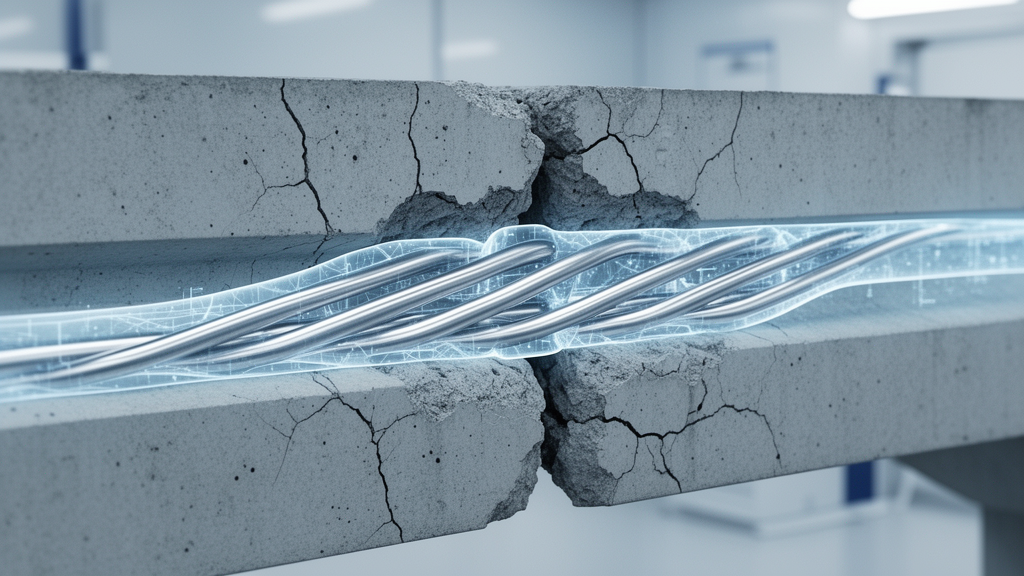
The work focuses specifically on the Polyfytos bridge in Greece, a landmark structure designed by Riccardo Morandi, where excessive deflections at the cantilever ends have raised concerns about potential prestress loss in the steel tendons.
The central challenge addressed by the team is the difficulty of directly inspecting tendons in prestressed concrete bridges. Because these structural elements are embedded within the concrete and not easily accessible, engineers rely on indirect indicators of their condition. The study utilizes vertical deck deflections as a proxy for identifying residual prestress forces. By measuring the magnitude and pattern of these deflections along the bridge span, the proposed method aims to quantify the extent of tendon loss in specific zones without requiring physical access to the tendons themselves.
The research builds upon a finite-element modeling framework previously established by Kazantzi et al. for the Polyfytos bridge. The team created a numerical dataset comprising 81 development observations derived from 27 prescribed tendon-loss patterns. Each pattern was evaluated under three different effective concrete Young’s modulus values of 10, 20, and 35 GPa, representing varying levels of concrete stiffness associated with material deterioration and creep. An additional five finite-element scenarios were reserved as an independent test set to evaluate the model’s performance on unseen data.
The proposed method employs a two-level cascade of Generalized Regression Neural Networks (GRNNs). In the first level, three separate GRNN models independently estimate tendon losses for three distinct zones of the bridge cantilever. These initial estimates are then used as supplementary inputs for a second level of GRNNs. The key innovation of this study is an iterative refinement mechanism at the second level, where the models repeatedly update their predictions using the current joint representation of the three zone-specific estimates. This process allows the model to account for the structural dependencies and interactions between the different tendon groups.
To optimize the model, the researchers used differential evolution to select the smoothing parameters for the GRNNs. The number of refinement iterations was determined by maximizing the mean validation coefficient of determination (R²) across the three zones. Validation results indicated that the mean R² increased from 0.9212 at the first iteration to a peak of 0.9646 at the third iteration. Consequently, the final model was configured with three refinement iterations, balancing predictive accuracy with computational efficiency.
When evaluated on the five held-out finite-element scenarios, the proposed iterative GRNN cascade demonstrated strong predictive performance. The model achieved R² values of 0.96, 0.98, and 0.90 for Zones 1, 2, and 3, respectively, resulting in an average R² of approximately 0.95. Zone 2 produced the lowest prediction errors, while Zone 3 remained the most challenging output, with a maximum absolute error of 4.00 percentage points. The results indicate that the method can reliably estimate tendon loss percentages across the different structural zones of the bridge.
The study compared the proposed method against two previously published neural-network ensembles: the original GRNN-based cascade and an enhanced ANN-based ensemble. The enhanced ANN ensemble achieved a slightly higher mean R² of approximately 0.96 but required significantly more computational time. The proposed iterative GRNN cascade offered a middle ground, improving accuracy in Zones 1 and 3 compared to the original cascade while maintaining a much faster training time than the ANN benchmark.
Computational efficiency was a key consideration in the design of the iterative method. On the specified hardware platform, the total training and hyperparameter optimization time for the original GRNN cascade was 6.54 seconds. The proposed iterative method increased this time to 16.87 seconds, a factor of 2.58. In contrast, the enhanced ANN ensemble required 2054.46 seconds for the same process. This substantial difference highlights the practical advantage of the GRNN-based approach for applications where computational resources are limited or where rapid assessment is required.
The analysis of error distribution revealed that in Zone 3, the largest individual error case contributed approximately 69% of the total squared error. This concentration suggests that specific difficult scenarios can heavily influence aggregate error metrics. The differences in performance across zones may reflect the overlapping structural effects of the tendon groups and the variation in response sensitivity in different parts of the bridge.
The study acknowledges several limitations in its scope and interpretation. The evaluation was conducted using finite-element simulations rather than physical measurements from the actual bridge. The five held-out scenarios characterize bridge-specific inverse-estimation performance under adopted numerical assumptions, and practical transfer to monitored bridges would require calibration for measurement variability and material uncertainty. The scenarios used for training were designed to capture a broad spectrum of realistic damage patterns but are not exhaustive of all possible failure modes.
The findings provide a basis for subsequent investigations into the deployment of machine learning methods for structural health monitoring. By combining finite-element simulations with iterative ensemble learning, the team has demonstrated a viable pathway for quantifying prestress losses in complex bridge structures. The method offers a non-destructive alternative to manual inspections, which are often time-consuming and impractical for large bridge portfolios. As more bridges approach the end of their design life, such computational tools become increasingly important for maintaining infrastructure safety.
The specific focus on the Polyfytos bridge provides a detailed case study of how these methods can be applied to a real-world landmark structure.
The Polyfytos bridge, also known as the Servia/Neraida High Bridge, spans 1,372 meters and connects the city of Kozani with the town of Servia in Greece. Designed by Professor Riccardo Morandi, the structure features a mixed system of simply supported I-beams and balanced cantilevers with variable cross-sections. The finite-element model used in this study follows the geometry and construction-stage simulation procedures established in prior work, representing successive concrete casting and post-tensioning stages using three-dimensional solid elements and one-dimensional tendon elements. This modeling approach accounts for nonlinear concrete behavior, providing a detailed numerical representation of the bridge’s structural response under various loading and damage conditions.
Because the exact layout and anchorage locations of the prestressing tendons were not fully documented in available records, the researchers determined their positions based on conventional practices used during the bridge’s construction. The cantilever portion of the bridge was divided into three distinct zones, each comprising two segments. Each zone is supported by specific sets of prestressing tendons, with overlapping contributions from tendons anchored in distant zones. A uniform damage assumption was applied within each zone, meaning that tendon loss is evenly distributed across all tendons in that zone and on both sides of the deck. This zoning strategy allows the model to capture the complex interactions between different tendon groups while maintaining a manageable computational framework for machine learning analysis.
The damage scenarios simulated in the study represent both sudden and gradual deterioration mechanisms, including tendon snapping, fatigue, and corrosion-induced cross-sectional loss. The numerical parameterization describes these deterioration processes through changes in tendon cross-sectional area, consistent with the finite-element assessment framework adopted in previous research. The intention behind defining these specific scenarios was to capture a broad spectrum of realistic damage patterns, creating a training set where different damage states are paired with corresponding bridge deck deflected shapes. Although the scenarios are not exhaustive of all possible failure modes, they were carefully selected to cover a wide range of bridge damage states and responses while maintaining the practicality of the proposed assessment methodology.
The input variables for the machine learning model include the vertical drift ratios for each of the three zones and the effective concrete Young’s modulus. These four structural-response features characterize the bridge’s condition and serve as the basis for estimating the percentage of tendon loss in each zone. The model uses Min-Max normalization to scale these input variables to the range of 0 to 1, with scaling parameters estimated exclusively from the training subset. This preprocessing step ensures that the model can effectively handle the varying magnitudes of the input features while preventing information leakage from the validation and test data. The consistent application of this normalization procedure across both cascade levels of the model helps maintain the integrity of the predictive process.
The selection of the refinement count was a critical aspect of the model optimization process. The researchers evaluated five different refinement iterations, measuring the mean coefficient of determination and other error metrics for each. The mean validation R² increased from 0.9212 at the first iteration to a peak of 0.9646 at the third iteration, after which it slightly decreased to 0.9642 and 0.9564 at the fourth and fifth iterations, respectively. The third iteration also yielded the lowest mean maximum absolute error of 3.0092. Based on these validation results, the final model was configured with three refinement iterations, a choice that balances predictive accuracy with computational efficiency. This iterative process allows the model to progressively refine its estimates by incorporating updated information from the other bridge zones at each step.
The computational experiments were conducted on a standard computer platform equipped with an Intel Core i7-8750H processor and 16 GB of RAM. The total training and hyperparameter optimization times for the different methods varied significantly. The original GRNN cascade required 6.54 seconds, while the proposed iterative GRNN cascade took 16.87 seconds. In contrast, the enhanced ANN ensemble required 2054.46 seconds for the same process. This substantial difference in computational time highlights the practical advantage of the GRNN-based approach for applications where rapid assessment is required.
Subject of Research: Machine learning methods for structural health monitoring and tendon loss estimation in prestressed concrete bridges
Article Title: Iterative ensemble learning for tendon loss identification in bridges
Article References: Izonin, I., Kazantzi, A. K., Pentassuglia, F., Nesterenko, I., Tkachenko, R., & Mitoulis, S.-A. (2026). Iterative ensemble learning for tendon loss identification in bridges. Results in Engineering, 32, Article 113935. https://doi.org/10.1016/j.rineng.2026.113935
Image Credits: AI Generated
DOI: 10.1016/j.rineng.2026.113935
Keywords: structural health monitoring, machine learning, prestressed concrete, bridge engineering, tendon loss, finite element analysis, ensemble learning, Polyfytos bridge, Iterative, ensemble, learning, tendon
News Source: Denise Maddox. (November 9, 2026). Iterative Learning Model Estimates Tendon Loss in Concrete Bridges. Scienmag.