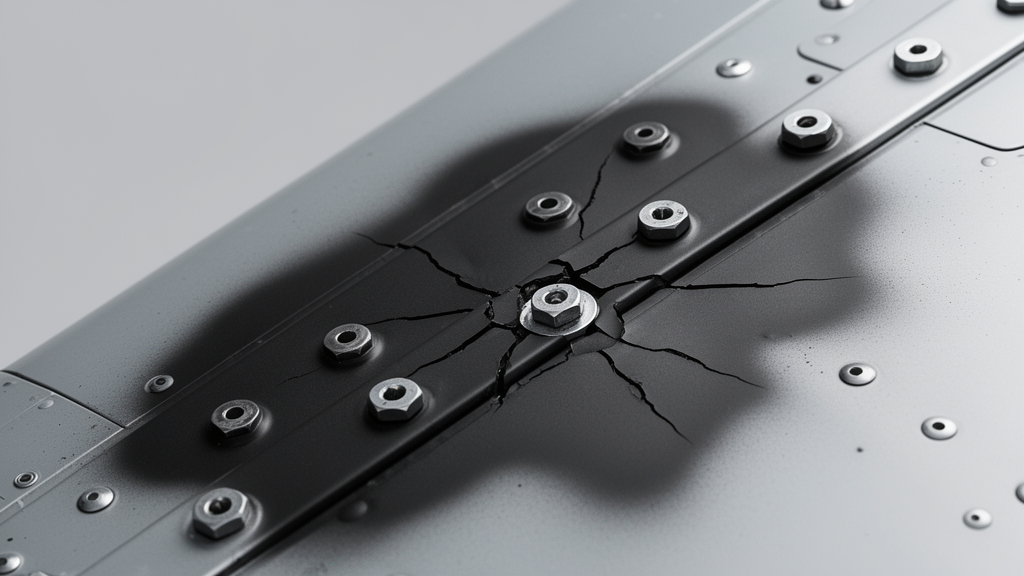
Researchers from China have developed a sprayed smart coating sensor capable of monitoring fatigue cracks in concealed bolt-hole regions of metallic structures without requiring the disassembly of connection components. Published in Case Studies in Construction Materials, the study addresses a significant challenge in structural health monitoring: the detection of cracks in areas covered by bolt heads, nuts, and washers, which are typically inaccessible to conventional visual or ultrasonic inspection methods. The proposed method utilizes a multilayer conductive coating that changes its electrical resistance as cracks propagate, providing an early-warning signal for critical damage in bearing-type bolted connections.
The motivation for this research stems from the widespread use of bolted connections in steel bridges, mechanical equipment, and aerospace structures. In bearing-type connections, loads are transferred through the contact between the bolt shank and the hole wall, creating significant stress concentrations around the bolt hole edges. These regions are highly susceptible to fatigue cracking under cyclic loading. However, in practical engineering, these high-risk zones are often obscured by washers, forming a concealed inspection area. Traditional inspection methods usually require the disassembly of the connection, which reduces efficiency and may disturb the original load-bearing state of the structure. Consequently, damage is often only detected after cracks have propagated beyond the washer edge, entering a critical phase.
The smart coating sensor developed in this study consists of three distinct layers: an insulating layer, a sensing layer, and a protective layer. The insulating layer, made from a modified polyurethane resin, isolates the conductive sensing layer from the electrically conductive metal substrate to prevent signal interference. The sensing layer is fabricated from a conductive composite containing silver-plated copper particles and a water-based acrylic emulsion. These particles, ranging from 10 to 25 micrometers in size, form a multiscale conductive network that is sensitive to crack-induced disruptions. The protective layer is a 0.1-mm-thick polyether ether ketone (PEEK) film designed to enhance wear resistance and long-term stability under complex service conditions.
The fabrication process involves a spray-based application method that offers advantages such as simple operation, controllable thickness, and adaptability to complex curved surfaces. The metal specimen surface is first pretreated by sandblasting and ethanol cleaning to remove impurities and enhance adhesion. The insulating layer is sprayed to a thickness of approximately 50 micrometers, followed by the conductive sensing layer, which is sprayed to a thickness of about 30 micrometers. The entire multilayer structure is then covered by the PEEK protective film. This spray-based approach allows for localized in situ construction, meeting the monitoring requirements of confined regions around bolt holes and beneath washers.
To establish a quantitative relationship between crack length and the measured electrical potential, the researchers developed a theoretical model based on an equivalent resistive network. The annular sensing layer is simplified into four equivalent resistances, with a constant voltage applied to the upper electrode and the lower electrode grounded. When a crack initiates and propagates radially outward from the hole edge, it interrupts the conductive path, effectively increasing the resistance of the affected branch. The model introduces a nonlinear equivalent conductive width to account for the spatially nonuniform disturbance caused by the crack. This width decreases as the crack grows, with the rate of reduction increasing markedly as the crack approaches the outer boundary of the annular sensing layer.
The theoretical model was validated through finite element analysis using COMSOL Multiphysics. The numerical simulations modeled the annular coating sensor structure at the edge of an M24 bolt hole, with the washer dimensions defining the sensing area. The crack was treated as an insulating slit, and the steady-state potential field distribution was solved for various crack lengths and locations. The results showed that the potential at the measurement points decreased as the crack length increased, consistent with the theoretical predictions. The nonlinear contraction parameter in the model was calibrated to 0.162 using the finite element results, demonstrating the model’s applicability to different crack initiation locations around the bolt hole.
Experimental validation began with simulated crack tests, where the smart coating was sprayed onto an insulating plastic sheet to avoid interference from the metal substrate’s conductivity. A utility knife was used to manually cut the sensing layer along a 45-degree path, simulating crack propagation. The potential variations were recorded in real time using a multifunction data acquisition card. The measured potential data were normalized to eliminate initial offsets and highlight the relative response characteristics induced by crack propagation. The results of 12 repeated tests demonstrated that the theoretical model effectively described the evolution of the potential response, achieving an average coefficient of determination (R-squared) of 0.9792 and a root mean square error of 0.0418.
Subsequent fatigue tests were conducted to evaluate the operational stability of the sensor under representative washer-clamping, bolt-preload, and cyclic-loading conditions. The fatigue specimen consisted of an 8-mm-thick Q235 steel plate with an M24 bolt and washer. A prefabricated notch was introduced to promote repeatable crack propagation. The test was performed under constant-amplitude cyclic loading with a maximum nominal stress of 244.4 MPa and a stress ratio of 0.1. The M24 bolt was tightened to 500 Newton-meters, corresponding to an estimated bolt preload of approximately 104 kilonewtons and a mean nominal washer contact pressure of approximately 108 megapascals.
During the fatigue test, the potential at the primary measurement point exhibited distinct stage-wise variation characteristics. In the initial stage, the potential remained stable, indicating that the sensor maintained good signal stability under the combined action of bolt preload and high-frequency cyclic loading. At approximately 3030 seconds, the potential began to show a continuous decreasing trend, indicating the initiation and gradual propagation of an internal fatigue crack. At approximately 3728 seconds, the potential exhibited an abrupt and rapid drop, signaling that the crack had entered the rapid propagation stage and extended to the edge of the washer-covered region. This abrupt drop serves as an important early-warning signal that the damage has entered a critical stage.
Post-test examination of the coating in the washer-clamped region showed that the multilayer structure generally remained intact, with no obvious crushing, delamination, or large-area wear. The bonding between the insulating and sensing layers remained satisfactory, and the conductive network was essentially intact, with only slight local indentation observed. These observations indicate that the applied bolt preload and high-frequency cyclic loading did not cause significant contact-induced failure of the coating. Therefore, the abrupt potential drop observed during the fatigue test was primarily associated with crack-induced interruption of the conductive path rather than mechanical damage caused by washer compression.
The study highlights the potential of smart coating sensors for in situ monitoring of concealed structural defects. The method offers advantages such as flexible deployment, strong structural adaptability, and convenient engineering implementation. By enabling the online sensing of damage states without disassembling connection components, the proposed method addresses a critical gap in structural health monitoring. The ability to detect the transition from stable crack propagation to rapid failure provides valuable diagnostic information for maintenance planning and safety assessment in engineering structures.
Limitations of the current study include the focus on a single dominant crack and the need for further investigation into the effects of complex service environments, such as temperature and humidity variations, corrosive media, and long-term cyclic loading. The calibration model is not suitable for quantitatively determining the length of multiple cracks developing simultaneously on the same side of the bolt hole, where electrical responses may become coupled. Future work should explore multipoint array layouts, data-driven identification algorithms, and field engineering validation to improve the identifiability and quantitative characterization of multiple cracks and to assess the long-term reliability of the proposed method in real-world applications.
Subject of Research: Development of a smart coating sensor for monitoring fatigue cracks in concealed bolt-hole regions
Article Title: A sprayed smart coating sensor for in-situ monitoring of hidden bolt-hole fatigue cracks under washer-covered conditions
Article References: Liu, K., Zhang, Q., Zhao, R., & Cui, C. (2026). A sprayed smart coating sensor for in-situ monitoring of hidden bolt-hole fatigue cracks under washer-covered conditions. Case Studies in Construction Materials, 25, Article e06697. https://doi.org/10.1016/j.cscm.2026.e06697
Image Credits: AI Generated
DOI: 10.1016/j.cscm.2026.e06697
Keywords: structural health monitoring, smart coating, fatigue crack detection, bolted connections, electrical resistance, in-situ monitoring, metallic structures, sensor technology, sprayed, smart, coating, sensor
News Source: Neil Sanderson. (November 8, 2026). Sprayed Coating Sensors Detect Hidden Bolt Fatigue Cracks. Scienmag.