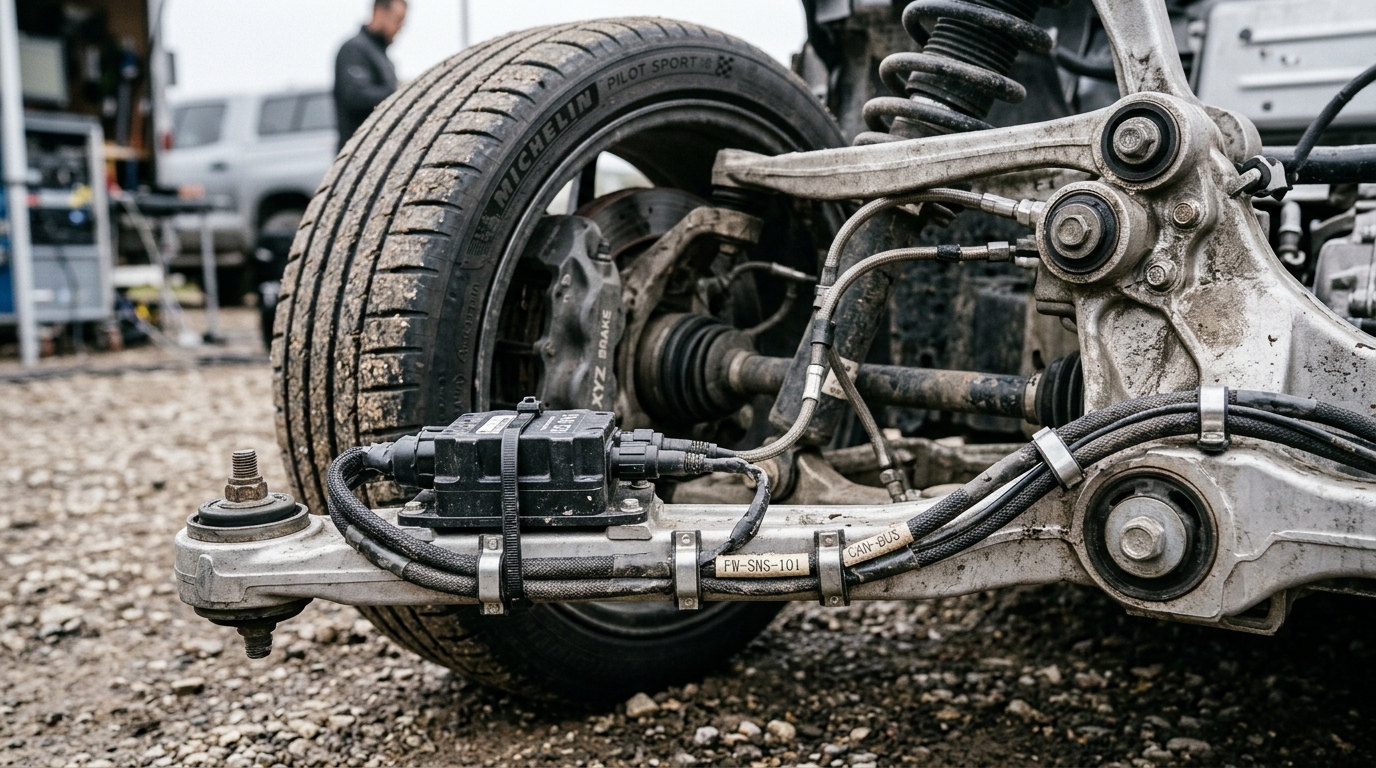
Researchers Kushal Khemani and Anjum Nazir Qureshi have introduced an artificial intelligence architecture that predicts connected vehicle maintenance needs by fusing external environmental signals with internal vehicular diagnostics. Published in the journal Discover Vehicles, the investigation evaluates this contextual data fusion model across four distinct experimental tiers: controlled simulation ablation, real-world industrial failure benchmarking, empirical noise sensitivity analysis, and an operational multi-country field pilot. Standard vehicle health monitoring pipelines rely almost exclusively on internal telemetry gathered through on-board diagnostics ports, observing engine temperatures, fault codes, and mechanical vibrations while ignoring surrounding operational stresses. By combining high-frequency internal sensor feeds with ambient weather, road surface roughness, local traffic density, and driver habits, the authors show that contextual variables improve failure prediction. The work bridges the longstanding gap between synthetic simulations and real-world operations by evaluating algorithmic generalisation on industrial datasets and deploying the contextual framework across nearly one thousand passenger car trips.
Modern vehicles produce high-frequency operational data across internal controller networks, yet conventional maintenance remains largely tied to rigid calendar schedules or fixed mileage intervals that fail to prevent unexpected breakdowns. Although diagnostic trouble codes and engine operational metrics retrieved via standard on-board interfaces provide useful snapshots of instantaneous mechanical state, they completely omit external operational stresses. Empirical studies demonstrate that severe pavement roughness, prolonged stop-and-go congestion, extreme ambient temperatures, and aggressive driving styles exert measurable independent influences on automotive component wear rates over time. Predictive systems that neglect these contextual factors risk systematically miscalculating remaining component life whenever driving conditions deviate from idealized training baselines. Furthermore, many prior predictive maintenance models have relied on synthetic benchmarks featuring deterministic binary labels, yielding artificially inflated accuracy scores that collapse in operational practice. To overcome these systemic limitations, the researchers designed a contextual fusion architecture capable of ingesting diverse external signals and executing low-latency inference directly on vehicle edge processors.
The proposed system integrates five distinct architectural layers: sensor acquisition, contextual data ingestion, edge processing, cloud synchronization, and automated dealer service scheduling. Telemetry is collected from the vehicle controller area network via standard on-board diagnostics interfaces, capturing nine internal mechanical metrics including engine coolant temperature, manifold absolute pressure, vehicle speed, fuel trim, tire pressure, battery state, and brake wear indicators. Pavement quality is independently monitored at fifty hertz using a three-axis inertial measurement unit through spectral power density analysis of vertical acceleration. External context arrives through two pathways: Vehicle-to-Everything communication protocols for local broadcast messages, alongside background application programming interfaces providing weather and road conditions updated under a sixty-second staleness threshold. In total, the feature space spans twenty-three variables across four groups: nine internal mechanical variables, four rolling-window driver behavior metrics, six environmental variables, and four cross-group interaction terms capturing complex physical stresses like engine thermal load and brake stress index.
To quantify the isolated value of contextual variables, the authors generated a physics-informed synthetic dataset comprising two thousand vehicle-month observations generated through an additive risk model. Because no public automotive repository combines component failure ground truth with rich environmental covariates, failure labels were assigned using an additive risk score combining mechanical wear, driver behavior, and environmental stressors with injected Gaussian noise to prevent trivial classification boundaries. In a five-fold cross-validation ablation study using a LightGBM classifier, the complete contextual model achieved a macro F1-score of 0.855, with a ninety-five percent confidence interval spanning from 0.825 to 0.885. Removing environmental features caused the macro F1-score to decline by 0.026 to 0.829, demonstrating a consistent directional benefit within the simulation. Operating exclusively on internal mechanical telemetry yielded an F1-score of 0.807, representing a 0.049-point deficit compared to full contextual fusion. Conversely, removing internal mechanical signals caused performance to plummet by 0.201 to 0.655, confirming that internal mechanical measurements remain the indispensable core of failure prediction.
To test algorithmic generalisation on real, imbalanced failure distributions without relying on synthetic data, the researchers evaluated their pipeline on the AI4I 2020 predictive maintenance benchmark. Featuring ten thousand records from industrial milling equipment, the dataset has an overall failure incidence of 3.4 percent across five failure categories: tool wear, heat dissipation, power failure, overstrain, and random failure. These categories provide structural analogues to automotive failure modes, mapping directly to progressive mechanical wear, thermal cooling deficits, electrical issues, and drivetrain overloads. Under five-fold stratified cross-validation with synthetic minority oversampling confined strictly to training folds, the LightGBM classifier attained a macro F1-score of 0.814 and an area under the receiver operating characteristic curve of 0.973. Performance varied predictably by failure mechanism: heat dissipation failure achieved an F1-score of 0.972, whereas inherently unpredictable random failures reached only 0.497, verifying the model’s ability to identify genuine physical degradation pathways while avoiding false confidence on stochastic noise.
Because operational deployments encounter imperfect sensor inputs, the researchers conducted an empirical noise sensitivity analysis alongside probability calibration testing. By systematically injecting zero-mean Gaussian noise across standard deviation levels from clean conditions up to heavy disruption, the team mapped model robustness. LightGBM maintained a macro F1-score above 0.88 under mild noise, recorded 0.848 under moderate noise typical of automotive environments, and degraded to 0.740 under severe noise before dropping to 0.665 under extreme disturbance. The area under the receiver operating characteristic curve degraded far more gradually than the F1-score, proving the system retains effective risk ranking even when sensor precision deteriorates. In parallel, the authors evaluated probability calibration, as raw ensemble outputs can produce compressed or overconfident risk estimates. Applying Platt scaling reduced the model’s Brier score from 0.082 to 0.080, aligning continuous predicted probabilities with true failure rates to support principled alert thresholds for automated workshop booking systems.
To validate the pipeline beyond computational simulations, the authors conducted an operational field pilot across five privately owned vehicles in Germany, India, and Brazil. The test fleet comprised an Opel Corsa and a Seat León operating under temperate German conditions, a Tata Safari Storme EX and a Toyota Innova Crysta driven across urban and highway routes in India, and a Toyota Etios operating in Recife, Brazil. Over the trial, the vehicles generated 992 recorded trips comprising approximately one hundred thirty million sensor observations sampled at one- to two-second intervals. Ground truth for component degradation was established through physical service records and manual screw gauge measurements of brake pad thickness and tire tread depth taken during workshop visits. These physical measurements served as empirical anchors, between which component wear was propagated across successive journeys using a physics-informed degradation model tracking cumulative braking events and road roughness until verified service resets occurred.
The field trial captured eleven evaluable maintenance events within thirty-day observation windows, allowing researchers to evaluate binary maintenance alerts and continuous days-to-service forecasts. Across six verified wear-driven events—involving brake pad replacements, tire renewals, and oil changes across four vehicles—the framework achieved a one hundred percent binary detection rate. For these wear-induced events, the model predicted required service timing with a mean absolute error of 12.2 days, a standard deviation of 9.8 days, and errors ranging from 4.2 to 30.5 days. Comparing the synthetic base model against per-vehicle fine-tuned models revealed the precise benefit of adaptation. The unadapted synthetic base model already detected all six wear-driven events on unseen vehicles, demonstrating that simulation pre-training provides sufficient diagnostic coverage. However, per-vehicle fine-tuning halved the timing error, reducing mean absolute error from 25.9 days to 12.2 days and illustrating that local adaptation provides crucial temporal calibration for fleet operators.
Despite strong results on mechanical wear, the field validation revealed distinct performance boundaries regarding scheduled preventive maintenance and geographic domain shifts. Across all eleven events, the unfiltered fleet mean absolute error was 49.7 days, an aggregate heavily skewed by the Brazilian Toyota Etios, which recorded an average error of approximately 206 days per event. The researchers attributed this divergence to a multi-year temporal gap in the Brazilian telemetry, the vehicle’s younger mechanical age, and a tropical coastal environment absent from synthetic training. Excluding the Etios reduced the mean absolute error to 15.1 days across the remaining nine events. Furthermore, the system struggled with scheduled preventive maintenance, recording a mean absolute error of 93.5 days and flagging only two of five events. Because the algorithm predicts physical wear rather than calendar intervals or owner scheduling preferences, components replaced early while still mechanically healthy triggered low predicted risk scores.
The investigation concludes by identifying structural limitations and charting future research priorities for connected vehicle diagnostics. Game-theoretic Shapley Additive Explanations confirmed that environmental features—such as rain conditions, traffic impact indices, and road roughness—ranked among the top nine predictors in the synthetic dataset, matching physical expectations. However, the authors caution that field trials gathered environmental data via third-party application programming interfaces rather than live Dedicated Short-Range Communications or Cellular Vehicle-to-Everything hardware, leaving direct wireless communication validated only in simulation. Future research priorities include expanding the field fleet to over twenty vehicles, developing electrochemical battery aging models, implementing federated learning architectures to handle geographic variations while preserving driver data privacy, and conducting moving-vehicle hardware trials with instrumented communication units.
Subject of Research: Contextual data fusion for connected vehicle predictive maintenance
Article Title: AI-driven predictive maintenance for connected vehicles using environmental context integration evaluated through simulation benchmarking and field validation
Article References: Khemani, K., & Qureshi, A. N. (2026). AI-driven predictive maintenance for connected vehicles using environmental context integration evaluated through simulation benchmarking and field validation. Discover Vehicles, 2(1), Article 19. https://doi.org/10.1007/s44465-026-00023-2
Image Credits: AI Generated
DOI: 10.1007/s44465-026-00023-2
Keywords: Predictive Maintenance, Connected Vehicles, Machine Learning, Environmental Context, Vehicle Telematics, Edge Computing, Sensor Fusion, LightGBM, AI-driven, predictive, maintenance, connected
News Source: Denise Maddox. (November 8, 2026). AI Vehicle Maintenance System Merges Environmental Context With Internal Sensor Diagnostics. Scienmag.