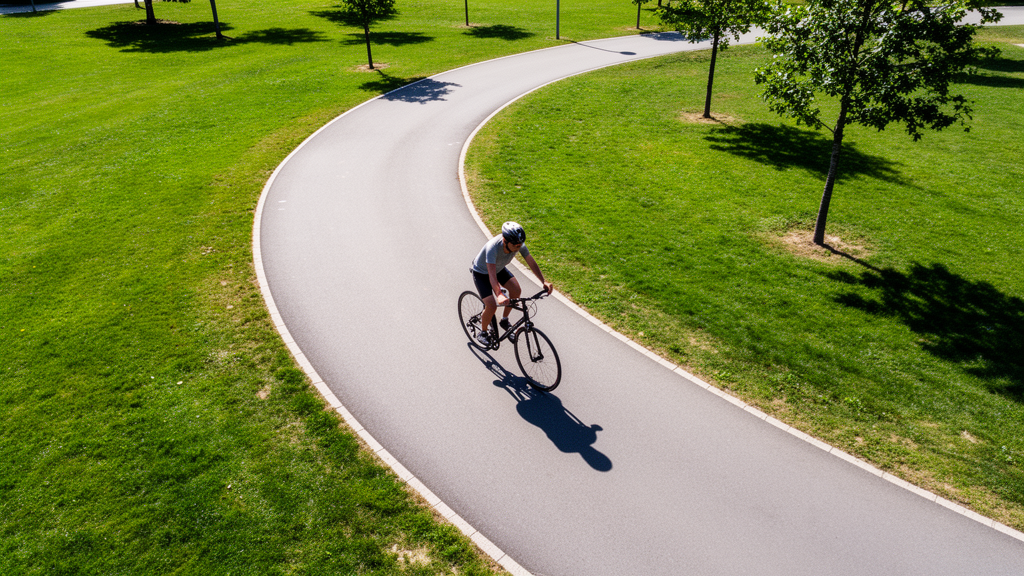
A new study published in the European Transport Research Review demonstrates that physical changes to shared-use paths, specifically alterations in surfacing and electric lighting, significantly influence the microscopic behavior of pedestrians and cyclists. By utilizing drone-based imaging technologies, researchers captured detailed movement data from two Swedish cities, revealing that environmental factors play a crucial role in how path users navigate their surroundings. The findings offer valuable insights for urban planners aiming to design infrastructure that enhances safety and efficiency for all users during periods of reduced daylight.
The research, led by Oksana Yastremska-Kravchenko and colleagues, investigated the interplay between the physical environment and lighting conditions on shared pathways. The study focused on two specific behavioral measures: speed and slalom, which refers to the lateral deviation of a path user from a straight line. Data were collected from shared-use paths in Linköping and Lund, two medium-sized university-oriented cities in Sweden known for their established active mobility cultures. These locations were chosen because their paths serve as key commuter corridors connecting outer urban areas to city centers, making them representative of typical daily travel routes.
Video recordings were obtained using drones positioned at a height of 120 meters, capturing sections of the paths that spanned approximately 150 meters in length. The data collection occurred during five distinct periods, each encompassing roughly 15 working days, specifically targeting times of reduced daylight hours in Sweden, typically from late October to early March. A total of 353 individual trajectories of path users were utilized for the analysis. The participants, who were students aged 18 to 35, were recruited from university campuses and instructed to travel along the paths individually as they normally would, either by walking or cycling.
To assess the impact of specific design features, researchers implemented physical interventions on the study sites between data collection periods. In Linköping, the first intervention involved resurfacing the path, widening it, and adding a white line to segregate cyclists from pedestrians. The second intervention replaced the original high-pressure sodium lamps with new LED luminaires. In Lund, the intervention involved new asphalt surfacing, trimming of greenery to increase visibility, and the installation of new LED luminaires at a different distance from the path edge. These changes allowed the researchers to isolate the effects of surfacing, design, and lighting on user behavior.
The analysis employed a two-way analysis of variance (ANOVA) to assess the significant interactions between physical environment changes and lighting conditions. The results indicated that both factors had a statistically significant effect on the speed and slalom of both cyclists and pedestrians. For cyclists in Linköping, the transition from the baseline to the first intervention, which included repaving and segregation, led to an increase in bicycle speed and a decrease in slalom values during daylight hours. However, this significant change was not observed under electric lighting conditions, suggesting that the new surfacing alone did not alter behavior in the dark.
When the electric lighting application was changed in the second intervention, cyclists in Linköping exhibited an increase in speed and a decrease in slalom during dark hours. This finding highlights the critical role of lighting quality in influencing cyclist behavior. Similarly, in Lund, the implementation of the intervention led to an increase in cyclist speed and a decrease in slalom. The study also noted that before the intervention, cyclists moved significantly faster during daylight hours compared to electric lighting conditions, but after the lighting upgrade, this difference was no longer statistically significant.
Pedestrian behavior showed different patterns compared to cyclists. In Linköping, there were no statistically significant differences in pedestrian speed or slalom during daylight periods. However, under electric lighting, the change in lighting application led to a decrease in both speed and slalom. The study observed that pedestrians tended to move more slowly during daylight hours while increasing their speeds under the original electric lighting conditions. This contrast with cyclist behavior, where cyclists moved faster in daylight, suggests that lighting conditions affect the perceived safety and movement patterns of pedestrians and cyclists differently.
The slalom measure, calculated as the cumulative sum of deviations from a local baseline, provided insight into the stability and comfort of path users. A decrease in slalom was interpreted as a perceived improvement in the pathway, reflecting a smoother and more stable trajectory. The study found that continuous, high-quality pavement markings and dedicated physical clearance, such as the white separation line, reduced user conflicts and improved operational efficiency. This aligns with previous research indicating that such design features help maintain the optimal stability window for cyclists, which is between 12 and 20 km/h.
Under low-light conditions, the interaction between surface quality and lighting became particularly critical. The combination of poor outdoor lighting and poor pavement quality elevates crash risks because hazards become difficult to detect. When visibility of the physical surface is compromised, active road users modify their micro-level behavior, such as adjusting lateral positions or altering speed, to maintain stability. The study found that the new surfacing in Linköping, which was perceived as darker and less reflective, may have affected path users’ visibility, leading cyclists to adopt more cautious speed profiles under electric lighting.
The study acknowledges several limitations, including the use of experimental participants rather than naturalistic data. While the participants were instructed to move as they normally would, informing them of the study aims could have influenced their behavior. Additionally, the sample sizes were somewhat limited due to the time and labor-intensive nature of video data processing. The analysis also did not address the technical characteristics of the electric lighting application, which warrants further research. Despite these limitations, the study provides new insights that can assist urban planners in designing safe and efficient shared-use paths that adapt to various environmental conditions.
The findings underscore the importance of considering both physical design and lighting conditions when planning active travel infrastructure. By understanding how these factors influence user behavior, cities can create more adaptable and user-friendly environments that promote walking and cycling. The study contributes to a deeper understanding of the complex dynamics between physical environments, lighting conditions, and human behavior in urban settings, offering a foundation for informed decisions that balance the needs of urban users with the goals of ecological preservation and energy efficiency.
The study builds on the Video Analysis of Microscopic Pedestrian Movements (VAMP) method, originally developed to analyze pedestrian lateral position and speed. Previous iterations of this methodology, including work by Johansson et al. and Yastremska-Kravchenko et al., established that lighting environments affect these indicators and expanded the scope to include bicyclists. The current research extends this framework by utilizing drone-based video collection rather than ground-based cameras, allowing for a more comprehensive assessment of how physical and lighting factors simultaneously impact both user groups. This methodological shift addresses a gap in understanding the micro-level interplay between the physical environment and human behavior, which is essential for developing evidence-based strategies in urban design.
Previous research on active travel has largely focused on daylight conditions, often neglecting the specific challenges faced by users in high-latitude cities during winter months when daylight is limited. Ensuring visibility is a critical component of traffic safety, as studies indicate that bicycle crashes are more prevalent during darkness and twilight hours. Darkness diminishes visibility, leading to slower reaction times and an increased risk of single-cyclist collisions. Beyond objective safety metrics, low-light conditions significantly degrade perceived social safety, acting as a major barrier to active travel for many individuals. Installing quality outdoor lighting has been shown to enhance reassurance and reduce the fear of crime, thereby encouraging bicycle commuting, though it remains only one part of a broader shift in urban design priorities.
Socio-demographic factors also play a significant role in how individuals navigate dark environments. Women report higher levels of fear and lower perceived social safety in the dark, which results in substantially lower odds of cycling or walking compared to men. To manage these risks, female active travelers often avoid isolated infrastructure, choose longer but better-lit routes, or travel in groups. Age and trip purpose further influence behavior; adolescents may cycle in the dark out of necessity for school commutes, while elderly populations show a markedly lower propensity to travel after dark due to heightened vulnerability. Route familiarity serves as a protective factor, with frequent utility commuters perceiving lower risks than occasional users. Additionally, the type of vehicle matters: users of e-bikes and S-pedelecs are more likely to cycle in low-light conditions due to superior built-in lighting and the ability to accelerate quickly, whereas sports cyclists and cargo bike users often avoid dark journeys due to visibility and navigation difficulties.
The physical design of shared-use paths, including width, clearance, and pavement material, significantly influences operations and safety. Cyclists must maintain sufficient speed for stability and adequate space to maneuver. According to de Groot, cycling speeds between 12 and 20 km/h are ideal for maintaining stability. If speed falls outside this range due to poor surface quality, slope angle, or facility design, instability increases, causing the bicycle to wobble or slalom. Under low-light conditions, the interaction between surface quality and lighting becomes critical. A combination of poor outdoor lighting and poor pavement quality, such as uneven surfaces or cracks, elevates crash risks because hazards become difficult to detect. When visibility of the physical surface is compromised, active road users modify their micro-level behavior, adjusting lateral positions, weaving, or altering speed to maintain stability and avoid hazards.
Infrastructure features such as clear ground markings, regular maintenance of adjacent vegetation, and obstacle removal are essential physical design strategies for maintaining safety and comfort during dark hours. The study’s findings suggest that understanding how the physical environment combined with outdoor electric lighting conditions enhances safe and comfortable walking and cycling is essential for effective transportation planning. This entails ensuring that the design of the physical environment aligns with the needs of path users, thereby motivating them to utilize outdoor spaces more frequently and ensuring these spaces are accessible for longer periods of the year. The results provide a foundation for informed decisions that balance the needs of urban users with the goals of ecological preservation and energy efficiency, particularly regarding the impact of lighting on nocturnal animals and insects.
Subject of Research: The role of path surfacing and lighting conditions in shaping pedestrian and cyclist behaviour: a comprehensive video analysis
Article Title: The role of path surfacing and lighting conditions in shaping pedestrian and cyclist behaviour: a comprehensive video analysis
Article References: Yastremska-Kravchenko, O., Rahm, J., Johansson, M., Niska, A., Johnsson, C., Laureshyn, A., D’agostino, C., & Gildea, K. (2026). The role of path surfacing and lighting conditions in shaping pedestrian and cyclist behaviour: a comprehensive video analysis. European Transport Research Review, 18(1), Article 74. https://doi.org/10.1186/s12544-026-00842-0
Image Credits: AI Generated
DOI: 10.1186/s12544-026-00842-0
Keywords: role, path, surfacing, lighting, conditions, shaping, pedestrian, cyclist, behaviour, comprehensive, video, analysis
News Source: Denise Maddox. (November 8, 2026). Drone Video Reveals How Path Design Shapes Cyclist Speed. Scienmag.