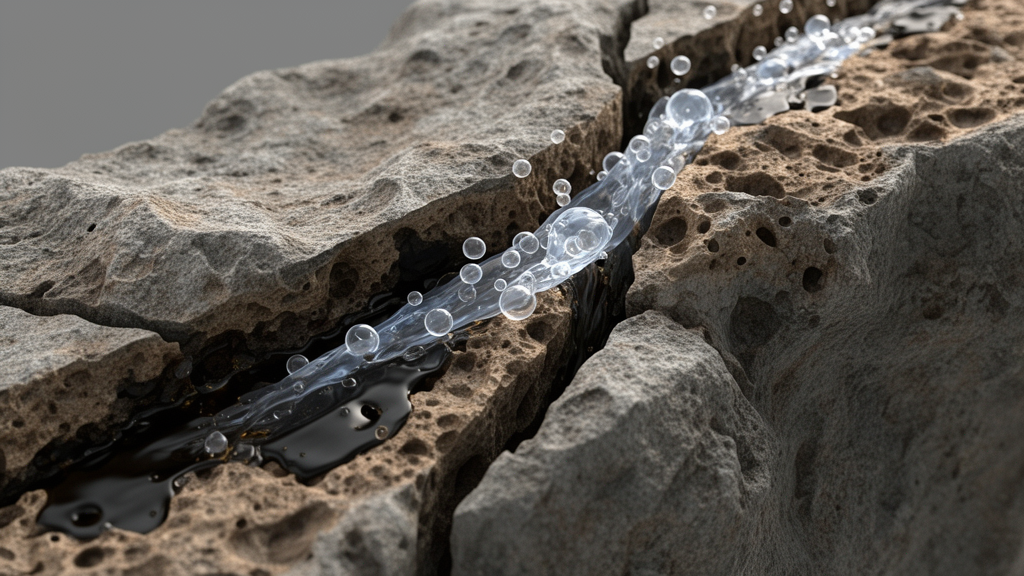
Researchers have developed numerical simulations to investigate the movement of immiscible supercritical carbon dioxide and oil within a single rough rock fracture. Published in the journal Geomechanics and Geophysics for Geo-Energy and Geo-Resources, the study addresses the complex fluid dynamics that occur during carbon dioxide fracturing-based oil displacement. The work distinguishes between transient and steady-state flow regimes, providing a detailed mechanistic understanding of how these two phases interact in the irregular geometry of natural rock fractures.
To accurately simulate the behavior of the fluids, the team developed temperature- and pressure-dependent models for the density and viscosity of scCO2. These models were then incorporated into numerical simulations to capture the transient and steady-state immiscible flow of scCO2 and oil. By systematically varying parameters such as fracture aperture, fractal dimension, contact angle, and injection pressure, the researchers were able to isolate the dominant factors controlling the migration of the fluid interface.
During the transient stage of the simulation, the study revealed the dynamic evolution of scCO2 saturation and the migration behavior of the interface between the carbon dioxide and oil. The researchers proposed an effective flow channel ratio to quantify the flow capacity of a single rough fracture. This metric allowed them to clarify how specific geometric features of the fracture, including its roughness and aperture, influence the overall ability of the fracture to transmit fluid.
In the steady-state displacement stage, the research introduced the root-mean-square value of the first-order derivative of the fracture profile as a quantitative measure of fracture roughness. This approach provided a rigorous method to analyze how the scCO2 volumetric flow rate responds to the pressure gradient under varying conditions of fracture aperture and surface roughness. The study determined the critical pressure gradient that marks the transition from linear to nonlinear flow.
To further characterize the nonlinear flow regime, the researchers developed a calculation method for the non-Darcy inertial coefficient within the Forchheimer equation. Additionally, a critical Reynolds number criterion was proposed to identify the onset of nonlinear flow for scCO2 in a single rough fracture.
The study provides theoretical support for the development of CO2-fracturing-based oil displacement technology.
Subject of Research: Transient and steady-state flow mechanisms of immiscible supercritical CO2–oil two-phase flow in a single rough rock fracture
Article Title: Transient and steady-state flow mechanisms of immiscible supercritical CO2–oil two-phase flow in a single rough rock fracture
Article References: Yang, Y., & Yao, W. (2026). Transient and steady-state flow mechanisms of immiscible supercritical CO2–oil two-phase flow in a single rough rock fracture. Geomechanics and Geophysics for Geo-Energy and Geo-Resources. https://doi.org/10.1007/s40948-026-01243-2
Image Credits: AI Generated
DOI: 10.1007/s40948-026-01243-2
Keywords: Transient, steady-state, flow, mechanisms, immiscible, supercritical, two-phase, single, rough, rock, fracture, scientific research
News Source: Denise Maddox. (November 8, 2026). Study Maps CO2-Oil Flow in Rough Rock Fractures. Scienmag.