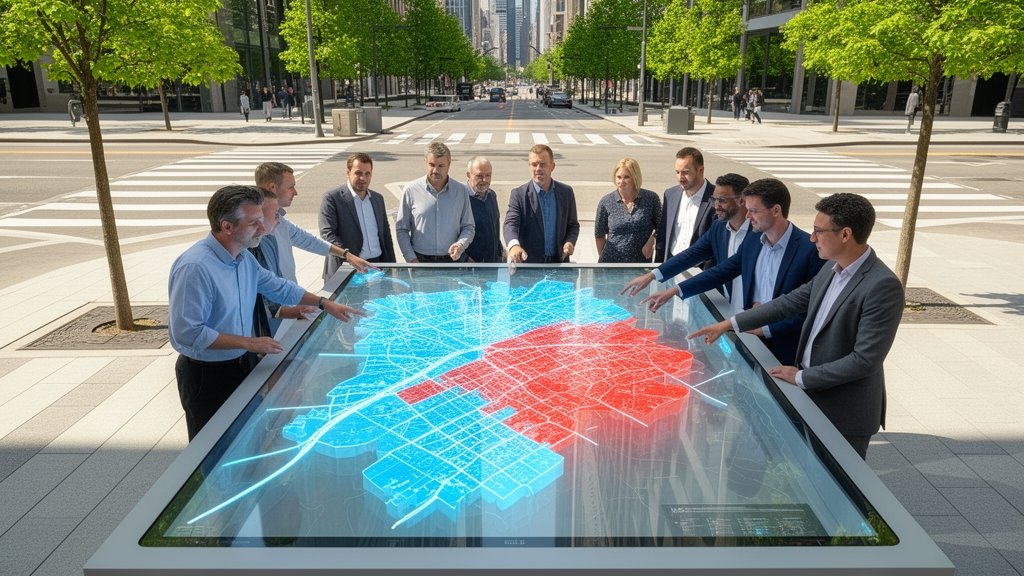
A qualitative investigation into computational urbanism argues that urban governance must transition from conventional techno-managerial control toward algorithmic stewardship to prevent municipal artificial intelligence from compounding socio-spatial disparities. Published in City and Built Environment by researcher Ehsan Dorostkar, the study demonstrates that municipal optimization platforms frequently worsen vulnerability by reducing complex social and environmental realities to narrow mathematical efficiencies. Rather than treating artificial intelligence systems as politically neutral tools that streamline resource distribution, the research characterizes emergent climate algorithms as active determinants of spatial value that routinely institutionalize historical inequalities. The analysis asserts that existing smart-city frameworks prioritize short-term performance metrics over enduring equity, effectively trading climatic justice for administrative order. To counteract this trajectory, the paper introduces algorithmic stewardship as a transformative governance paradigm designed to retool automated systems around multidimensional justice. The framework establishes that urban survival during accelerating ecological instability requires computation to prioritize restorative ethics, transparency, and collective preservation over uncritical operational efficiency.
Methodologically, the investigation is structured as a qualitative case study that synthesizes academic literature, municipal policy documentation from the Tehran Municipality and the Tehran Urban Innovation Center, and critical discourse analysis of public pronouncements regarding smart-city initiatives. The empirical inquiry centers on Tehran, a water-scarce megacity confronting severe environmental hazards, seismic risks, and accelerated urbanization. In the late 2010s, regional administrative authorities and national technical institutes introduced the Smart Tehran agenda, framing computational interventions as necessary instruments to enhance resource management, civic service delivery, and municipal effectiveness amid mounting demographic stress. By critically examining the documented deployment and social impacts of these algorithmic programs, the study bridges critical discourses surrounding techno-managerial urbanism with urban political ecology. The research establishes that computational deployments are fundamentally anchored to the prevailing political ontologies of the institutions deploying them, showing that benevolent technological systems can actively entrench distributive disparities when operating under inadequate ethical regimes.
To establish a coherent analytical foundation, the study defines urban climatic justice not merely as the equitable distribution of environmental risks and resources, but as an integrated, multidimensional construct. This architecture incorporates recognitive justice, which validates non-formalized adaptation techniques and lived environmental knowledges developed by marginalized populations. It further integrates procedural justice, which secures inclusive participation and formal veto rights for communities disproportionately exposed to climate risks within automated decision-making pipelines. In addition, the paradigm embeds intergenerational justice, which obligates municipal systems to protect long-term ecological viability and resources for future urban inhabitants. The author explains that conventional artificial intelligence operations introduce a profound temporal conflict, as their abbreviated calculation horizons frequently compromise long-term communal welfare. While municipal algorithms favor quantifiable, immediate gains in energy conservation or utility distribution, they systematically sacrifice qualitative imperatives including aquifer stability, biocultural resilience, and cultural heritage conservation across multi-decade planning horizons.
The qualitative assessment reveals this conflict clearly through an examination of Tehran’s algorithmic water governance systems. Deployed under the rubric of automated demand management, algorithmic rationing platforms optimize municipal supply continuity by prioritizing industrial facilities and high-revenue sectors while systematically restricting deliveries to peripheral, economically marginalized settlements. Although these optimization algorithms are mathematically designed to minimize conveyance losses and support municipal revenue, they effectively construct a regime of hydrological injustice that allocates scarcity according to economic productivity rather than human survival needs. Furthermore, optimization platforms manage municipal reservoir levels through calculations that prioritize short-term operational targets, accelerating the overexploitation of peripheral groundwater and compromising the biocultural resilience of ancient subterranean qanat networks. These computational sorting mechanisms are compounded by artificial-intelligence-assisted wastewater recycling initiatives in affluent northern districts, which divert critical greywater flows away from southern agricultural zones and imperil ancestral sabzeh cultivation practices.
A parallel dynamic appears within Tehran’s municipal heat-vulnerability mapping initiatives, where computational tools exhibit what the author describes as the illusion of algorithmic objectivity. By synthesizing registered property deeds with municipal infrastructure layers, these automated assessments routinely equate adaptive capacity with formal engineering integrity and real estate market value. This computational reductionism completely overlooks customary cooling strategies deployed across informal settlements, such as Khak-e Sefid, where subterranean residential quarters known as sofkeh and communal evaporative coolers sustain human habitability despite municipal neglect. As a consequence of this calculative erasure, algorithmic risk visualizations channel public investments in protective cooling infrastructure toward affluent, high-value commercial quarters while leaving historically disadvantaged neighborhoods unassisted. The study emphasizes that training computational models on records from historically segregated landscapes causes algorithms to internalize and intensify pre-existing municipal biases, validating spatial stratification under the guise of objective technical optimization.
The study also documents significant systemic distortions within municipal air-quality governance and transport regulation. Real-time emission-monitoring platforms concentrate regulatory restrictions heavily upon private vehicle commuters while consistently exempting state-affiliated industrial facilities and major infrastructural polluters from comparable oversight. A prominent manifestation of this operational asymmetry is the green traffic zone algorithm, which restricts vehicular movement based on European emission classifications. Rather than regulating structural petrochemical emissions, this algorithm effectively penalizes economically disadvantaged drivers operating older vehicles, transforming atmospheric injustice into an individualized problem of personal behavioral modification. Simultaneously, municipal air-purification models frequently optimize visual atmospheric clarity rather than achieving the authentic elimination of hazardous toxins. This administrative calculus shifts carcinogenic particulates away from affluent northern enclaves such as Niavaran toward industrialized southern suburban districts, redistributing lethal exposures across class divisions without addressing aggregate atmospheric pollution.
Synthesizing these urban dynamics, the author demonstrates that advanced disaster-management models can participate in computational necropolitics. By evaluating prospective interventions through property valuations and commercial asset protection, automated disaster-response algorithms mechanize decisions regarding which districts receive structural defense and which populations are treated as expendable during climate catastrophes. When flood-mitigation networks prioritize commercial centers over informal settlements, or when cooling investments favor glass skyscrapers over pedestrian bazaars, computational platforms enact algorithmic triage under the pretext of environmental adaptation. The author identifies this phenomenon as the algorithmic justice paradox, wherein municipal technologies reduce gross systemic risk across an entire metropolis while simultaneously concentrating vulnerability among politically marginalized communities. Rather than remaining neutral analytical mechanisms, automated platforms convert structural violence into an algorithmically necessary condition, validating technocratic privilege through performative, justice-washed metrics that obscure fundamental governance failures.
To dismantle these systemic disparities, the research outlines three transfigurative operational principles designed to govern urban computation. First, the legibility principle elevates transparency to a matter of epistemic justice, requiring that the hidden value hierarchies and socio-spatial trade-offs within climate algorithms be made fully contestable through legible, intuitive public interfaces. Second, the principle of intergenerational proxy mandates the formal integration of future generations’ ecological rights directly into computational optimization functions. Applied to depleted aquifers, this mechanism replaces consumption-maximizing code with specialized aquifer testimony modules that model ecological outcomes across fifty-year horizons, ensuring that present adaptations do not sacrifice future water sovereignty. Third, the principle of democratic immunity delineates inviolable spheres of uncomputability where automation is explicitly prohibited. These algorithmic asylum zones insulate traditional vernacular architecture, including historic badgir wind-catchers, and require manual community authority over floodgates and emergency life-safety decisions.
To translate these conceptual principles into practical administrative mechanisms, the author proposes three interconnected institutional counter-architectures. The framework introduces Algorithmic Courts of Equity, which function as permanent, publicly accessible venues where community members from neighborhoods such as Khazaneh can formally challenge discriminatory computational allocations. Through technical and legal reverse engineering, these equity tribunals can mandate the structural redesign of algorithmic parameters under the oversight of multi-stakeholder commissions. Additionally, municipal administrations must deploy Ecological Application Programming Interfaces that mandate computational platforms to ingest subaltern environmental epistemologies, such as street-level toxicity journals from asthma patients in Zafaranieh and customary dust-storm forecasts from Damavand pastoralists. Finally, the model institutes Dynamic Moral Auditing linked to a civic Climatic Bill of Rights. If automated systems violate established environmental thresholds, such as minimum breathable air standards or agricultural soil moisture baselines, these protocols trigger immediate algorithmic demotion.
Ultimately, the paper defines an extensive forward-looking research agenda focused on epistemic resistance, planetary algorithmic literacy, and post-anthropocentric custodianship. Epistemic resistance requires the systematic creation of counter-data repositories that validate localized adaptations, including microclimatic heuristics used by traditional bazaar merchants, safeguarding community methods against algorithmic data colonialism. Simultaneously, planetary algorithmic literacy seeks to develop public diagnostic interfaces that translate abstract technical outputs into visceral social consequences, such as expected respiratory hospitalizations or future water deficits. Extending stewardship beyond human actors, post-anthropocentric custodianship proposes granting formal ecological personhood to natural systems, embedding algorithmic legal representation for the Alborz watersheds and granting urban tree canopies explicit veto power over municipal planning decisions. Dorostkar concludes that computational systems will inevitably shape the future of global cities, making algorithmic stewardship an urgent structural imperative to ensure urban intelligence serves collective survival rather than technocratic subjugation.
Subject of Research: Algorithmic stewardship and climatic justice in urban artificial intelligence governance
Article Title: Algorithmic stewardship for urban climatic justice
Article References: Dorostkar, E. (2025). Algorithmic stewardship for urban climatic justice. City and Built Environment, 3(1), Article 21. https://doi.org/10.1007/s44213-025-00065-4
Image Credits: AI Generated
DOI: 10.1007/s44213-025-00065-4
Keywords: urban governance, algorithmic stewardship, climatic justice, artificial intelligence, smart cities, environmental justice, urban planning, Tehran, computational urbanism, climate adaptation, Algorithmic, stewardship
News Source: Blake Davidson. (November 8, 2026). Algorithmic Stewardship Framework Reframes Urban Artificial Intelligence for Climatic Justice. Scienmag.