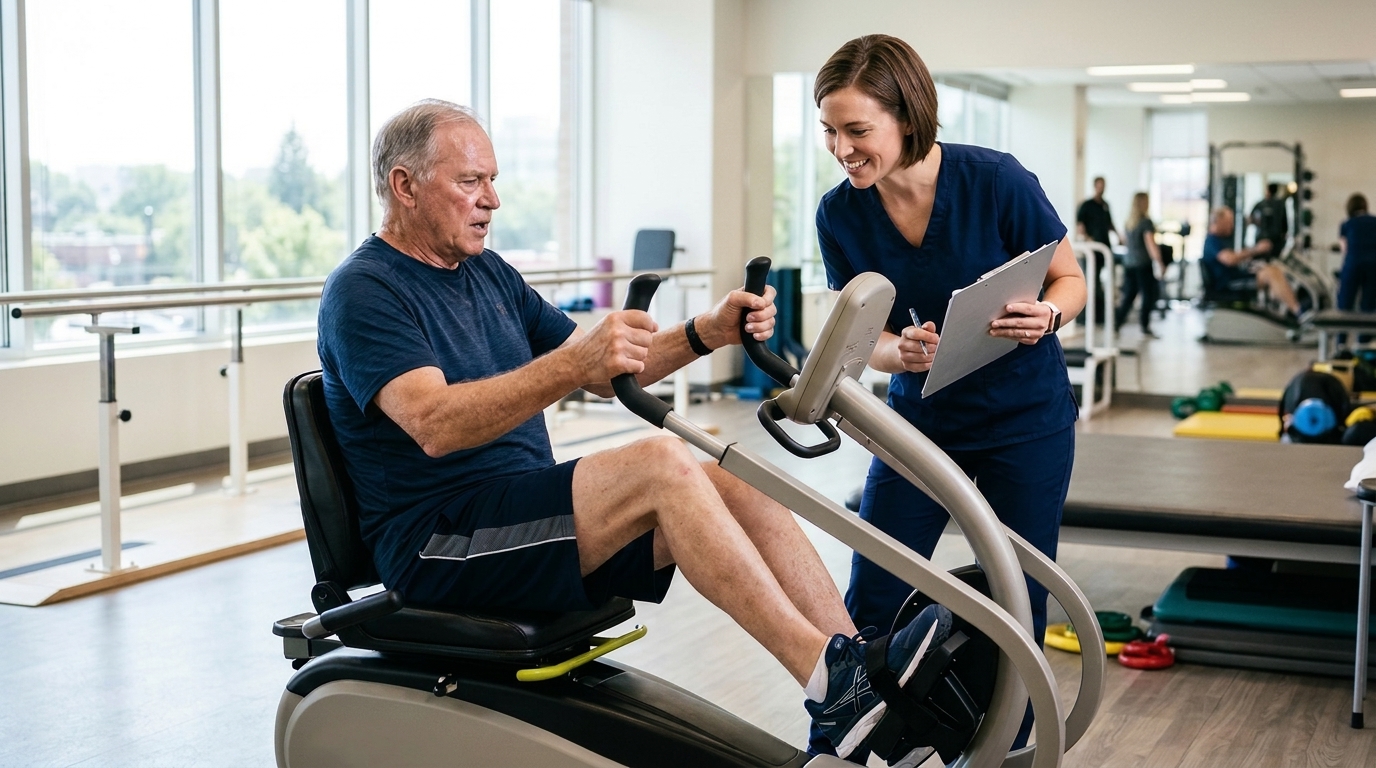
The Fitness After Stroke Trial, known as FAST, is a double-blind, two-arm, parallel-group preliminary efficacy study designed to evaluate the impact of high-intensity interval training on cardiorespiratory fitness in individuals with chronic stroke. Published in the journal Artery Research, the protocol outlines a rigorous comparison between high-intensity interval training and moderate-intensity continuous training, utilizing a total body recumbent stepper as the primary exercise modality. The study aims to address a significant gap in stroke rehabilitation by testing whether a submaximal exercise testing protocol can safely and effectively guide individualized exercise prescription, thereby overcoming the barriers associated with maximal exercise testing in clinical settings.
Cardiorespiratory fitness, typically measured as peak oxygen consumption, is a critical marker of cardiovascular health, and lower values are associated with increased risks of all-cause mortality. People who have experienced a stroke often exhibit reduced peak oxygen consumption, frequently falling below the levels of their age- and sex-matched peers. This reduction in fitness is accompanied by broader cardiovascular dysfunction, including impairments in both cerebrovascular and peripheral vascular regulation. Previous research has consistently demonstrated alterations in middle cerebral artery velocity responses to acute exercise in both subacute and chronic stroke populations, highlighting the need for targeted interventions to improve these physiological markers.
While moderate-intensity continuous training is currently recommended to improve cardiorespiratory fitness post-stroke, emerging evidence suggests that high-intensity interval training may elicit greater physiological benefits, particularly when exercise intensity is a key driver of fitness gains. However, the integration of high-intensity interval training into stroke recovery remains limited due to the reliance on maximal exercise testing for prescription, which is often not feasible in clinical settings. The FAST trial addresses this challenge by utilizing the Total Body Recumbent Stepper submaximal exercise test to predict maximal power output and heart rate, allowing clinicians to prescribe precise training intensities tailored to each individual’s capacity without requiring gas exchange analysis or maximal exertion.
The trial will enroll 50 individuals with chronic stroke, who will be stratified by lower extremity motor function and randomized to either the high-intensity interval training or moderate-intensity continuous training group. Participants will engage in exercise sessions three times per week for four weeks, using a total body recumbent stepper under one-to-one supervision. The primary outcome of the study is the estimated peak oxygen consumption from the submaximal exercise test, while secondary outcomes include middle cerebral artery velocity at rest and during exercise, flow-mediated dilation, and pulse wave velocity. Tertiary outcomes will assess walking speed and distance, providing a comprehensive view of both physiological and functional improvements.
For the high-intensity interval training group, the protocol consists of repeated one-minute high-intensity bouts alternated with one-minute active recovery bouts for a total of 25 minutes. The high-intensity phase is initially prescribed at 70% of peak watts, with a range of 65% to 95% to ensure that vigorous-intensity heart rates are met. In contrast, the moderate-intensity continuous training group will perform continuous exercise for 25 minutes at 55% of peak watts, with a target heart rate of 60% to 70% of maximal heart rate. Both groups will complete a five-minute warm-up and cool-down, and heart rate will be continuously monitored to ensure adherence to the prescribed intensity zones.
To ensure scientific rigor and minimize bias, the trial employs full blinding of outcome assessors and data analysts, although complete participant blinding to perceived exertion is not feasible. Participants will not be informed of the specific intervention labels or the comparative study hypotheses to reduce expectancy bias. Vascular health assessments, including flow-mediated dilation and pulse wave velocity, will be conducted in a temperature-controlled environment following strict pre-assessment instructions regarding food, caffeine, and medication. These measures provide prognostic value for cardiovascular events and offer insight into the peripheral vascular function, which is often impaired post-stroke.
Cerebrovascular hemodynamics will be assessed using transcranial Doppler ultrasound to measure middle cerebral artery velocity at rest and during an acute exercise bout. This noninvasive technique allows for the evaluation of cerebrovascular regulation, which is crucial for understanding the impact of exercise on brain health. Additionally, magnetic resonance imaging will be used to quantify global and regional cerebral blood flow, capturing spatial resolution and blood flow dynamics. These advanced imaging techniques, combined with physiological measures, will provide a detailed assessment of how different aerobic intensities influence cardiovascular and cerebrovascular function in individuals recovering from stroke.
The statistical analysis plan for the FAST trial focuses on assessing the preliminary efficacy of the interventions by calculating mean, standard deviation, and 95% confidence intervals for peak oxygen consumption at each time point. An Analysis of Covariance model will be fitted with four-week peak oxygen consumption as the response variable, adjusted for baseline values and minimization variables. The study is designed to generate directional estimates and effect size data rather than definitive efficacy, which is critical for powering a future definitive trial. Given the planned sample size, the precision of the effect estimate is sufficient for this preliminary phase, allowing researchers to determine whether the observed improvements justify further investigation.
Limitations of the study include the requirement for participants to demonstrate a minimal level of functional capacity to safely complete the initial stage of the exercise test, which may limit generalizability to individuals with the most severe motor impairments. The protocol is intended for those who can perform seated stepping exercise, reflecting safety considerations and the focus on evaluating preliminary efficacy in a population capable of engaging in structured aerobic training. Despite these constraints, the trial represents a significant step forward in stroke rehabilitation research by integrating a clinically feasible exercise testing approach with robust physiological outcomes.
The findings from the FAST trial are expected to provide critical data needed to optimize dosing strategies for high-intensity interval training post-stroke. By demonstrating the feasibility and preliminary efficacy of using a submaximal exercise test to guide prescription, the study aims to expand the clinical usability of such tools in rehabilitation settings. The development of web-based calculators and open-access packages to assess intensity attainment further supports the clinical translation of these exercise strategies, offering practical resources for healthcare professionals implementing post-stroke exercise programs.
As the trial progresses, the data collected will contribute to a deeper understanding of the physiological mechanisms underlying exercise-induced improvements in stroke recovery. The integration of cerebrovascular and peripheral vascular outcomes alongside functional measures provides a comprehensive framework for evaluating the benefits of different exercise intensities. This approach not only advances scientific knowledge but also offers a scalable and physiologically grounded protocol that can be adapted for use with other modalities, such as cycle ergometers, in settings where recumbent steppers are not available.
The FAST trial underscores the importance of individualized exercise prescription in stroke rehabilitation, moving beyond generic recommendations to tailor interventions based on individual physiological responses. By leveraging validated submaximal testing protocols, the study aims to make high-intensity interval training more accessible and safe for a broader population of stroke survivors. The results will be disseminated through manuscripts and presentations, inviting collaboration and further research to refine and expand upon the initial findings, ultimately contributing to improved clinical practices and patient outcomes in stroke recovery.
Subject of Research: Preliminary efficacy of recumbent stepper high-intensity interval training for cardiorespiratory fitness in chronic stroke
Article Title: Fitness After Stroke Trial (FAST): Protocol for a Preliminary Efficacy Study of Recumbent Stepper High-Intensity Interval Training
Article References: Bartsch, B. L., Britton-Carpenter, A. J., Engler, A., Baldridge, T., Moores, A., Hazen, E. M., Montgomery, R. N., & Billinger, S. A. (2026). Fitness After Stroke Trial (FAST): Protocol for a Preliminary Efficacy Study of Recumbent Stepper High-Intensity Interval Training. Artery Research, 32(1), Article 12. https://doi.org/10.1007/s44200-026-00104-3
Image Credits: AI Generated
DOI: 10.1007/s44200-026-00104-3
Keywords: stroke recovery, high-intensity interval training, cardiorespiratory fitness, recumbent stepper, cerebrovascular function, clinical trial, exercise prescription, vascular health, Fitness, Stroke, Trial, FAST
News Source: Cassandra Pierce. (November 8, 2026). FAST Trial Tests Recumbent Stepper HIIT for Stroke Recovery. Scienmag.