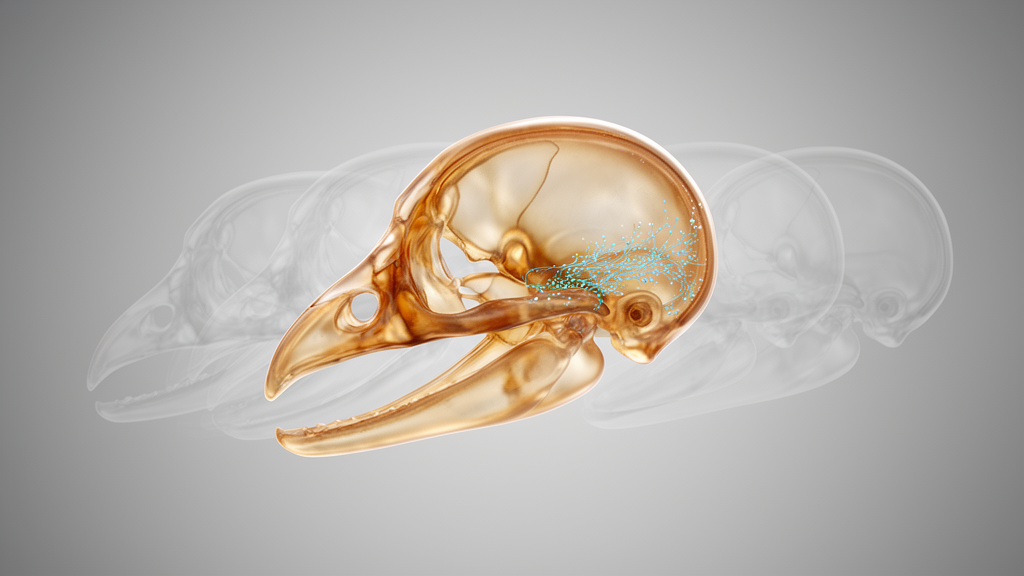
A high-resolution embryological investigation into cranial bone formation across landfowl and waterfowl has demonstrated that avian skull development frequently defies classic biological rules governing evolutionary ontogeny, specifically von Baer’s laws of animal development and Ernst Haeckel’s theory of recapitulation. Researchers led by Bassel Arnaout, Albert Chen, Benjamin Steventon, and Daniel J. Field examined micro-computed tomography scans of embryonic growth series across four species within the clade Galloanserae: chickens and Japanese quails representing Galliformes, alongside mallards and swan geese representing Anseriformes. By discretising cranial osteogenesis into five standardized morphological stages based on homologous bone ossification sequences, the study found that diagnostic features of deep evolutionary clades often emerge surprisingly late in embryonic development, overlapping directly with lineage-specific and species-specific adaptations rather than strictly preceding them.
Historic principles of comparative embryology, most notably formulated by Karl von Baer in the nineteenth century, proposed that morphological features common to a broad group of animals appear earlier in embryonic development than specialized traits unique to lower-level taxa. This concept was subsequently adapted by Ernst Haeckel into the recapitulation model, which asserted that embryonic divergence mirrors evolutionary transitions across phylogenetic history, and later refined into the developmental hourglass model, which posits increased morphological variation early in ontogeny, narrowing at a phylogenetically conserved mid-embryonic phylotypic stage before diverging again during later growth phases. In testing these long-standing developmental frameworks against late-stage tissue-level skeletal formation, the authors established that the sequence of cranial bone ossification does not align with the hierarchical breadth of phylogenetic inheritance, but instead reflects localized anatomical constraints and directional osteogenic progression.
To rigorously evaluate the timing and geometry of skeletal emergence, the research team analyzed seventy-seven fertilized eggs comprising twenty-six chicken eggs, twenty Japanese quail eggs, twenty-one mallard eggs, and ten swan goose eggs, along with seven late-stage deceased swan goose embryos obtained for comparative staging. The eggs were incubated under controlled laboratory conditions at 37.5 degrees Celsius, maintaining relative humidity at fifty percent for galliform clutches and forty-five percent for anseriform clutches. Embryos were sampled at regular intervals corresponding to the onset and maturation of skull osteogenesis, spanning from eight days of incubation in chickens and quails to eleven days in mallards and fourteen days in geese. Extracted specimens were fixed in paraformaldehyde, dehydrated through graded ethanol series, and scanned using a Nikon XTEK H 225 ST micro-CT scanner at the Cambridge Biotomography Centre, yielding high-resolution image stacks that were subsequently denoised and digitally segmented to trace individual ossification centres across developmental time.
Because existing developmental frameworks such as the Hamburger and Hamilton staging system are anchored primarily to external superficial characters that exhibit heightened interspecific divergence at later embryonic periods, the investigators formulated a five-tier skull staging framework based on the co-ossification of homologous elements across all four taxa. Skull stage one captures the earliest detectable cranial ossification, which begins at Hamburger and Hamilton stages 35 to 36 in chickens and quails, stage 36 in mallards, and stage 36 in swan geese. Across all four species, this initial phase is defined by the emergence of caudolateral elements, comprising the angular, supraangular, squamosal, and quadratojugal, alongside the rostromedially and caudolaterally oriented pterygoid. Despite the disparate adult anatomies of landfowl and waterfowl, the spatial site of ossification initiation within each element and the orientation of subsequent progression were identical across all four species, indicating a conserved spatial signalling mechanism governing early skeletal induction across Galloanserae.
Despite this conserved initial spatial induction, early elements immediately displayed distinct taxonomic divergence. In skull stage one, while the angular, supraangular, and squamosal centres appeared broadly uniform across taxa, the pterygoid exhibited pronounced lineage divergence. In galliform embryos, the dorsal side of the pterygoid formed a sheet of bone with a rostral end mediolaterally wider than its caudal end, displaying further species-level divergence as chicken pterygoids were wider rostrally than those of quails. In anseriform embryos, the rostral aspect of the pterygoid presented a lateral wedge shape with a distinct rostromedial rostral process. Furthermore, species-specific differences appeared immediately between waterfowl taxa: the mallard rostral process formed as an elongate structure curving parallel to the medial plane of the skull with a laterally curved caudal end, whereas in swan geese the rostral process was shorter and directed medially, demonstrating that species-specific traits can appear concurrently with broad clade features at the very onset of cranial ossification.
At skull stage two, characteristic clade-level skull shapes consolidated, with galliforms developing a rostrocaudally short, dorsoventrally deep, pointed beak accompanied by an enlarged orbit and shallow braincase, while anseriforms established a rostrocaudally elongate, dorsoventrally flattened bill with a broad, rounded rostral tip and narrow braincase. In the premaxillary, galliform embryos displayed a small triangular body with a fine rostral tip and ventrolaterally directed maxillary processes, whereas anseriforms produced a broad, blunt rostral tip with dorsolaterally pointing caudal margins, alongside species differences in premaxillary length between mallards and geese.
Crucially, at skull stage three, the lacrimal formed a diagnostic osteological synapomorphy uniting the phylogenetically inclusive clade Galloanserae—an apomorphically short, triangular orbital process located at its caudomedial margin—which was observed in mallards and quails.
Skull stage four, approaching pre-hatching morphology at Hamburger and Hamilton stages 40 to 44, was marked by the appearance of the mesethmoid, epiotic, and opisthotic, alongside complete ossification of the vomer, orbitosphenoid, prootic, and articular across replicates. The shared galloanseran short orbital process of the lacrimal emerged during this stage in chicken and goose replicates, confirming its delayed appearance across the clade. Clade-specific divergences appeared in the prootic, where anseriforms developed two large internal foramina and a shallow groove with three small foramina, contrasted with galliforms which possessed a single large foramen and a deep groove. Meanwhile, the vomer formed as a small, ventrally positioned oval element in Galliformes, often bifurcated caudally in chickens, but presented as a deep wedge-shaped ossification with elongate anterior and posterior sheet-like processes in Anseriformes, extending further rostrally and caudally in mallards than in geese.
At skull stage five, representing the embryonic hatching stage at Hamburger and Hamilton stages 42 to 45, all primary cranial bones were present, though notably lacking retroarticular, postorbital, and basipterygoid processes, as well as the quadrate mandibular condyles. A prominent galliform synapomorphy became clearly visible: a rostromedial foramen situated on the otic process of the quadrate. Morphological comparisons revealed that adult beak and bill shapes, including the deep bill characteristic of swan geese and the pointed beak of chickens, were fully established. However, the researchers emphasized that the relative timing of bone formation depended primarily on two mechanistic factors: the global ossification sequence of the skull and the local vector of bone growth within each individual element, rather than reflecting the phylogenetic age or hierarchical breadth of the anatomical structure as predicted by von Baer’s principles.
The study also documented developmental system drift, an evolutionary process where homologous adult anatomical structures develop through divergent developmental pathways. In swan geese, the rostral process of the pterygoid formed along a lateral-to-medial vector, whereas in mallards, it ossified in a medial-to-lateral direction, showing greater geometric disparity at initial skull stage two than at hatching stage five. To reconcile these non-linear ontogenetic patterns, the authors proposed a braiding hourglass model of developmental divergence. Rather than adhering to a strict linear accumulation of differences or an isolated mid-embryonic constriction, the braiding model envisions ontogeny as a process where degrees of morphological similarity wax and wane repeatedly across embryonic stages, driven by the dynamic interaction between conserved spatial constraints and lineage-specific developmental shifts.
Subject of Research: Avian cranial osteogenesis and embryonic developmental divergence
Article Title: Galloanseran cranial development highlights exceptions to von Baer’s laws
Article References: Arnaout, B., Brzezinski, K., Chen, A., Steventon, B., & Field, D. J. (2025). Galloanseran cranial development highlights exceptions to von Baer’s laws. EvoDevo, 16(1), Article 17. https://doi.org/10.1186/s13227-025-00253-7
Image Credits: AI Generated
DOI: 10.1186/s13227-025-00253-7
Keywords: evolutionary developmental biology, avian cranial development, Galloanserae, skull osteogenesis, von Baers laws, developmental hourglass, micro-computed tomography, synapomorphy timing, Galloanseran, cranial, development, highlights
News Source: Drew Townsend. (November 8, 2026). Bird Skull Development Study Reveals Surprising Exceptions to Historic Embryological Laws. Scienmag.