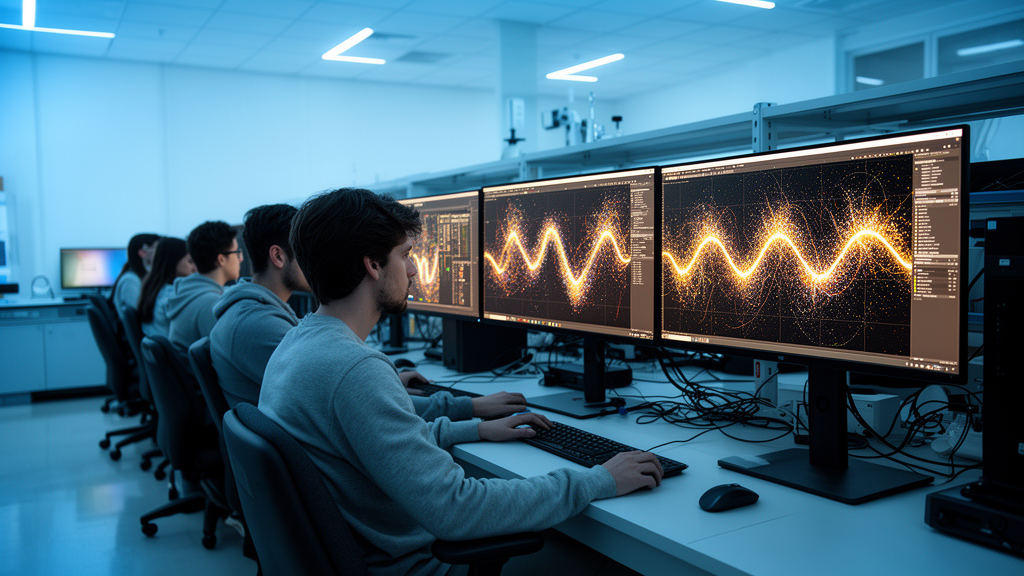
The SMARTHEP Innovative Training Network, funded through the Marie Skłodowska-Curie Actions from 2021 to 2025, has concluded its four-year mission to train twelve PhD students in the intersection of high-energy physics and industrial applications. An editorial published in EPJ Research Infrastructures on February 19, 2026, details the outcomes of this collaborative effort, which aimed to advance machine learning and real-time analysis techniques. The network sought to bridge the gap between fundamental research and commercial application by placing early-stage researchers at the center of these converging fields. The authors, including Johannes Albrecht, Laura Boggia, and Sten Åstrand, present the perspectives of students, supervisors, and external observers regarding the work conducted within the network.
The SMARTHEP network provided training enabling Early Stage Researchers to manage the data challenges of the High-Luminosity LHC. The training extended beyond the laboratory, driving innovation in sectors such as autonomous systems and finance.
The results of the network’s activities included the development of new trigger algorithms for major experiments at the Large Hadron Collider, specifically ATLAS, CMS, and LHCb. Additionally, the network contributed to improved commercial fraud detection systems, illustrating the practical utility of the research. The editorial highlights that these outcomes prove the viability of cross-sector training in producing concrete technical results that benefit both the scientific community and the private sector.
Partnerships established during the SMARTHEP period ensure the continuity of these training methods beyond the current funding cycle. The network collaborated with the EuCAIF coalition, the NextGen project, and the EPIGRAPHY COST Action to sustain the momentum of its educational and research initiatives. The editorial notes that the experience demonstrated that the gap between fundamental research and industrial application can be bridged by a shared focus on real-time analysis and machine learning.
The study, categorized as an editorial, provides a retrospective analysis of the network’s impact over its four-year duration. It does not present new experimental data or datasets, as the authors state that no datasets were generated or analyzed during the current study. Instead, the text serves as a comprehensive overview of the training outcomes and the emerging themes from the network’s experiences. The authors present perspectives concerning the added value compared to “typical” PhD positions.
Subject of Research: Training outcomes of the SMARTHEP Innovative Training Network in high-energy physics and industry
Article Title: SMARTHEP: Training PhD Students in Real-time Analysis at the LHC and in Industry
Article References: Albrecht, J., Boggia, L., Bozianu, L., Carey, A., Cocha, C., Doglioni, C., Gooding, J. A., Hansen, J., Inkaew, P., Iversen, K., Jawahar, P., Kirschenmann, H., Magdalinski, D., Ohlson, A., Olocco, M., Piñeiro Monteagudo, H., Schramm, S., Sokoloff, M., Sopasakis, A., … Åstrand, S. (2026). SMARTHEP: Training PhD Students in Real-time Analysis at the LHC and in Industry. EPJ Research Infrastructures, 10(1), Article 5. https://doi.org/10.1007/s41781-025-00155-2
Image Credits: AI Generated
DOI: 10.1007/s41781-025-00155-2
Keywords: SMARTHEP, PhD Training, Machine Learning, Real-time Analysis, High-Energy Physics, LHC, Industrial Applications, Marie Skłodowska-Curie Actions, Training, Students, Real-time, Analysis
News Source: Katie Riggs. (November 8, 2026). SMARTHEP Network Trains PhD Students in Real-time Physics Analysis. Scienmag.