Applying in-situ cathodic polarization via chronopotentiometry at −100 mA cm-2 significantly reduced the polarization resistance of CoFe2O4 spinel cathodes in solid oxide fuel cells. Over 180 minutes of cumulative activation at 800 °C, the cathode polarization resistance dropped from 24.465 Ω cm2 to 5.885 Ω cm2, achieving an overall reduction of 75.9 percent relative to the untreated state. Distribution of relaxation times analysis identified the medium-frequency response as the region exhibiting the largest change, with its normalized integrated area declining to 3.07 percent. Accompanying characterizations confirmed that this electrochemical activation modified the surface microstructure and crystal characteristics of the cathode. Field-emission scanning electron microscopy revealed a finer surface grain structure, grazing-incidence X-ray diffraction showed low-angle peak shifts, and X-ray photoelectron spectroscopy demonstrated shifts in cation distribution across tetrahedral and octahedral sites alongside an increased surface oxygen component.
Solid oxide fuel cells attract widespread interest for stationary power generation owing to their high energy-conversion efficiency compared with alternative fuel-cell platforms. However, overall electrochemical performance is governed by ionic transport through the solid electrolyte and reaction kinetics at the porous electrodes. The oxygen reduction reaction at the cathode represents a primary source of polarization loss, with conventional cathode materials displaying sluggish kinetics and elevated polarization resistance at reduced operating temperatures. Transition-metal spinel oxides have therefore been investigated as low-cost alternatives offering favorable thermal and chemical compatibility with zirconia-based electrolytes. Cobalt ferrite possesses a relatively simple formulation and straightforward synthesis while exhibiting notable cathodic activity, making it a valuable system for investigating spinel cathode electrochemistry. In these oxides, cation distribution between tetrahedral and octahedral sites directly influences electronic structures and electrochemical properties, yet systematic studies clarifying time-dependent activation behavior during cathodic polarization have previously remained scarce.
To evaluate this behavior, cobalt ferrite powder was synthesized via glycine-assisted solution combustion. Stoichiometric amounts of cobalt nitrate hexahydrate and iron nitrate nonahydrate were dissolved in 75 milliliters of deionized water to achieve a cobalt-to-iron molar ratio of 1:2. Glycine was added as a complexing agent and combustion fuel at a glycine-to-total-metal-cation molar ratio of 1.48:1, and the resulting solution was stirred at 80 °C for one hour. The mixture was subsequently placed on a hot plate at 270 °C, where evaporation triggered self-sustaining combustion to yield precursor ash. This ash was ground and calcined at 600 °C for five hours, followed by a second calcination at 1000 °C for five hours to establish the pure spinel phase. The calcined powder was then ball-milled at 200 revolutions per minute for 24 hours to ensure homogeneous particle size.
Electrochemical test cells were constructed around 8 mol% yttria-stabilized zirconia electrolyte disks. The electrolyte powder was uniaxially pressed in a 24-millimeter die at 20 megapascals for 30 seconds and sintered at 1500 °C for ten hours, producing disks that were ground to a thickness of 800 ± 10 micrometers and polished to a surface roughness of 1.0 micrometer. A screen-printing ink was prepared by dissolving ethyl cellulose in an ink vehicle at 100 °C, combining it with the synthesized powder, and homogenizing the mixture using a three-roll mill with gaps of 15 and 10 micrometers at 60 revolutions per minute. The working electrode was screen-printed onto the electrolyte using an 85 Shore A squeegee and sintered at 1000 °C for two hours in air. Platinum current-collecting grids with 0.20-millimeter line widths and 0.60-millimeter spacings were screen-printed onto the working and counter electrodes, while a concentric platinum reference ring with outer and inner diameters of 16 and 14 millimeters was deposited around the counter electrode.
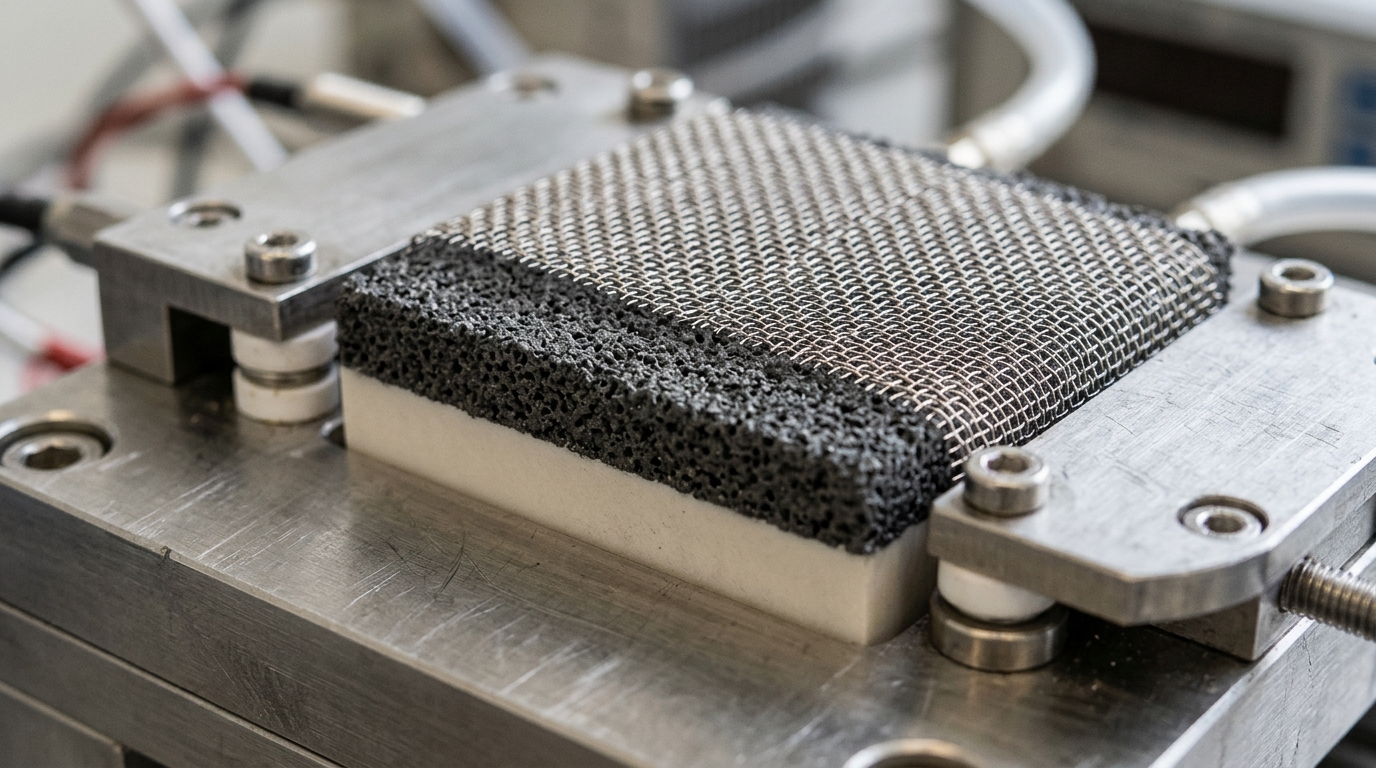
The three-electrode cell was mounted within stainless-steel and alumina fixtures, using ceramic bonding adhesive to prevent direct contact between steel elements and the cell. Inner alumina tubes featuring two-millimeter circular channels delivered air to each electrode at 100 standard cubic centimeters per minute while holding 100-mesh platinum current collectors with wire diameters of 0.07 millimeters against the surfaces. After heating to 800 °C until electrochemical stabilization occurred, measurements were executed using a potentiostat/galvanostat. Electrochemical impedance spectroscopy was performed under open-circuit conditions with a 10-millivolt perturbation amplitude from 200 kilohertz to 100 millihertz during current interruptions. Impedance spectra were fitted using an equivalent circuit containing an ohmic resistor and two parallel resistor-constant phase element loops, designated R1 + (R2||Q2) + (R3||Q3), allowing independent calculation of the area-normalized ohmic resistance RΩ = (R1)A and polarization resistance Rp = (R2 + R3)A.
Cathodic polarization was carried out using chronopotentiometry at a current density of −100 mA cm-2 in sequential intervals of 5, 10, 15, 30, and 120 minutes, generating cumulative polarization durations of 5, 15, 30, 60, and 180 minutes. When current was initially applied, the working electrode potential dropped sharply to approximately −1.06 volts and then recovered to −0.97 volts during the first polarization interval. Over subsequent steps, the polarization potential shifted toward less negative values, moving from −0.83 to −0.58 volts in the final 120-minute step and signaling a decrease in cathodic overpotential. Electrochemical impedance showed a substantial, continuous decline in polarization resistance, falling from 24.465 Ω cm2 in the untreated state to 17.485 Ω cm2 at 5 minutes, 13.397 Ω cm2 at 15 minutes, 10.189 Ω cm2 at 30 minutes, 7.881 Ω cm2 at 60 minutes, and 5.885 Ω cm2 at 180 minutes. The rate of reduction was most rapid during initial intervals, while the ohmic resistance remained restricted within a narrow range between 1.647 and 2.412 Ω cm2 throughout testing.
Distribution of relaxation times analysis was applied to the impedance spectra recorded at 0, 15, and 180 minutes of cumulative activation using Tikhonov regularization in the DRTtools program. The analysis revealed that the most prominent suppression of polarization losses occurred in the medium-frequency range between 100 and 10000 hertz. The integrated DRT area across the 100 to 100000 hertz span, normalized to the untreated state, shrank to 23.30 percent after 15 minutes and dropped further to 3.07 percent after 180 minutes of polarization. In earlier investigations of cobalt ferrite cathodes, this intermediate frequency response has been associated with surface-related phenomena, including oxygen adsorption, dissociation, surface diffusion, and charge-transfer events. Because several electrochemical steps may coincide within this frequency regime, the authors noted that DRT profiles alone cannot isolate a single elementary reaction mechanism responsible for the overall reduction in polarization resistance.
Surface morphology was examined before and after activation using field-emission scanning electron microscopy operated at an accelerating voltage of 5 kilovolts. Micrographs showed that 180 minutes of cathodic polarization produced a finer surface microstructure containing a larger population of small grains across different imaging magnifications. Apparent surface grain sizes were quantified from the micrographs by manually tracing individual grain boundaries in ImageJ to calculate equivalent circular diameters from measured grain areas. Ten grains were evaluated for the untreated electrode and thirteen grains were evaluated for the activated electrode. The average apparent grain size in the untreated sample measured 1.957 ± 0.692 micrometers, whereas the average value dropped to 1.052 ± 0.272 micrometers after 180 minutes of activation, representing an apparent size decrease of 46.2 percent. The authors suggested that this morphological refinement could increase the accessible surface area and active sites for the oxygen reduction reaction.
Grazing-incidence X-ray diffraction was performed using copper K-alpha radiation over a two-theta range from 10° to 80° at an incidence angle of 1° to assess crystal structure changes. The characteristic reflections of the cubic spinel structure were maintained after activation without the appearance of secondary crystalline phases. However, peak shifts were observed across multiple reflections. The primary (311) reflection shifted from 35.503° to 35.402°, corresponding to a 0.101° decrease in two-theta, an interplanar spacing increase from 2.527 to 2.533 angstroms, and a calculated apparent lattice parameter change from 8.379 to 8.402 angstroms. Shift behavior varied among reflections: the (111), (220), (400), and (440) reflections shifted to lower diffraction angles, while the (511) reflection shifted toward a higher angle, moving from 57.083° to 57.128°. Because peak shifts were non-identical across crystallographic planes, the authors emphasized that the calculated parameter represents an apparent value rather than uniform lattice expansion, reflecting near-surface structural adjustments tied to defect chemistry and oxygen non-stoichiometry.
X-ray photoelectron spectroscopy was employed to probe near-surface electronic states, calibrating binding energies against adventitious carbon at 284.6 electronvolts using Shirley backgrounds and GL(30) line shapes. Spectral deconvolution of cobalt 2p and iron 2p spectra demonstrated redistributions between octahedral and tetrahedral sites: cobalt divalent octahedral contributions decreased from 87.62 to 79.28 percent as tetrahedral contributions rose from 12.38 to 20.72 percent, while iron trivalent octahedral contributions increased from 69.57 to 72.43 percent. The cobalt-derived apparent inversion degree fell from 87.62 to 79.28 percent, and the iron-derived inversion degree decreased from 60.87 to 55.14 percent; the authors noted that these disparate values reflect model dependency rather than a single quantitative distribution. In oxygen 1s spectra, the surface oxygen component expanded from 13.29 to 36.87 percent while lattice oxygen contracted from 86.71 to 63.13 percent, indicating modifications to the surface oxygen environment. The researchers underscored that these morphological, diffraction, and chemical shifts occurred concurrently rather than establishing isolated mechanistic causation, and noted that the long-term stability of the activated state requires future investigation.
Subject of Research: Electrochemical cathodic activation of cobalt ferrite spinel cathodes for solid oxide fuel cells
Article Title: Reduced polarization resistance of CoFe2O4 cathodes via in-situ cathode activation for solid oxide fuel cells
Article References: Park, S., Wang, H., & Li, O. L. (2026). Reduced polarization resistance of CoFe2O4 cathodes via in-situ cathode activation for solid oxide fuel cells. Frontiers in Chemistry, 14, Article 2007035. https://doi.org/10.3389/fchem.2026.2007035
Image Credits: AI Generated
DOI: 10.3389/fchem.2026.2007035
Keywords: solid oxide fuel cells, cobalt ferrite, cathodic polarization, polarization resistance, spinel cathode, distribution of relaxation times, surface microstructure, X-ray photoelectron spectroscopy, Reduced, polarization, resistance, CoFe2O4
News Source: Victoria Harrison. (November 8, 2026). Cathodic Polarization Substantially Reduces Cobalt Ferrite Cathode Resistance in Fuel Cells. Scienmag.