Hydrogen is the smallest atom in the universe, and that very smallness has made it one of the most frustratingly elusive subjects in materials science. For decades, researchers have known that hydrogen can slip inside metal alloys and, in some cases, quietly undermine their strength, causing pipelines and storage tanks to crack without warning. Yet actually seeing where individual hydrogen atoms sit within a metal crystal has remained out of reach. Now, a team at the University of Sydney reports the first direct observation of hydrogen dissolved in the tiny spaces between metal atoms, a milestone the researchers describe as a long-sought goal for the field.
The findings, published in Nature, focus on the three states in which hydrogen can exist inside a metal: bound into compounds called hydrides, trapped at defects such as dislocations and grain boundaries, or dissolved in the interstitial gaps between the atoms of the crystal lattice itself. The first two states had been observed experimentally before. The third, although predicted by theory, had proved extremely difficult to capture directly, because hydrogen atoms are both tiny and highly mobile, slipping away from instruments during sample preparation.
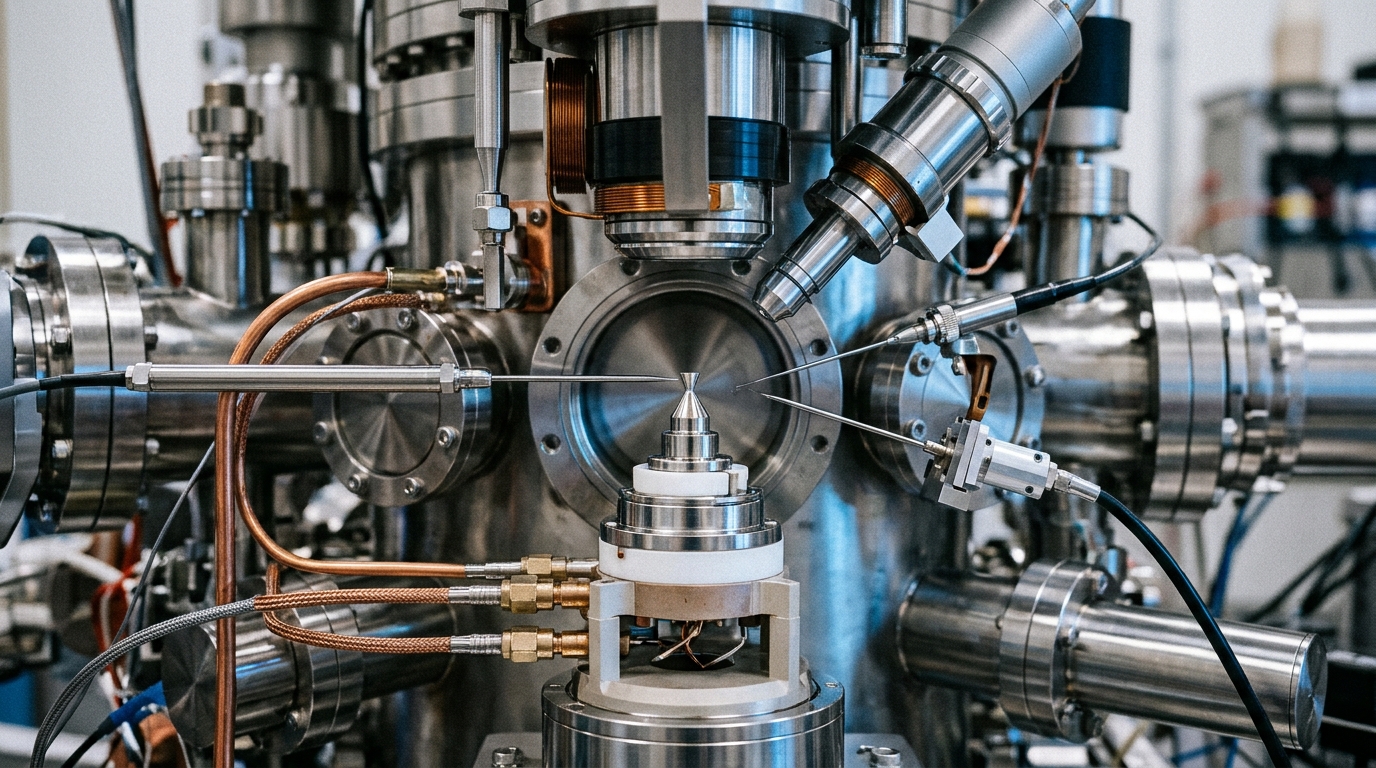
Led by Professor Julie Cairney of the School of Aerospace, Mechanical and Mechatronic Engineering and the Australian Centre for Microscopy and Microanalysis, the team overcame this problem with a clever substitution. Rather than trying to image hydrogen itself, they swapped it for deuterium, the heavier isotope of hydrogen, in several metallic alloys. Using cryogenic atom probe tomography, a technique that chills samples to preserve volatile atoms, they mapped the three-dimensional distribution of the deuterium inside the metals. The low-temperature preparation minimised the loss of the isotope during sample making, making the internal distribution far easier to study.
The maps revealed something striking: the deuterium did not simply cluster at imperfections. Instead, it accumulated preferentially in particular regions of the alloys, showing that the arrangement and chemical composition of the surrounding metal atoms influence where dissolved hydrogen chooses to reside. When the researchers combined these maps with atomic-resolution electron microscopy and theoretical calculations, they verified that the hydrogen was present in an interstitial state, sitting between metal atoms in solid solution, rather than only being trapped at defects.
That distinction matters because it changes how scientists think about the earliest stages of hydrogen damage. Until now, observations had largely captured hydrogen gathered at imperfections in the metal, the places where cracks are most likely to begin. The new results show that hydrogen also occupies the ordinary spaces of a seemingly perfect lattice, and that its preferred locations depend on the local chemistry and geometry of the atomic environment. Understanding that behaviour is a step toward understanding how hydrogen moves through metals, where it collects, and how it may contribute to damage in pipelines and storage equipment.
The practical stakes are considerable. Hydrogen is widely expected to play a central role in a cleaner energy future, but storing and transporting it safely remains an unsolved challenge. When hydrogen enters metal pipelines and storage vessels, it can make otherwise strong materials prone to unexpected cracking, a phenomenon known as hydrogen embrittlement. To reduce that risk, engineers need to know how much hydrogen enters a metal, where it goes, and how it interacts with the structure from within. The Sydney team’s technique offers, for the first time, a way to answer those questions at the atomic scale.
“By identifying not only where hydrogen accumulates, but also why it prefers particular atomic environments, we can gain a deeper understanding of its fundamental behaviours in metals,” Professor Cairney said. “This understanding is essential for developing safer and more reliable materials for hydrogen storage and transport, helping to lay the scientific foundations for future hydrogen energy technologies.”
The study’s first author, Dr Chao Huang, a postdoctoral researcher who recently completed his PhD in the Faculty of Engineering, said the discovery builds on years of research in Professor Cairney’s team. “This work studies how hydrogen exists in metals and how its various states affect its performance,” he said. The next step, he explained, is to understand how hydrogen inside metals affects the way they deform and perform under stress, work the group is already pursuing through research on ultra-high-strength steels. “Ultimately, we hope to use these insights to develop stronger, more hydrogen-resistant steels for real-world engineering applications,” Dr Huang said.
The researchers emphasise that the work is a foundation rather than a finished solution. The observations were made in several metallic alloys under laboratory conditions, using deuterium as a stand-in for hydrogen, and the team notes that the immediate contribution is a verified picture of where dissolved hydrogen sits, not yet a recipe for new materials. Even so, the ability to see interstitial hydrogen directly should help guide the design of stronger, more hydrogen-resistant alloys, and the University of Sydney presents the work as an example of how long-term investment in advanced microscopy infrastructure can enable discoveries relevant to emerging energy technologies.
As hydrogen becomes increasingly important to clean energy transitions, understanding its behaviour at the atomic scale will be essential for developing materials that perform safely and reliably in hydrogen-rich environments, Professor Cairney said. The research, published under the DOI 10.1038/s41586-026-11238-4 with no declared competing interests, brings together expertise in materials science, electron microscopy and atom probe analysis. For a problem that has challenged metallurgists for generations, the answer, it turns out, was hiding in the smallest spaces imaginable.
Subject of Research: Direct observation of interstitial hydrogen dissolved in metal lattices using cryogenic atom probe tomography
Article Title: Breakthrough enables scientists to observe hydrogen between metal atoms
Article References: Breakthrough enables scientists to observe hydrogen between metal atoms. Original publication (Bibliographic details unavailable.)
Image Credits: AI Generated
DOI: Not provided
Keywords: hydrogen embrittlement, atom probe tomography, deuterium, metal alloys, interstitial hydrogen, hydrogen storage, cryogenic microscopy, materials science, hydrogen energy, steel, crystal lattice, University of Sydney
News Source: Denise Maddox. (November 8, 2026). Scientists finally see hydrogen hiding between metal atoms. Scienmag.