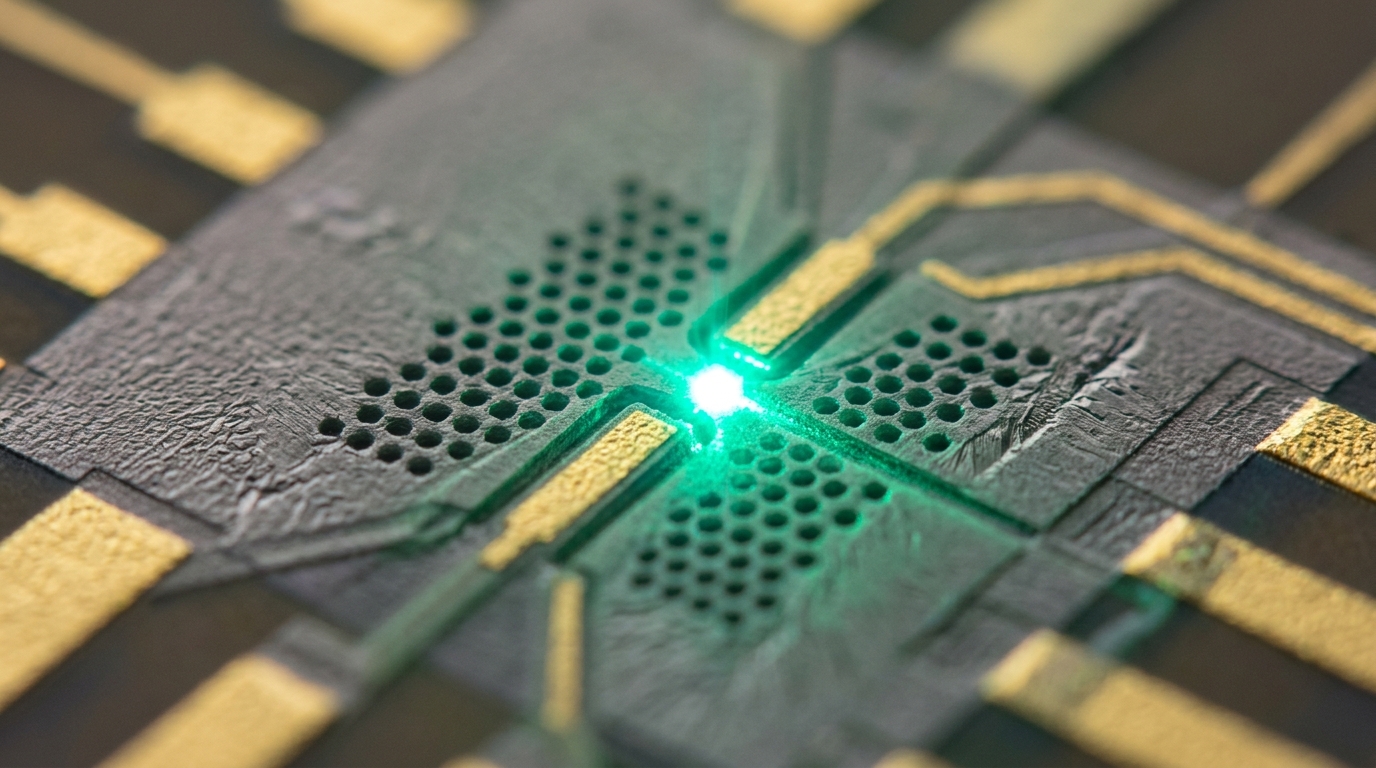
In an experimental advance for optoelectronics, researchers have demonstrated an electrically pumped 940-nanometer laser based on an optimized bound state in the continuum microcavity. Reported in Frontiers of Optoelectronics, the study achieves a measured quality factor of 1.1776 times 10 to the fourth power, representing a two-order-of-magnitude enhancement over an unoptimized cavity on the same footprint. Bound states in the continuum, or BICs, offer an attractive framework for light confinement because they theoretically possess infinite radiative lifetimes without leakage. To overcome this limitation, the authors systematically investigated two structural strategies to suppress finite-size boundary disruptions: a reflective boundary photonic crystal design and a continuously graded lattice architecture.
Planar photonic crystal cavities have attracted widespread interest for their ability to tailor electromagnetic dispersion and control light-matter interactions. However, conventional laser cavities relying on Fabry-Pérot reflections face severe intrinsic trade-offs that make it difficult to simultaneously achieve a high quality factor, a narrow emission linewidth, and high output power. Furthermore, existing efforts to improve conventional photonic crystal lasers typically require complex architectures, such as multiple nested periodic lattices or irregular, asymmetric unit cells. Manufacturing such structures demands stringent nanofabrication tolerances that are challenging to reproduce reliably. In contrast, lasers exploiting bound states in the continuum require only a single periodic lattice, intrinsically supporting theoretically infinite quality factors without out-of-plane radiation loss. This mechanism simplifies fabrication complexity while offering strong optical confinement.
Under idealized mathematical conditions, bound states in the continuum manifest as localized states residing stably within an open radiation continuum without radiative decay. Because a perfect bound state exhibits zero coupling to radiation modes, out-of-plane leakage is eliminated, yielding an infinite theoretical quality factor while lowering the pumping threshold and narrowing the spectral linewidth. Nevertheless, true bound states require an infinite periodic lattice, which cannot be realized in practical devices. Early investigations by Kodigala and colleagues across array sizes from eight-by-eight to twenty-by-twenty periods confirmed that quality factors drop rapidly as the lattice footprint decreases. Subsequent efforts to preserve bound states required macroscopically large structures spanning centimeters, complex reciprocal-space matching techniques, or sub-wavelength resonator models. Consequently, prior demonstrations were largely limited to optically pumped devices or terahertz emitters near three terahertz, leaving electrically driven bound-state lasers in the optical domain unrealized.
To quantitatively analyze how physical truncation degrades cavity performance, the authors simulated two-dimensional square-latticed photonic crystal membranes. In an infinite, periodic structure with periodic boundary conditions, the lowest energy band at the central Gamma point displays a localized standing wave pattern characteristic of an ideal bound state. Examining resonance behavior as a function of air-hole radius demonstrated that the quality factor reaches a sharp maximum at an optimal radius of 105 nanometers, dropping rapidly when the radius deviates from this value. When the simulation domain was constrained to finite lattices, the quality factor experienced a dramatic reduction as the number of periods, N, decreased from infinity down to five. While an infinite crystal exhibited a calculated quality factor of 5.8 times 10 to the twelfth power, the quality factor dropped to 9.2 times 10 to the third power for N equals 40, to 186 for N equals 11, and to 30.5 for N equals 5.
The physical cause of this performance collapse stems from the disruption of ideal destructive interference at the outer physical boundaries. In an infinite lattice, radiation into out-of-plane channels is completely suppressed through destructive interference and precise phase matching. When a finite boundary abruptly truncates the lattice, spatial Fourier transformation introduces auxiliary wavevector components that scatter the localized mode into radiative channels. Mathematically, the effective wavevector of the truncated cavity shifts away from the ideal bound-state wavevector by an out-of-plane leakage perturbation term, coupling energy into the vertical continuum. As system dimensions shrink, this edge mismatch becomes proportionally more dominant, driving severe boundary scattering and vertical leakage. Across finite dimensions, the quality factor follows a power-law scaling relationship proportional to N raised to an exponent alpha, reflecting how confinement improves as the interior core becomes isolated from outer edge perturbations.
To counteract boundary-induced radiative losses, the researchers formulated their first engineering solution: a dual-region reflective boundary photonic crystal cavity. In this planar configuration, the active optical resonator comprises a central core region, designated as Region A, consisting of an eleven-by-eleven square lattice supporting the target bound state. Surrounding this central core is a secondary photonic crystal boundary, designated as Region B, engineered to serve as a reflective cladding that confines the optical field laterally. The band structure of Region B was designed so that its complete photonic bandgap precisely overlaps the operational frequency of Region A’s bound state at 300.6 terahertz. To prevent lattice mismatch along the boundary between the two zones, the surrounding crystal was engineered with anisotropic lattice parameters: it maintains an identical lattice constant of 317.8 nanometers parallel to the interface, while featuring an expanded lattice constant of 335 nanometers perpendicular to the interface.
Quantitative numerical analysis confirmed that this reflective cladding architecture neutralizes boundary truncation. At the resonance frequency of 300.6 terahertz, the simulated quality factor of the composite eleven-period cavity reached a peak value of 13,974, delivering nearly a two-order-of-magnitude enhancement over the bare eleven-by-eleven structure, which exhibited a quality factor of only 186. The authors attributed this enhancement to two complementary mechanisms: first, the complete bandgap of the surrounding lattice acts as a soft reflective barrier that smoothly redirects outgoing waves back into the central core rather than causing abrupt truncation; second, the smooth interface eliminates structural discontinuities, fostering adiabatic wave adaptation that minimizes interface scattering. Furthermore, the simulation demonstrated robust spectral scalability, showing that adjusting the in-plane lattice parameters systematically shifts the resonant emission frequency while preserving high optical confinement.
As a second methodology for mitigating finite-size truncation, the researchers analyzed a graded photonic crystal cavity designed to provide smooth, adiabatic mode transitions. In this structure, the radii of adjacent air holes vary systematically from the core outward according to an arithmetic stepping relation where each successive hole radius equals the prior radius plus an incremental shift, delta r. As delta r was increased up to an optimal step of positive 8 nanometers, the cavity quality factor rose monotonically by three orders of magnitude, reaching a maximum simulated value of 92,091. Concurrently, the effective mode area contracted to a minimum, confirming that a positive structural gradient establishes a buffer layer that tightly isolates the optical field within the cavity center.
The physical origin of this quality factor enhancement in graded structures was elucidated by contrasting the optical dispersion characteristics of smaller and larger air-hole radii. Band structure calculations comparing hole radii of 100 nanometers and 110 nanometers revealed that increasing the hole dimensions shifts the fundamental energy bands upward while significantly flattening the dispersion curve around the Gamma point where group velocity approaches zero. A flatter band curve indicates stronger spatial localization, making it more difficult for electromagnetic energy to escape into the radiation continuum. In the reciprocal-space modal distribution, the optical field at larger hole radii transforms into an elliptical profile concentrated within the high-index dielectric medium. From a wavevector perspective, the spatial modulation introduced by the graded hole radius contributes an additional momentum compensation term whose sign opposes the out-of-plane radiative leakage vector, directly cancelling the boundary perturbation. Conversely, a negative radius gradient of negative 3.5 nanometers caused the optical field to spread across the cavity, producing severe edge scattering and a sharp drop in quality factor.
Although the graded crystal architecture yielded an exceptionally high theoretical quality factor exceeding 90,000, fabricating such a design requires maintaining dimensional variations of 8 nanometers across adjacent periods, exceeding the reliable process margins of electron-beam lithography. Consequently, the research team selected the reflective boundary architecture for device fabrication. Processing began with spin-coating ZEP520 electron-beam resist onto the substrate, followed by a three-step aligned electron-beam lithography sequence to define the mesa geometry, write the photonic crystal air-hole arrays, and pattern electrical contact electrodes. Sidewall profiles and hole geometries were controlled using optimized reactive ion etching protocols to ensure optical fidelity across both lattice regions. Vertical optical feedback and electrical injection were achieved by integrating distributed Bragg reflector stacks provided by Vertilite Company Limited, consisting of alternating quarter-wavelength dielectric layers forming p-doped top and n-doped bottom mirrors. By engineering fewer pairs in the upper mirror, laser emission was directed predominantly through the top surface.
Experimental characterization was performed using an optical testing apparatus featuring a three-axis translation mount, a precision current source capable of one-picoampere and one-hundred-nanovolt resolution, and dual measurement channels connected to a power meter and an optical spectrum analyzer. Under electrical injection, the fabricated 940-nanometer laser exhibited single-mode emission characterized by a signal-to-noise ratio of 38.6 decibels, determined relative to the secondary emission peak while background optical feedback remained suppressed below 45 decibels. The experimentally measured cavity quality factor reached 11,776, standing as the highest reported value for an electrically pumped, simple-structured photonic crystal microcavity without nested lattices or irregular unit cells. Notably, while previous bound-state lasers operated at 1550 nanometers under optical pumping or required lateral dimensions spanning thousands of nanometers, this device demonstrated efficient electrical operation at 940 nanometers within a compact lattice period of 317.8 nanometers. The underlying experimental datasets remain available from the authors upon reasonable request, establishing a scalable foundation for high-coherence integrated photonic sources.
Subject of Research: Electrically pumped photonic crystal bound states in the continuum lasers
Article Title: Performance optimization of planar photonic crystal bound states in the continuum cavities: mitigating finite-size effects
Article References: Hao, R., Ye, B., Xu, J., & Zou, Y. (2025). Performance optimization of planar photonic crystal bound states in the continuum cavities: mitigating finite-size effects. Frontiers of Optoelectronics, 18(1), Article 3. https://doi.org/10.1007/s12200-025-00147-5
Image Credits: AI Generated
DOI: 10.1007/s12200-025-00147-5
Keywords: photonic crystals, bound states in the continuum, semiconductor lasers, quality factor, optical cavities, distributed Bragg reflectors, finite-size effects, electron-beam lithography, Performance, optimization, planar, photonic
News Source: Denise Maddox. (November 8, 2026). Engineers Build Electrically Pumped Microcavity Laser by Mitigating Finite Size Effects. Scienmag.