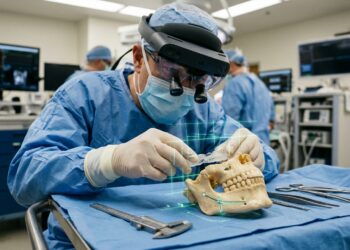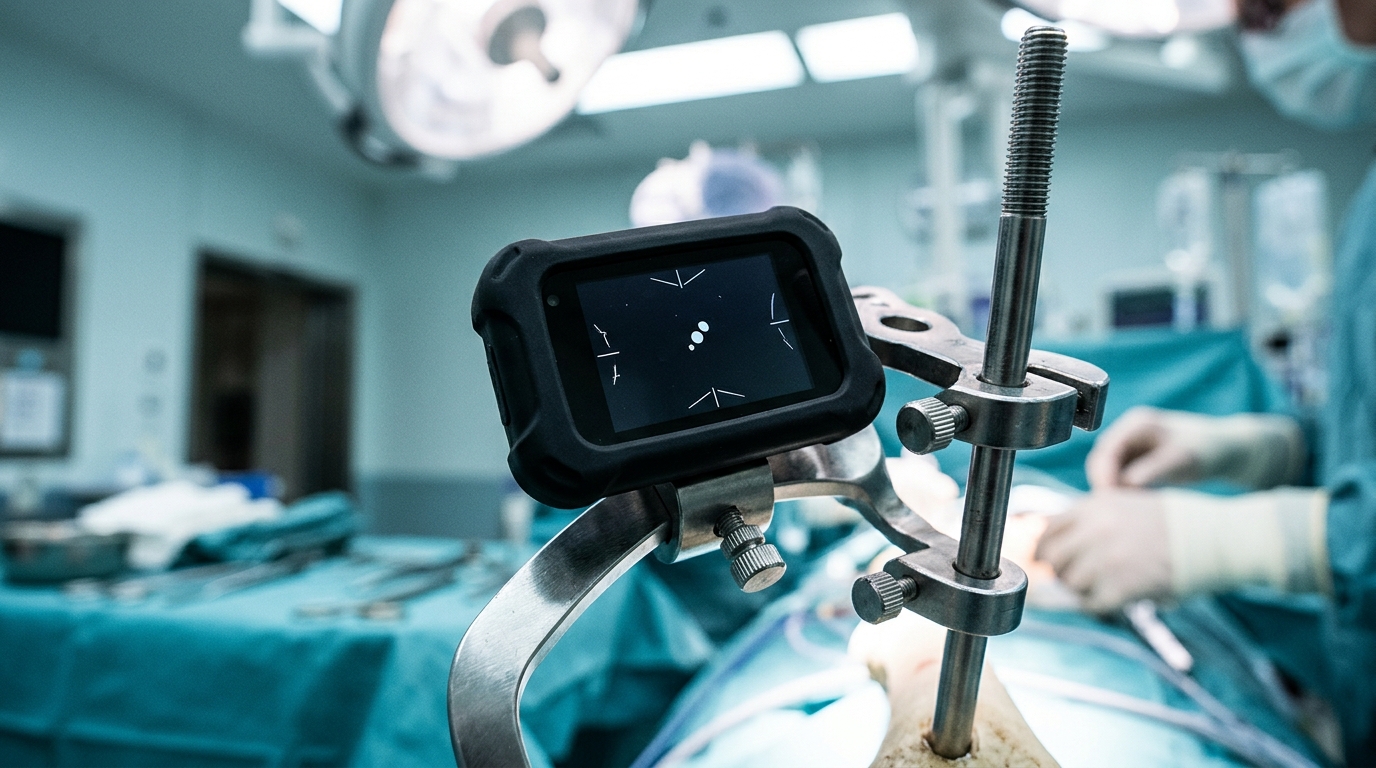
A commercially available smartwatch has been used as a pelvic tracking device during total hip replacement surgery, in what researchers describe as the first clinical application of a consumer wearable in this role. In a preliminary study of 30 hips in 27 patients, a smartwatch fixed to the pelvis communicated with a smartphone-based augmented reality navigation system, allowing surgeons to monitor the orientation of the acetabular cup in real time without keeping a pelvic reference marker continuously in the camera’s view. Navigation was completed successfully in all 30 hips, with no conversion to a backup technique.
The study, conducted at a single university hospital and published in the journal Arthroplasty, evaluated a system developed by Xelha Medical that paired an Apple Watch Series 10 with an iPhone 16e. The smartwatch was rigidly fixed to the iliac crest using two percutaneous pins and continuously transmitted orientation information derived from its gyroscope and accelerometer to the smartphone via Bluetooth. The smartphone served as the navigation platform, generating and reconstructing the functional pelvic plane and calculating radiographic inclination and radiographic anteversion in real time during cup implantation.
Accurate assessment of pelvic orientation is essential for acetabular cup placement in total hip arthroplasty. Malpositioning of the acetabular component is associated with postoperative dislocation, impingement, accelerated wear, reduced range of motion, and patient dissatisfaction. To improve the accuracy of cup placement, various computer-assisted technologies have been developed, including CT-based navigation systems, imageless navigation systems, robotic-assisted systems, and augmented reality-based navigation systems. Many of these systems use pelvic tracking devices to continuously monitor pelvic orientation throughout the procedure, because changes in pelvic position during surgery may influence cup alignment.
Conventional pelvic tracking systems generally rely on dedicated tracking hardware and optical tracking infrastructure, which may increase system complexity, equipment size, and cost. Smartphone-based augmented reality navigation systems have already demonstrated satisfactory accuracy with reduced hardware requirements and improved portability, but in conventional marker-based AR navigation the pelvic reference marker must remain within the field of view of the camera to continuously update pelvic orientation. The real-time display of radiographic inclination and anteversion relative to the current pelvic position therefore generally requires continuous recognition of the pelvic marker during cup implantation. The new system was designed to remove that constraint by using the smartwatch’s wireless orientation data instead of continuous optical visualization.
The retrospective study included 30 hips of 27 consecutive patients who underwent primary total hip arthroplasty using the smartwatch-based pelvic tracking navigation system between May 2025 and April 2026. Three patients underwent bilateral procedures, and in those cases the smartwatch was removed and refixed for the contralateral procedure as part of the sterile surgical workflow, with fixation and pelvic registration performed independently for each hip. All patients were diagnosed with hip osteoarthritis, and the cohort consisted of three men and 24 women with a mean age of 68.8 years, ranging from 53 to 84. All procedures were performed by three experienced arthroplasty surgeons using the supine anterolateral approach.
Before surgery, the smartwatch was fixed to the iliac crest and pelvic registration was performed by generating the functional pelvic plane on the smartphone using augmented reality-based registration of the bilateral anterior superior iliac spines together with gravity information from the device sensors. At the same time, the current orientation of the smartwatch was transmitted to the smartphone, which calculated and stored the spatial relationship between the registered functional pelvic plane and the smartwatch orientation. The smartwatch was then temporarily detached during surgical exposure and reattached using a dedicated fixation mechanism before cup implantation, allowing reproducible reattachment in the same predefined position and orientation relative to the pelvis.
Immediately before cup implantation, an FPP invocation procedure was performed. The smartphone recognized an augmented reality marker displayed on the smartwatch screen while simultaneously receiving the current smartwatch orientation via Bluetooth. Using the previously stored spatial relationship together with the current orientation, the smartphone reconstructed the current functional pelvic plane without repeating registration of the anterior superior iliac spines. This procedure was introduced to compensate for potential relative drift between the smartphone and smartwatch, which independently estimate their orientations and can accumulate a time-dependent relative orientation error. During clinical use, the system required FPP invocation whenever 10 minutes had elapsed since the previous invocation before navigation could continue. After reconstruction, the smartphone recognized an AR marker attached to the cup impactor and calculated inclination and anteversion relative to the reconstructed plane in real time, displaying the values simultaneously on both the smartphone and the smartwatch.
The primary outcome measures were the absolute errors of radiographic inclination and anteversion, calculated as the absolute differences between the final intraoperative navigation measurements and postoperative CT measurements obtained for all patients and evaluated with ZedHip software relative to the functional pelvic plane coordinate system. The mean absolute inclination error was 2.8 degrees with a standard deviation of 2.1 degrees, and the mean absolute anteversion error was 3.6 degrees with a standard deviation of 2.2 degrees. Postoperative CT measurements were within 5 degrees of the final intraoperative navigation measurements for inclination in 86.7 percent of hips and for anteversion in 70.0 percent of hips. The mean signed difference, defined as the postoperative CT measurement minus the final navigation measurement, was +1.05 degrees for inclination and −1.75 degrees for anteversion. Intra-observer reproducibility of the CT measurements was excellent, with intraclass correlation coefficients of 0.976 for both inclination and anteversion. No registration failure requiring repeat registration, unsuccessful FPP invocation, Bluetooth disconnection, clinically relevant data-transmission delay, or display interruption was observed, and no navigation-related intraoperative complications occurred. No postoperative dislocations, periprosthetic fractures, or surgical site infections occurred within 3 months after surgery.
Additional bench testing provided technical support for the tracking architecture. In a detach–reattach reproducibility test, the smartwatch was repeatedly detached and reattached 20 times on a fixed pelvic model, resulting in mean differences from the initial reference of −0.86 degrees for inclination and +0.10 degrees for anteversion, with maximum absolute differences of 1.4 degrees and 0.9 degrees, indicating reproducible restoration of navigation-derived orientation under controlled conditions. In a time-dependent drift test under static conditions, mean inclination differences from the initial reference before FPP invocation were 1.23, 2.03, and 2.27 degrees at 10, 30, and 60 minutes, respectively; after FPP invocation the corresponding differences fell to −0.40, 0.80, and 0.63 degrees. Anteversion differences before invocation were −0.03, 0.00, and 0.77 degrees at the same time points, and after invocation were 0.10, 0.27, and −0.13 degrees. These findings support periodic FPP invocation as a practical mechanism for limiting the influence of relative orientation drift during navigation.
The authors emphasize that the study did not include a direct comparison with other navigation systems or with freehand cup placement, so the accuracy figures should not be interpreted as demonstrating equivalence or superiority to existing techniques. The principal contribution, they write, is the demonstration of a novel smartwatch-based pelvic tracking architecture that enables intraoperative cup-orientation measurement without continuous optical visualization of a pelvic reference marker. The study also had limitations: it was a single-center retrospective study with a small exploratory sample of 30 hips from 27 patients, postoperative cup orientation was measured by a single observer, the technical validation was performed under controlled bench conditions that may not fully reproduce intraoperative conditions, continuous intraoperative pelvic orientation data were not stored, and the short follow-up period precludes conclusions regarding clinical safety and longer-term outcomes. A sensitivity analysis using one hip per patient produced similar results, with mean absolute differences of 2.62 degrees for inclination and 3.65 degrees for anteversion. Because commercially available wearable devices continue to evolve rapidly, the researchers suggest that future systems may benefit from improvements in sensor performance, wireless communication, computational power, and device miniaturization, and that wearable-based pelvic tracking may open opportunities for future investigations of intraoperative pelvic motion during hip replacement. Further studies with larger patient cohorts and comparative designs are warranted.
Subject of Research: A smartwatch-based pelvic tracking system for augmented reality navigation in total hip arthroplasty
Article Title: Smartwatch-based pelvic tracking system for augmented reality navigation in total hip arthroplasty: a preliminary clinical study
Article References: Takada, R., Inokuchi, R., Amano, Y., Yamashita, R., Yoshii, T., & Koga, H. (2026). Smartwatch-based pelvic tracking system for augmented reality navigation in total hip arthroplasty: a preliminary clinical study. Arthroplasty, 8(1), Article 82. https://doi.org/10.1186/s42836-026-00441-3
Image Credits: AI Generated
DOI: 10.1186/s42836-026-00441-3
Keywords: smartwatch, pelvic tracking, augmented reality navigation, total hip arthroplasty, acetabular cup orientation, wearable device, radiographic inclination, radiographic anteversion, functional pelvic plane, Bluetooth, consumer electronics, preliminary clinical study
News Source: Ophelia Keating. (November 8, 2026). Smartwatch Tracks Pelvis During Hip Replacement Surgery in First Clinical Test. Scienmag.