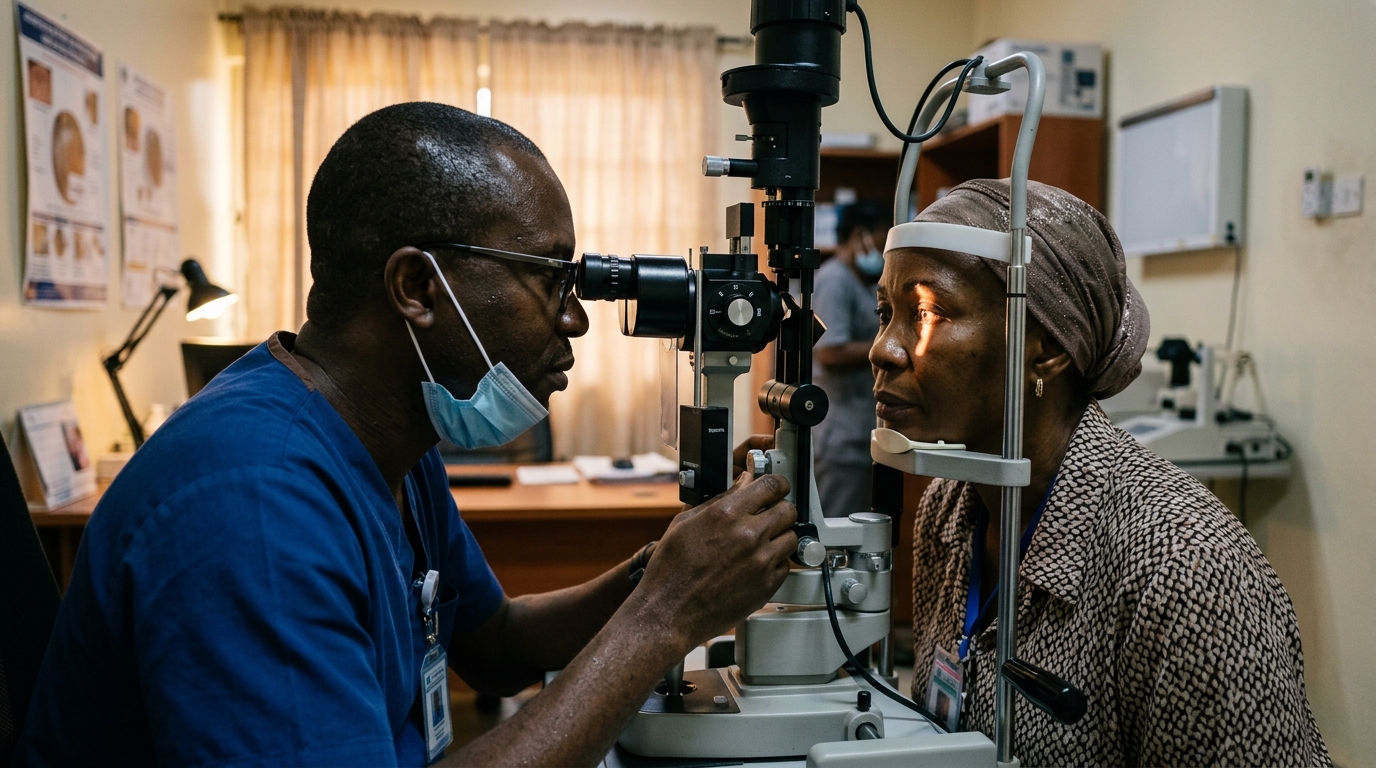
In a prospective comparative study conducted at a tertiary care facility in Kaduna, Nigeria, visual acuity trends predicted by the ocular trauma score aligned closely with observed patient recovery three months after mechanical eye injuries. Researchers evaluated Kuhn and colleagues’ ocular trauma score against actual final visual acuity, determining that predicted values and final visual outcomes did not differ significantly (p = 0.835) while displaying a statistically significant positive correlation (Spearman’s r = 0.60, p < 0.001, 95% CI [0.42, 0.74]). The findings confirm the ocular trauma score as a valuable prognostic tool for clinicians counseling patients and guiding management decisions in settings facing a high burden of trauma-induced visual impairment.
The investigation assessed the predictive performance of the ocular trauma score specifically across both open-globe and closed-globe injuries. To evaluate patients systematically, the authors classified all mechanical trauma cases in accordance with the Birmingham Eye Trauma Terminology System (BETTS). The primary study endpoint was defined as final visual acuity measured at three months following initial clinical presentation. In addition to testing the predictive value of the ocular trauma score, the study protocol analyzed the direct statistical association and correlation connecting presenting visual acuity to the final visual outcomes achieved by patients.
The study enrolled 79 patients, establishing a demographic profile characterized by a mean age of 21.16 years (standard deviation ± 12.63) and a male-to-female ratio of 2.8 to 1. Among the participants, closed-globe trauma accounted for 65.8% of cases, while 34.2% sustained open-globe injuries. Regarding timing of medical attention, approximately 31.6% of patients presented to the facility within 24 hours of their injury. Overall clinical management required medical therapy in 49.3% of the cohort, whereas 38% of patients underwent surgical intervention for their ocular trauma.
Analysis of injury mechanisms revealed that contusions formed the most prevalent diagnosis, occurring in 59.5% of cases, followed by penetrating injuries in 16.5% and ruptured globes in 13.9%. Less frequent trauma categories included lamellar lacerations, observed in 6.3% of patients, and intraocular foreign bodies, documented in 3.8%. The anatomical involvement assessed by zonal distribution showed that 30.4% of injuries were located in Zone I, 48.1% affected Zone II, and 21.5% extended into Zone III.
Initial evaluations demonstrated substantial impairment, with presenting visual acuity recorded as hand motion or worse in 48.7% of patients, compared to 23.1% presenting with visual acuity of 6/12 or better. By three months post-presentation, recovery improved such that final visual acuity reached 6/12 or better in 58% of the cohort. Presenting visual acuity showed an association (p < 0.001) and correlation (Spearman’s r = 0.53, p < 0.001, 95% CI [0.32, 0.69]) with final visual acuity.
Subject of Research: Validation of the ocular trauma score for mechanical eye injuries
Article Title: Validation of ocular trauma score as a prognosticator of visual outcomes in open and closed-globe injuries at Kaduna, Nigeria
Article References: Ndife, T. I., Saidu, A., Nasiru, M., Mohammed, A. S., & Ndife, J. C. (2026). Validation of ocular trauma score as a prognosticator of visual outcomes in open and closed-globe injuries at Kaduna, Nigeria. BMC Ophthalmology, 26(1), Article 730. https://doi.org/10.1186/s12886-026-05509-x
Image Credits: AI Generated
DOI: 10.1186/s12886-026-05509-x
Keywords: ocular trauma score, mechanical ocular trauma, visual acuity, open globe injuries, closed globe injuries, ophthalmology, prognostic tools, Kaduna Nigeria, Validation, ocular, trauma, score
News Source: Ophelia Keating. (November 8, 2026). Ocular Trauma Score Validated for Predicting Visual Recovery in Nigeria. Scienmag.