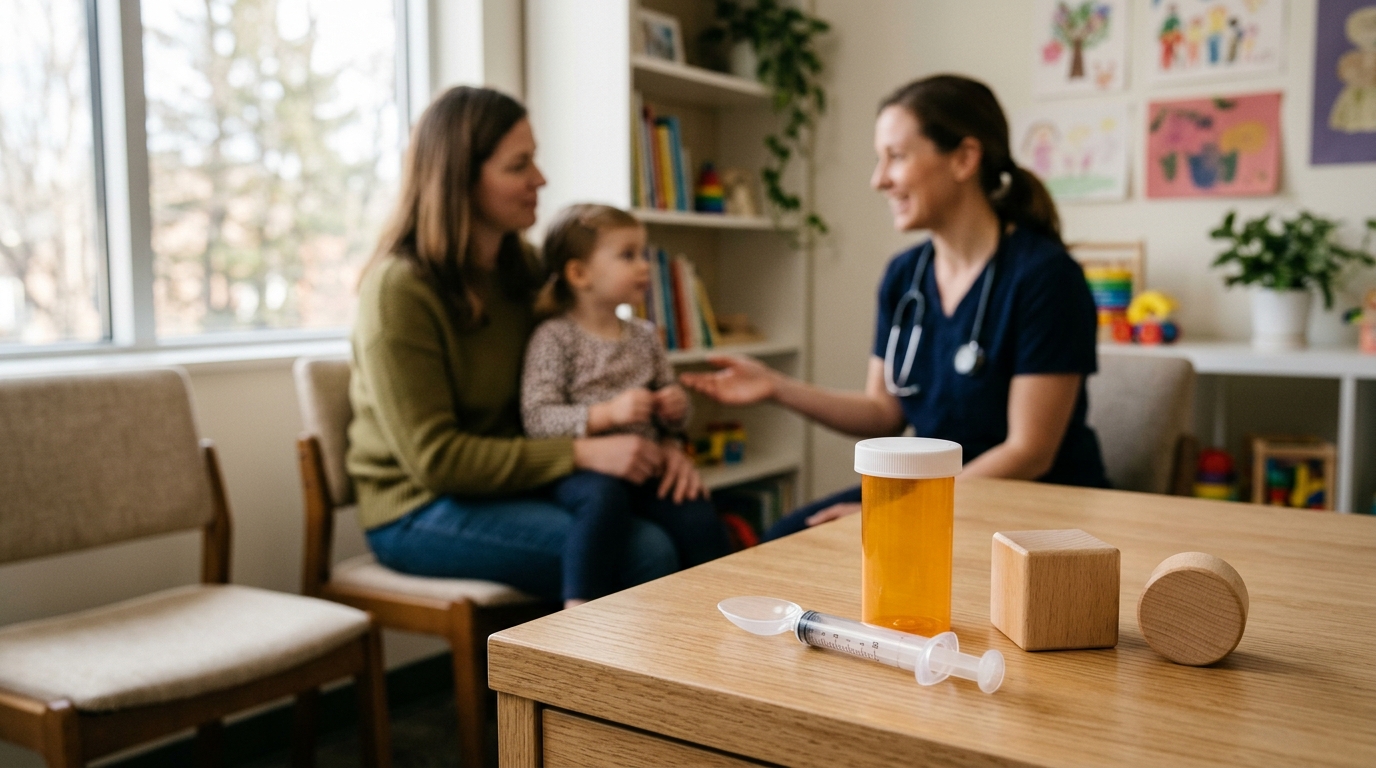
Artificial intelligence models can accurately learn expert prescribing patterns and predict medication decisions for children with neurodevelopmental conditions, according to a multi-cohort study. Researchers developed and validated machine learning tools designed to predict prescribing decisions across three major drug classes: stimulants, anti-depressants, and anti-psychotics.
The study addressed ongoing challenges in pediatric neurodevelopmental healthcare, where psychotropic medications are frequently prescribed but patient responses vary widely. Prescribing practices in this field remain largely off-label, and the specialized clinical expertise needed to guide complex pharmacological treatment is heavily concentrated in dedicated regional programs.
To establish initial model feasibility within research cohorts, investigators trained algorithms to predict cross-sectional medication use from the Child Behaviour Checklist. Model development and internal testing were conducted using data from 598 participants in the Province of Ontario Neurodevelopmental network. External generalizability was then evaluated across two independent datasets: the Healthy Brain Network study, comprising 1,764 participants, and the Adolescent Brain Cognitive Development study, comprising 2,396 participants.
During internal testing across the research cohorts, the artificial intelligence models achieved a median area under the receiver operating characteristic curve of 0.75 (interquartile range: 0.73 to 0.80) for stimulants, 0.83 (interquartile range: 0.78 to 0.87) for anti-depressants, and 0.79 (interquartile range: 0.72 to 0.86) for anti-psychotics. External testing across the independent cohorts confirmed the generalizability of these predictions.
Clinical evaluation was conducted using electronic medical records from 312 patients in the Psychopharmacology Program at Holland Bloorview Kids Rehabilitation Hospital to predict the medication class prescribed at a follow-up visit approximately three months later. In this real-world clinical cohort, the models achieved a median area under the curve of 0.84 (interquartile range: 0.81 to 0.88) for stimulants, 0.82 (interquartile range: 0.77 to 0.87) for anti-depressants, and 0.87 (interquartile range: 0.83 to 0.91) for anti-psychotics.
The researchers noted that the modelled outcome across all cohorts was the clinician’s prescribing decision rather than a direct measurement of treatment response or clinical benefit. These prescribing decisions incorporate clinician judgement, family preference, medication tolerability, and access to care alongside expected effectiveness, supporting the potential of data-driven tools to assist personalized medication management.
The findings were shared early as accepted, peer-reviewed research carrying a permanent digital object identifier ahead of the final Version of Record.
Subject of Research: Artificial intelligence models predicting psychotropic medication prescribing in neurodevelopmental conditions
Article Title: A precision health approach to medication management in neurodevelopmental conditions: a model development and validation study using four international cohorts
Article References: Vandewouw, M. M., Niroomand, K., Bokadia, H., Lenz, S., Rapley, J., Arias, A., Crosbie, J., Trinari, E., Kelley, E., Nicolson, R., Schachar, R. J., Arnold, P. D., Iaboni, A., Lerch, J. P., Penner, M., Baribeau, D., Anagnostou, E., & Kushki, A. (2026). A precision health approach to medication management in neurodevelopmental conditions: a model development and validation study using four international cohorts. Translational Psychiatry. https://doi.org/10.1038/s41398-026-04541-1
Image Credits: AI Generated
DOI: 10.1038/s41398-026-04541-1
Keywords: Artificial Intelligence, Neurodevelopmental Conditions, Psychopharmacology, Pediatric Health, Stimulants, Antidepressants, Antipsychotics, Precision Health, precision, health, approach, medication
News Source: Glenn Wilkins. (November 8, 2026). AI Predicts Medication Prescribing Patterns for Children With Neurodevelopmental Conditions. Scienmag.