The study, published in December 2025, introduces a multi-agent system designed to address the limitations of traditional walkability indices, which often rely solely on proximity to amenities while neglecting the perceptual and morphological qualities that shape the pedestrian experience. By integrating these diverse data sources, the framework aims to provide a more holistic and actionable tool for urban planners and designers.
The core of the system is a Graph Machine Learning (GML) engine that models cities as interconnected networks. This approach allows the model to learn from partial data and test hypothetical scenarios, moving beyond static spatial analysis. Surrounding this central engine are complementary agents: Large Language Models (LLMs) act as perception interpreters, translating visual and textual information from street views into experiential insights; computational agents handle deterministic data operations; and human agents provide final validation and policy context. This hybrid architecture ensures that the outputs remain transparent and socially grounded.
To quantify walkability, the researchers developed the Street Walkability Index (SWI). This composite metric aggregates three distinct data streams: LLM-derived street perception scores, traditional Walkscore metrics based on land-use and amenity proximity, and Street Hits, which serve as behavioral proxies for pedestrian activity. The SWI is calculated as a simple arithmetic mean of these components, creating a multidimensional measure that captures both objective spatial structure and subjective environmental quality. This index serves as the primary target for the model’s predictive and evaluative tasks.
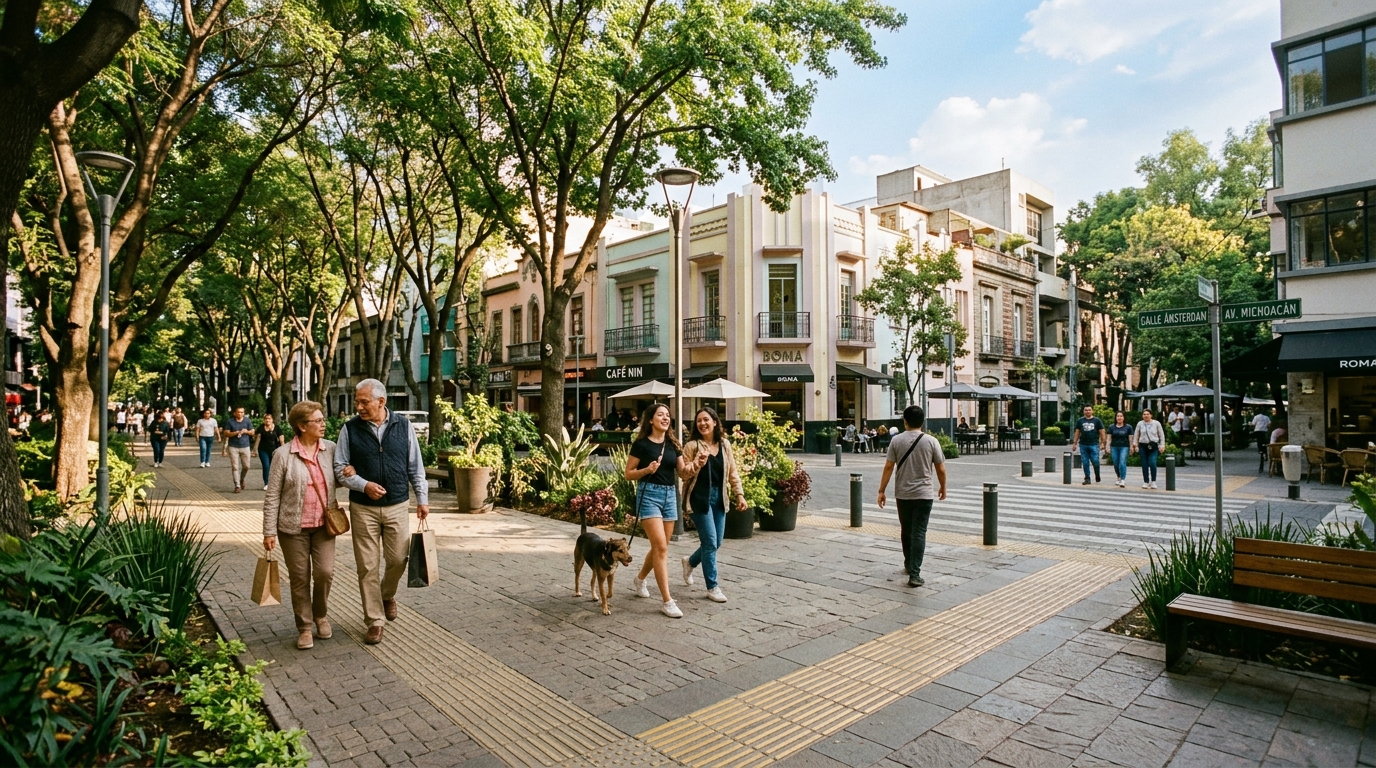
The framework was tested in the Historic Center of Mexico City, a two-square-kilometer area surrounding Alameda Central. This location was selected for its diverse urban conditions, including a mix of pedestrian corridors, narrow alleys, and vehicular arteries. Approximately 1,814 street segments were analyzed using data from OpenStreetMap, Google Street View imagery, and existing walkability benchmarks. The area’s complexity provided a robust environment for testing the system’s ability to capture structural and perceptual contrasts within a dense urban fabric.
Experiment 1 compared the traditional Walkscore with the LLM-derived perception scores to identify divergences between amenity-based and visually derived measures. The results revealed a significant structural divergence across the 1,814 street segments. In 1,349 segments, Walkscore rated the area as more walkable, while only 465 segments showed higher LLM perception scores. The mean difference between the two measures was 42.9 points, with nearly half of the segments showing gaps of 50 points or more. This discrepancy highlights that areas rich in amenities may still lack the environmental quality necessary for comfortable walking.
Experiment 2 evaluated the predictive capacity of the GML agent through a masked city prediction task. Portions of the city were masked, and the model inferred missing SWI values from surrounding classes. An ablation study quantified the contribution of different feature sets, including amenities, geometry, topology, and K-Means clustering. Models relying solely on amenity data or clustering achieved the lowest F1 scores, ranging from 0.445 to 0.476. In contrast, the full model, which integrated amenities, geometry, topology, and clustering, achieved the highest overall performance with an F1 score of 0.753. This progression confirmed that walkability emerges from the interplay between spatial configuration, environmental attributes, and amenity distribution.
Experiment 3 demonstrated the framework’s ability to simulate and evaluate urban interventions. The LLM agent identified low-performing street segments and proposed three architectural interventions, including a mixed-use block, a cultural hub, and a transportation-oriented node. The human agent translated these suggestions into specific massing parameters, such as building footprint and height. The GML agent then simulated the outcomes by predicting updated SWI values. The model reached a training accuracy of 0.75 and a validation accuracy of 0.65 after 600 epochs, with an F1 score of 0.613. The results indicated that while some segments saw minor reductions, the overall average class values increased considerably, with Intervention 1 producing the most substantial improvements in previously low-scoring areas.
The study highlights the importance of integrating perceptual and topological features to enhance predictive performance. The LLM perception layer exposed discrepancies between objectively connected areas and those perceived as walkable, revealing that spatial prominence does not always translate into network importance or pedestrian activity. For instance, streets around Alameda Central scored high due to shade and active façades, while peripheral vehicle-dominated streets received lower ratings. This suggests that traditional metrics may misrepresent actual walkability in areas where pedestrian activity is most concentrated, potentially distorting investment priorities in urban planning.
The researchers acknowledge several limitations in the framework. The reliance on Google Street View imagery introduces spatial and temporal biases, as coverage varies by location and may not reflect current conditions. Additionally, OpenStreetMap data can be inconsistent in quality across different cities. Some Walkscore values within Alameda Central returned zero, likely because the park’s large footprint places internal paths far from mapped amenities. The study also notes that LLM perception is sensitive to prompt design and model versioning, which can affect consistency. Direct human validation through surveys remains a necessary step for calibration to mitigate biases inherent in training data.
This research contributes to the field by positioning graph machine learning as the central predictive engine for urban evaluation, enriched by LLM-based interpretive perception and human input. The proposed multi-agent workflow bridges human insight, computational measures, and AI-driven reasoning, offering a transparent and participatory manner for generating and evaluating urban interventions. By moving beyond descriptive mapping to predictive and design-oriented tools, the framework provides a methodological foundation for participatory and interpretable urban intelligence.
The findings suggest that multi-agent GML systems offer a powerful decision-support approach for participatory urban evaluation. By bridging data-based, perceptual, and human intelligences, the system aims to support more equitable and actionable urban design strategies. Future research could extend the framework to evaluate other urban issues such as safety, comfort, or environmental resilience, and test its external validity across diverse urban contexts. The integration of real-time mobility traces and more sophisticated user interfaces could further enhance the system’s accessibility and temporal sensitivity.
The study underscores the shift from black-box prediction to explainable urban cognition, aligning computation with human interpretability. By treating cities as hybrid cognitive systems where intelligence emerges from the interaction between spatial form, human experience, and computational reasoning, the framework reframes walkability as an emergent quality. This perspective resonates with graph-based and configurational theories of urban form, extending them through the inclusion of AI-driven perception and narrative interpretation. The system operationalizes collective intelligence, where multiple agents generate insights that no single entity could produce alone.
As computational design tools evolve alongside artificial intelligence, such multi-agent systems may redefine the relationship between urban data, design reasoning, and collective decision-making. The framework offers a model for cities understood not merely as systems of infrastructure, but as living networks of perception, interaction, and shared cognition. By combining graph-based prediction, multimodal perception, and human evaluation, the research establishes a path toward a new generation of AI-assisted urban analysis that is both rigorous and responsive to lived experience.
Subject of Research: Multi-agent graph machine learning framework for urban walkability evaluation
Article Title: Hybrid urban intelligences: graph machine learning-driven multi-agent system for walkability
Article References: Palomares Avena, L. F. (2025). Hybrid urban intelligences: graph machine learning-driven multi-agent system for walkability. Architectural Intelligence, 4(1), Article 27. https://doi.org/10.1007/s44223-025-00106-2
Image Credits: AI Generated
DOI: 10.1007/s44223-025-00106-2
Keywords: urban walkability, graph machine learning, large language models, multi-agent systems, urban planning, Mexico City, Street Walkability Index, computational design, Hybrid, urban, intelligences, graph
News Source: Denise Maddox. (November 8, 2026). Graph AI System Predicts Urban Walkability in Mexico City. Scienmag.