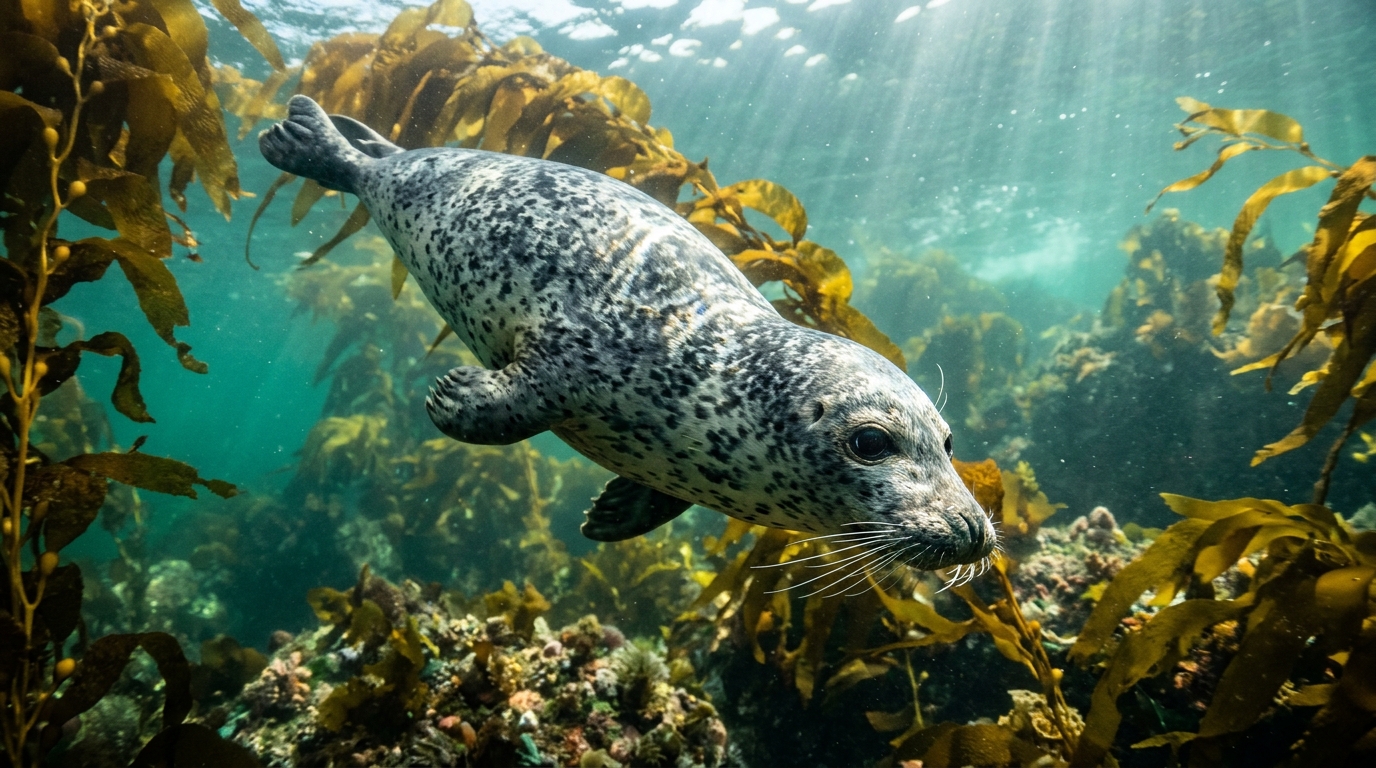
Harbour seals do not automatically flee from shipping noise, a new study reveals. Instead, their behavioural responses depend significantly on the intensity of the sound and their current activity. Researchers found that seals are more likely to change their behaviour when noise levels are high and when they are resting, but less likely to react when they are actively foraging, particularly if prey availability is high. This suggests that the decision to respond to disturbance is a calculated trade-off between the risk of noise and the energetic benefits of the current activity.
The study, published in Animal Biotelemetry, aimed to quantify the acute behavioural responses of free-ranging harbour seals to anthropogenic noise events. The research focused on the English Channel, one of the densest marine traffic areas in the world. Shipping is a major source of underwater noise, which can impact marine species by masking communication, inducing stress, or causing hearing impairment. Harbour seals are particularly vulnerable because they inhabit coastal areas with high marine traffic and rely on sound for navigation and foraging.
Previous research on the impact of shipping noise on harbour seals has largely relied on visual observations of haulout behaviour or controlled experiments with captive animals. These approaches often assume individuals are immobile, a condition that rarely applies to wild, free-ranging seals. To address this gap, the study used digital acoustic recording tags, known as DTags, which record both high-resolution movement data and sound over several weeks. This technology allows for the study of fine-scale behavioural responses to anthropogenic noise in the field, providing a more realistic picture of how seals interact with their noisy environment.
Harbour seals were captured at haulout sites in the Baie de Somme, France, in May 2022. Six adult seals, five males and one female, were fitted with DTags and a release system device. The tags recorded data for approximately 30 days, during which the seals remained within a 50 km radius of the haulout site. The DTags included a hydrophone to record sound, a pressure sensor for depth, and a three-axis accelerometer for movement. This multi-sensor approach enabled the researchers to link specific noise events with precise behavioural changes.
The research team identified high noise events using a high-level noise detector and classified them as vessel passes by three independent evaluators. A fixed detection threshold of 91 dB re 1 µPa was applied to ensure consistent cross-individual comparison. For each vessel pass, a 15-minute window around the event was extracted, including spectrogram data, accelerometer data, and movement tracks. Behavioural changes were classified into categories such as “Wake up,” “Freeze,” “Flee,” or “Other changes.” Events where the behaviour could not be clearly distinguished were excluded from the analysis.
Out of 418 analyzable events, seals showed behavioural changes in 29.7% of cases, while 70.3% showed no change. The probability of a behavioural change was significantly influenced by the peak noise level. Seals were more likely to change behaviour when noise levels were high, with a 50% probability of change occurring at 91.6 dB re 1 µPa for resting dives, compared to 116.0 dB re 1 µPa for foraging dives. This indicates a dose-response relationship, where higher noise levels increase the likelihood of a response, but the threshold varies depending on the seal’s activity.
The pre-exposure behaviour of the seals was a significant driver of their response. Seals were more likely to change behaviour when they were resting, specifically during resting dives, compared to when they were actively diving. In contrast, seals engaged in foraging dives had a lower probability of changing behaviour for the same noise level. This difference suggests that the cost of interrupting foraging is higher than the cost of interrupting rest, leading seals to tolerate higher noise levels when they are hunting.
The study also examined the role of prey availability in shaping these responses. Prey capture attempts were used as a proxy for foraging efficiency. The results showed that the probability of a behavioural change decreased as the rate of prey capture attempts increased. When seals were achieving a high rate of prey capture, they were unlikely to change their behaviour even in the presence of high noise levels. This finding supports the risk-disturbance hypothesis, which posits that animals weigh the costs and benefits of remaining in a disturbed area against the costs of leaving.
Individual variation was observed in the distribution of behavioural responses. Some seals exhibited a higher proportion of “No change” responses, while others showed more frequent changes. This variation was likely linked to differences in their behavioural state prior to noise exposure and their spatial distribution relative to shipping lanes. Seals that travelled closer to the coastline and harbours encountered more shipping noise events than those that moved further offshore. The study included individual identity as a random effect in the statistical models, accounting for this variation.
The findings highlight the complexity of marine mammal responses to anthropogenic noise. Rather than a uniform reaction, harbour seals exhibit flexible behaviour that is context-dependent. The ability to tolerate noise when foraging successfully may be an adaptive strategy that allows them to exploit productive habitats despite the presence of shipping. However, the study notes that the absence of a behavioural response does not imply a lack of impact, as physiological effects such as stress or increased vigilance may still occur.
Limitations of the study include the exclusion of the “Unknown” behavioural category, which accounted for 32.9% of events. Additionally, the study focused on noise measured at 2 kHz, a frequency band chosen to minimize flow noise from the tag while detecting anthropogenic noise. This choice limits the direct comparison of noise levels with other studies that use different frequency bands. The surfacing behaviour was also not fully interpretable due to the method of noise detection, which filtered out signals near the surface to avoid transient noise.
Further research in areas with varying levels of shipping noise is essential to better understand how seals make behavioural decisions in response to disturbance. Establishing accurate thresholds for behavioural responses will be crucial for environmental risk assessments.
The statistical framework used to identify these behavioural drivers was a generalised additive mixed model, which accounted for the non-independence of data points collected from the same individual. The model evaluated fourteen explanatory variables, including event duration, time differences between events, noise variation, peak levels, distance to the coast, distance to haul-out sites, distance to harbours, bathymetry, body mass, total body length, girth, hour of the day, tide, and the seal’s behaviour prior to noise. After checking for collinearity, the researchers selected the most parsimonious model based on the Akaike information criterion. This final model explained 26.1% of the deviance in the data. While noise variation strongly improved the model’s fit, it did not have a statistically significant effect on the probability of a behavioural change. In contrast, peak levels and the behaviour occurring before the noise event were the only significant drivers retained in the analysis.
The specific thresholds at which seals were equally likely to change or maintain their behaviour varied markedly by activity. For resting dives, the 50% probability threshold was reached at 91.6 dB re 1 µPa RMS. For shallow dives, this threshold was 97.7 dB re 1 µPa, and for active dives, it was 107.0 dB re 1 µPa. The highest threshold was observed during foraging dives, at 116.0 dB re 1 µPa. This 25 dB gap between the response thresholds for resting and foraging suggests that the energetic cost of abandoning a foraging dive is substantially higher than the cost of interrupting rest. The model indicated that seals were more likely to change behaviour when resting compared to the reference group of active dives, while foraging dives had a lower probability of change than active dives at the same noise level.
The study also investigated whether the behavioural changes themselves affected foraging efficiency. The researchers compared the mean prey capture attempt rates across the periods before, during, and after noise exposure for events where seals reacted to the noise. A paired nonparametric test revealed no significant difference in prey capture attempt rates between these phases. This finding indicates that the observed behavioural changes did not directly cause a reduction in foraging efficiency. Instead, the variation in prey capture attempt rates likely reflects differences in prey availability or foraging success in the specific areas where the seals were located. This supports the interpretation that seals are making active decisions to tolerate noise based on the immediate ecological context rather than suffering a passive decline in performance due to the disturbance.
Individual variation in the number of noise events encountered was linked to the spatial distribution of the seals. Four individuals travelled southwards from their haulout site, with three of them remaining close to the coastline and near harbours. These individuals, specifically S29, S31, and S34, experienced the highest number of shipping noise events, with counts of 226, 111, and 134 respectively. In contrast, two individuals, S27 and S28, travelled northwest and more offshore, experiencing fewer noise events, with counts of 49 and 26. This spatial variation highlights the heterogeneity of noise exposure even within a single study area. The standard deviation of the random intercept for individual identity in the model was 0.16, with a 95% confidence interval of 0.02 to 1.08, indicating low but uncertain individual variation in baseline response probability.
The study’s focus on noise measured at 2 kHz was a methodological choice designed to balance the need to detect anthropogenic noise with the need to minimize interference from flow noise generated by the tag itself. This frequency band is high enough to reduce flow noise but low enough to capture the frequency range of vessel noise. However, this specific choice limits the direct comparability of the noise levels reported in this study with other research that uses different frequency bands or broadband metrics. The researchers noted that for environmental risk assessments, it would be valuable to compare the behavioural change thresholds obtained here with sound exposure levels known to cause auditory damage, such as temporary or permanent threshold shifts. The absence of a behavioural response during foraging could potentially occur at sound levels that might cause long-term hearing loss, a connection that requires further investigation.
Subject of Research: Harbour seal behavioural responses to anthropogenic noise
Article Title: To flee or not to flee: harbour seal behavioural responses to anthropogenic noise events using high resolution biologging tags
Article References: Wynn-Simmonds, S., Vance, H., Treussard, S., Goulet, P., Richard, G., & Vincent, C. (2026). To flee or not to flee: harbour seal behavioural responses to anthropogenic noise events using high resolution biologging tags. Animal Biotelemetry, 14(1), Article 39. https://doi.org/10.1186/s40317-026-00476-y
Image Credits: AI Generated
DOI: 10.1186/s40317-026-00476-y
Keywords: harbour seals, anthropogenic noise, biologging tags, behavioural response, shipping noise, foraging, marine mammals, English Channel, flee, harbour, seal, behavioural
News Source: Drew Townsend. (November 8, 2026). Harbour seals weigh noise risks against foraging benefits. Scienmag.