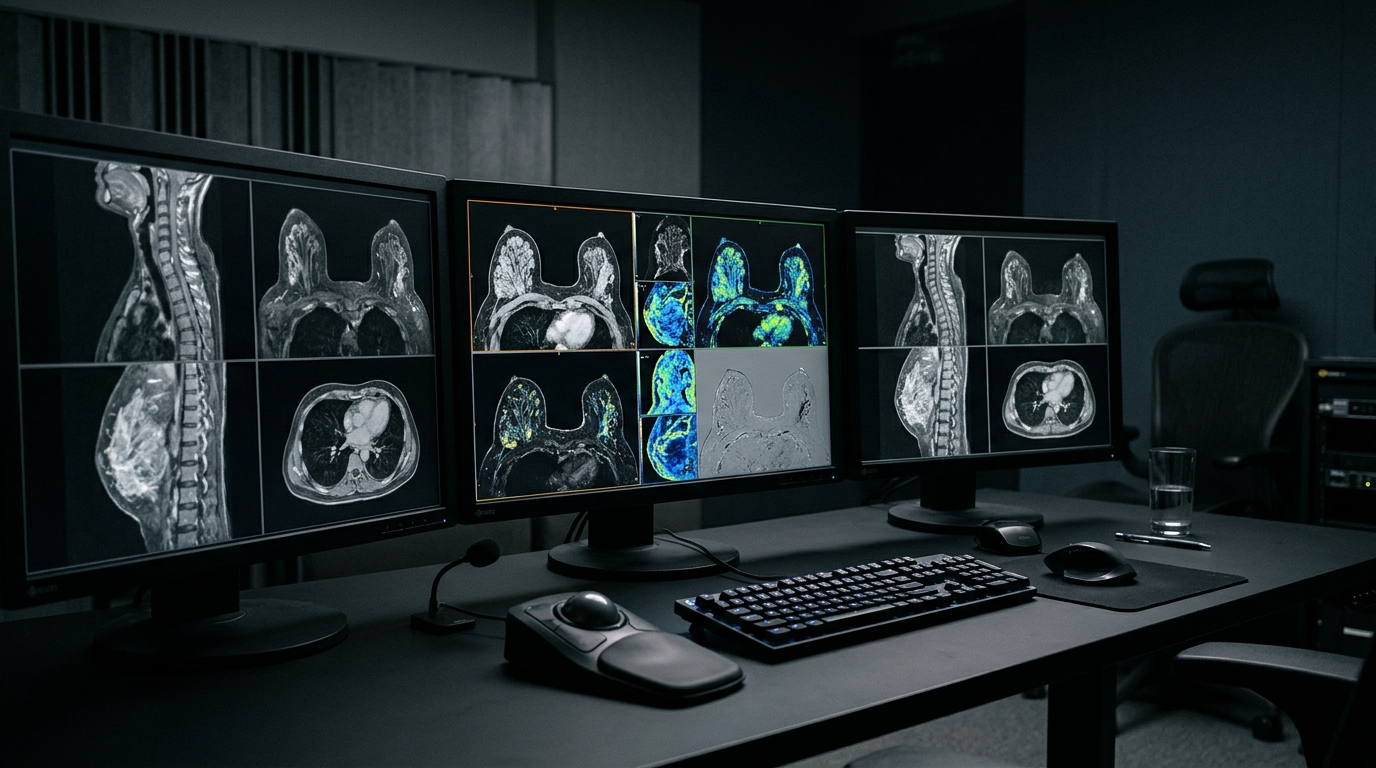
A retrospective diagnostic prediction-model study published in Frontiers in Physiology evaluated whether integrating cardiometabolic context and MRI-derived vascular features could improve the risk stratification of breast lesions classified as BI-RADS 3 and 4A. These categories represent a narrow management boundary in clinical practice, where patients face a choice between imaging surveillance and biopsy. The research team aimed to determine if adding these specific data points to conventional lesion-level MRI information could better distinguish between benign and malignant findings, potentially reducing unnecessary invasive procedures while maintaining diagnostic accuracy.
The study included a cohort of 420 women, each presenting with one MRI-detected lesion. Malignancy was established through histopathology for biopsied lesions or, for those not biopsied, by demonstrating at least 24 months of imaging stability. Out of the total cohort, 27 lesions were confirmed malignant, including three BI-RADS 3 lesions and 24 BI-RADS 4A lesions.
The researchers developed four prespecified ridge logistic regression models to assess the incremental value of different data sources. The first model relied solely on conventional MRI features. The second model added cardiometabolic burden to the MRI data. The third model incorporated an MRI-derived vascular remodeling score. The fourth and fully integrated model combined all these elements. The complete modeling procedure, including preprocessing and penalty selection, was internally validated using 2,000 bootstrap resamples to account for optimism in performance estimates.
The MRI-only model achieved an AUC of 0.760. Adding cardiometabolic data improved this to 0.775, while the model including the vascular remodeling score reached an AUC of 0.812. The fully integrated model achieved the highest AUC of 0.826. The paired optimism-corrected AUC difference between the fully integrated model and the MRI-only model was 0.066, with a 95% confidence interval of 0.019 to 0.113 and a p-value of 0.006. This statistically significant improvement suggests that the additional variables provided meaningful predictive information beyond standard MRI features.
Calibration metrics for the integrated model indicated reasonable alignment between predicted probabilities and observed outcomes. The bootstrap-corrected calibration intercept was −0.08, and the calibration slope was 0.94, with a Brier score of 0.052. Using aggregated out-of-bootstrap predictions, the researchers applied a locked risk threshold below 0.020 to reassign 91 BI-RADS 4A lesions to 6-month MRI follow-up instead of immediate biopsy. Of these reassigned lesions, 90 were benign and one was malignant.
For BI-RADS 3 lesions, a risk threshold of at least 0.050 flagged six lesions for intensified assessment. This group included two of the three malignant BI-RADS 3 lesions observed in the study. The authors noted that because only three malignant BI-RADS 3 lesions were observed, this specific alert result should be regarded as hypothesis-generating rather than definitive. The overall sensitivity of the integrated model was 92.6%, with a specificity of 61.8%. The positive predictive value was 14.3%, and the negative predictive value was 99.2%.
However, the authors emphasized that the limited number of malignant outcomes, particularly in the BI-RADS 3 category, precludes immediate clinical implementation. The findings suggest that cardiometabolic context and MRI-derived vascular information can improve internally validated risk estimation, but prospective external validation is required before these tools can be adopted in routine clinical practice.
Subject of Research: Retrospective diagnostic prediction model for breast lesion risk stratification
Article Title: Re-stratification of BI-RADS 3/4A breast lesions based on dynamic contrast-enhanced MRI: integrating cardiometabolic risk and breast microvascular remodeling phenotypes to improve diagnostic accuracy and reduce unnecessary biopsies
Article References: Hu, X., Chen, F., & Gu, Q. (2026). Re-stratification of BI-RADS 3/4A breast lesions based on dynamic contrast-enhanced MRI: integrating cardiometabolic risk and breast microvascular remodeling phenotypes to improve diagnostic accuracy and reduce unnecessary biopsies. Frontiers in Physiology, 17, Article 1984062. https://doi.org/10.3389/fphys.2026.1984062
Image Credits: AI Generated
DOI: 10.3389/fphys.2026.1984062
Keywords: Breast MRI, BI-RADS 3, BI-RADS 4A, Diagnostic prediction model, Cardiometabolic risk, Vascular remodeling, Breast cancer screening, Medical imaging, Risk stratification, Frontiers in Physiology, Re-stratification, BI-RADS
News Source: Ophelia Keating. (November 8, 2026). MRI and metabolic data help triage ambiguous breast lesions. Scienmag.