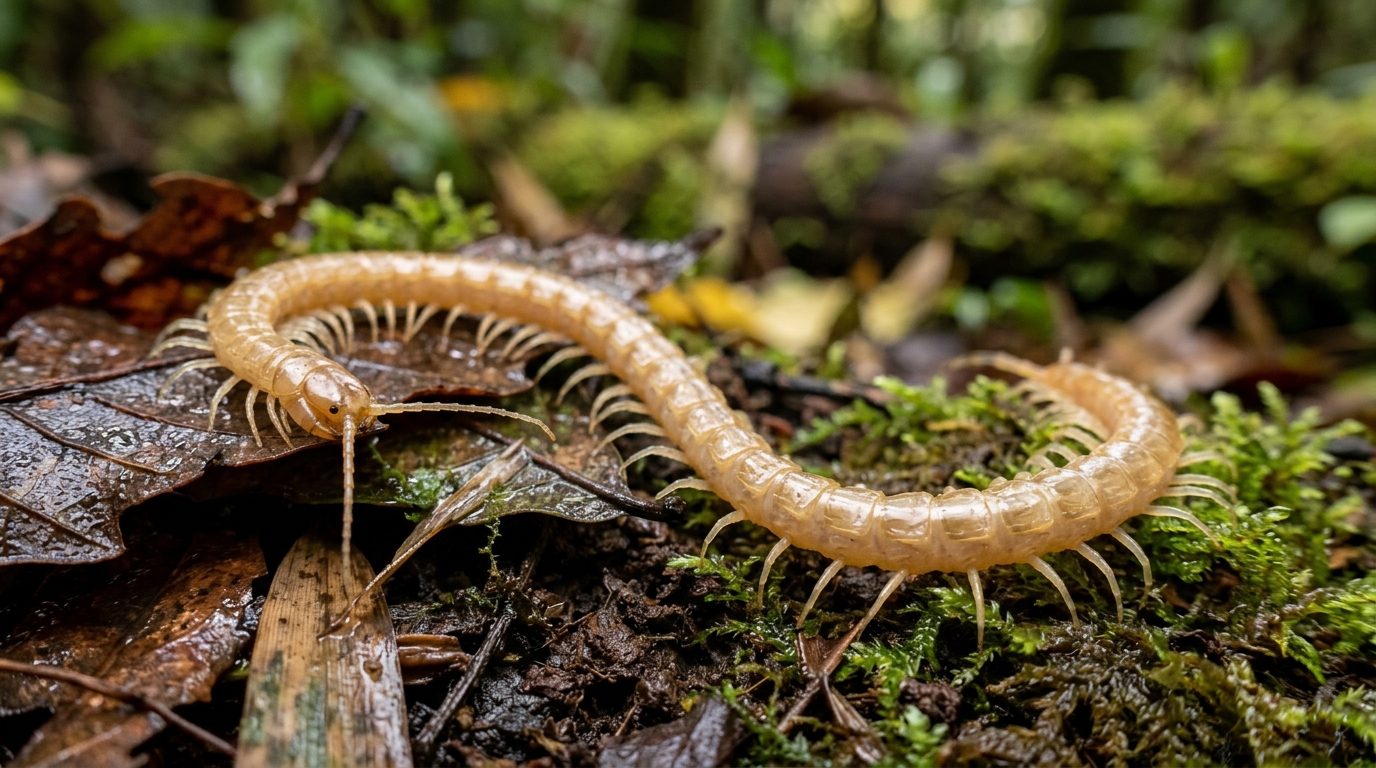
Researchers have documented the first occurrence of the centipede family Gonibregmatidae in China, a finding that significantly extends the known geographic range of this poorly understood group of soil-dwelling arthropods. The discovery, based on specimens collected in Hainan Province, identifies the species Vinaphilus unicus, which was previously known only from northern Vietnam. This record not only marks the first appearance of the family in the country but also provides the first detailed description of the male morphology for this specific species, a critical gap in the existing taxonomic literature.
Gonibregmatidae is a species-poor family within the order Geophilomorpha, characterized by some of the largest and most elongate centipedes in the world. Adults of several species within this family can exceed 10 centimeters in length, and the group includes Gonibregmatus plurimipes, a species endemic to Fiji that holds the record for the highest number of leg pairs in the class Chilopoda, with 191 pairs. Under the current taxonomic circumscription, the family comprises 10 genera and 19 described species, most of which are found in the Indo-Australasian Region, ranging from the Indian Peninsula to New Guinea and the Fijian Islands. Prior to this study, no members of this family had been recorded from China, leaving a notable gap in the regional biodiversity data.
The genus Vinaphilus was originally established in 2019 for the species V. unicus, which was described from two female specimens collected in Vinh Phuc Province, northern Vietnam. The genus is distinguished by a unique tripartite arrangement of ventral pore fields on the metasternites, consisting of two anterior sublateral fields and one medial posterior field. Since the original description, two additional species, V. chuyangsinensis and V. dentatus, have been described from the Central Highlands of Vietnam. However, because the original description of V. unicus relied exclusively on female material, the morphology of males and the species’ distribution beyond the type locality remained unknown until the recent collection in Hainan.
The specimens examined in this study were collected by hand using tweezers from under decaying wood in Jianfengling National Forest Park, Hainan Province, on February 24, 2024. The two adult males were preserved in 75% ethanol and deposited at the National Resource Center for Chinese Materia Medica in Beijing. The collection site is located at an elevation of approximately 1,150 meters above sea level, a significantly higher altitude than the type locality in Vietnam, which is situated in secondary forest at approximately 150 meters.
Morphological examination of the Hainan specimens revealed body lengths ranging from 39 to 51 millimeters, with 85 to 87 leg-bearing segments. This is notably smaller than the Vietnamese holotype, which measured 65 millimeters, and the paratype, which measured 90 millimeters. Furthermore, the number of leg-bearing segments in the Hainan population is lower than the invariable 109 segments found in the known Vietnamese females. The cephalic capsule of the Hainan males is subrectangular, with a length approximately 1.2 times its width, and the clypeus is about 1.8 times as wide as it is long. These measurements differ from those of the original type material, where the cephalic plate was roughly as long as it was wide and the clypeus was approximately 2.7 times as wide as long.
The identification of the Hainan specimens as V. unicus is supported by the presence of the diagnostic ventral pore-field arrangement, which is unique to the genus Vinaphilus. The specimens also exhibit incomplete chitin-lines on the forcipular coxosternite and a lack of denticles along its anterior margin, a combination of characters that distinguishes V. unicus from its two congeners. A key to the three known species of Vinaphilus highlights these differences, noting that V. dentatus possesses denticles on the anterior margin of the forcipular coxosternite, while V. chuyangsinensis has complete chitin-lines. The Hainan specimens align with V. unicus in the absence of these features, confirming their taxonomic placement despite the quantitative morphological differences.
The observed differences between the Hainan population and the Vietnamese type population may reflect sexual dimorphism, geographic variation, or a combination of both factors. In geophilomorph centipedes, females generally possess more leg-bearing segments than males, which could account for the difference in segment count between the Hainan males and the Vietnamese females. However, because the available material consists of only two males from Hainan and two females from Vietnam, sex is completely confounded with geographic origin. This small sample size prevents researchers from determining whether the observed differences represent consistent sexual dimorphism or genuine geographic differentiation within the species.
The ecological context of the Hainan specimens also differs from that of the Vietnamese types. While the Hainan centipedes were found beneath decaying wood at a high elevation, the Vietnamese types were collected in secondary forest at a much lower altitude. The forest type in Hainan and the specific microhabitat in Vietnam remain undocumented, which limits the ability to make direct ecological comparisons between the two populations.
This discovery highlights the incompleteness of our knowledge regarding the diversity and distribution of Vinaphilus in Southeast Asia and southern China. The apparent geographical gaps in the distribution of this genus may partly reflect insufficient sampling of soil-dwelling arthropods rather than true distributional discontinuities. The limited records available to date do not permit conclusions about historical dispersal, geographical isolation, or population differentiation. To clarify the extent and sources of variation within V. unicus, further targeted sampling in southern China, including Hainan and intervening areas of Southeast Asia, is necessary.
By providing detailed descriptions and illustrations of the male morphology, this research fills a critical gap in the taxonomic knowledge of Vinaphilus unicus.
Subject of Research: First record of Gonibregmatidae from China and description of male Vinaphilus unicus
Article Title: First record of the family Gonibregmatidae Cook, 1896 from China ( Chilopoda , Geophilomorpha )
Article References: Yang, C., You, C., & Jiang, C. (2026). First record of the family Gonibregmatidae Cook, 1896 from China (Chilopoda, Geophilomorpha). Biodiversity Data Journal, 14, Article e217565. https://doi.org/10.3897/bdj.14.e217565
Image Credits: AI Generated
Keywords: Gonibregmatidae, Vinaphilus unicus, Chilopoda, Geophilomorpha, Hainan Province, Biodiversity, Taxonomy, Soil Centipedes, Biogeography, Morphology, First, record
News Source: Drew Townsend. (November 8, 2026). New Centipede Record Expands Gonibregmatidae Range Into China. Scienmag.