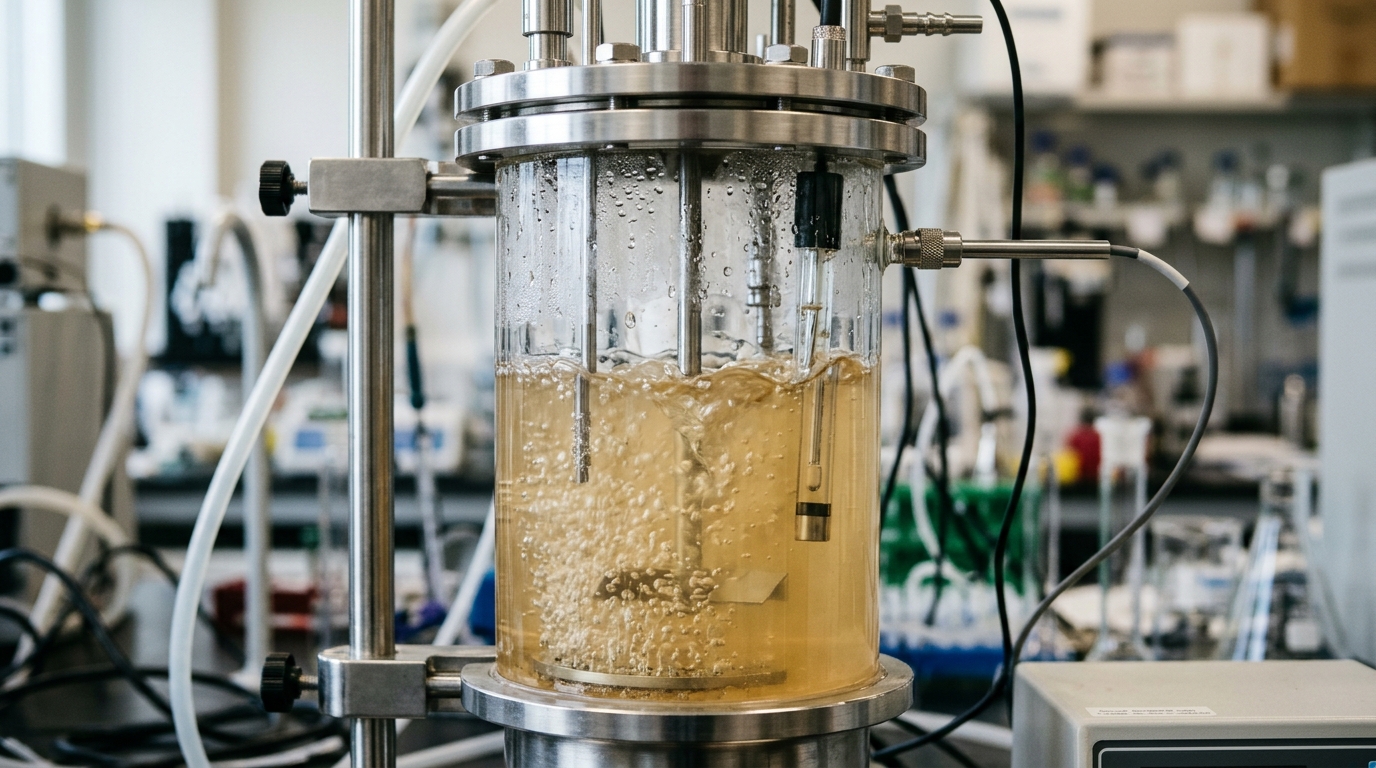
Investigators have optimized the growth and potassium-solubilizing performance of a soil-derived bacterial isolate closely related to Bacillus cereus, demonstrating enhanced yield through statistical modeling and laboratory-scale bioreactor cultivation. The experimental investigation focused on isolating efficient potassium-solubilizing bacteria from diverse soil environments, refining nutritional and physical culture parameters to promote bacterial growth, and verifying process performance under controlled bioreactor conditions. According to the researchers, potassium-solubilizing bacteria provide a microbial approach for mobilizing mineral-bound potassium that may contribute to sustainable nutrient management strategies.
The experimental workflow began with the collection of twenty soil samples gathered from agricultural and mineral-rich sites. From these samples, the authors obtained a total of 119 bacterial isolates, which were subsequently screened for functional capacity. Laboratory testing on Aleksandrov medium revealed that 21 of the 119 isolates displayed potassium-solubilizing activity. The most promising isolate among this cohort was selected for further taxonomic and physiological characterization.
Detailed evaluation of the selected strain included morphological examination, biochemical testing, and partial 16S ribosomal RNA sequence analysis. These diagnostic evaluations confirmed that the isolated organism possesses a close phylogenetic relationship with Bacillus cereus. Subsequent nutritional screening assessed various carbon and nitrogen sources to determine optimal components for bacterial biomass accumulation. The screening identified glucose as a suitable carbon source and yeast extract as a suitable nitrogen source for supporting bacterial growth.
To systematically assess operational parameters, the researchers applied a central composite design paired with response surface methodology. This statistical framework evaluated the individual and interactive effects of five critical variables: substrate concentration, incubation period, incubation temperature, medium pH, and agitation rate. The mathematical model developed from the design displayed a strong fit to the experimental observations, achieving a coefficient of determination (R2) of 0.961 and an adjusted R2 of 0.899.
Process optimization defined ideal culture conditions at 0.3 percent substrate, an incubation period of 96 hours, a temperature of 40 degrees Celsius, a pH of 7.0, and an agitation rate of 160 revolutions per minute. Under these specified conditions, the authors recorded an experimental optical density of 1.76 at 600 nanometers, surpassing the model-predicted value of 1.55 at 600 nanometers. Subsequent evaluation in a laboratory-scale bioreactor confirmed process execution under controlled cultivation parameters, recording its highest response at 168 hours with agitation at 300 revolutions per minute and an aeration rate of 2 vessel volumes per minute. The authors noted that these findings indicate potential for further development and validation of the Bacillus isolate within microbial systems.
Subject of Research: Bioprocess optimization of bacterial potassium solubilization
Article Title: Bioprocess optimization of potassium solubilization by a Bacillus isolate using response surface methodology and laboratory-scale bioreactor evaluation
Article References: Shahid, S., Chaudhary, H. J., Munis, M. F. H., Ullah, N., Sarwar, A., Nelofer, R., Aziz, T., Siddig, N. H., Al-Hoshani, N., & Tombozara, N. (2026). Bioprocess optimization of potassium solubilization by a Bacillus isolate using response surface methodology and laboratory-scale bioreactor evaluation. Annals of Microbiology. https://doi.org/10.1186/s13213-026-01886-2
Image Credits: AI Generated
DOI: 10.1186/s13213-026-01886-2
Keywords: Bacillus, potassium solubilization, bioprocess optimization, response surface methodology, bioreactor, soil bacteria, Aleksandrov medium, Bioprocess, optimization, potassium, solubilization, isolate
News Source: Drew Townsend. (November 8, 2026). Researchers Optimize Potassium Solubilization by Soil Bacillus Isolate in Bioreactor Evaluation. Scienmag.