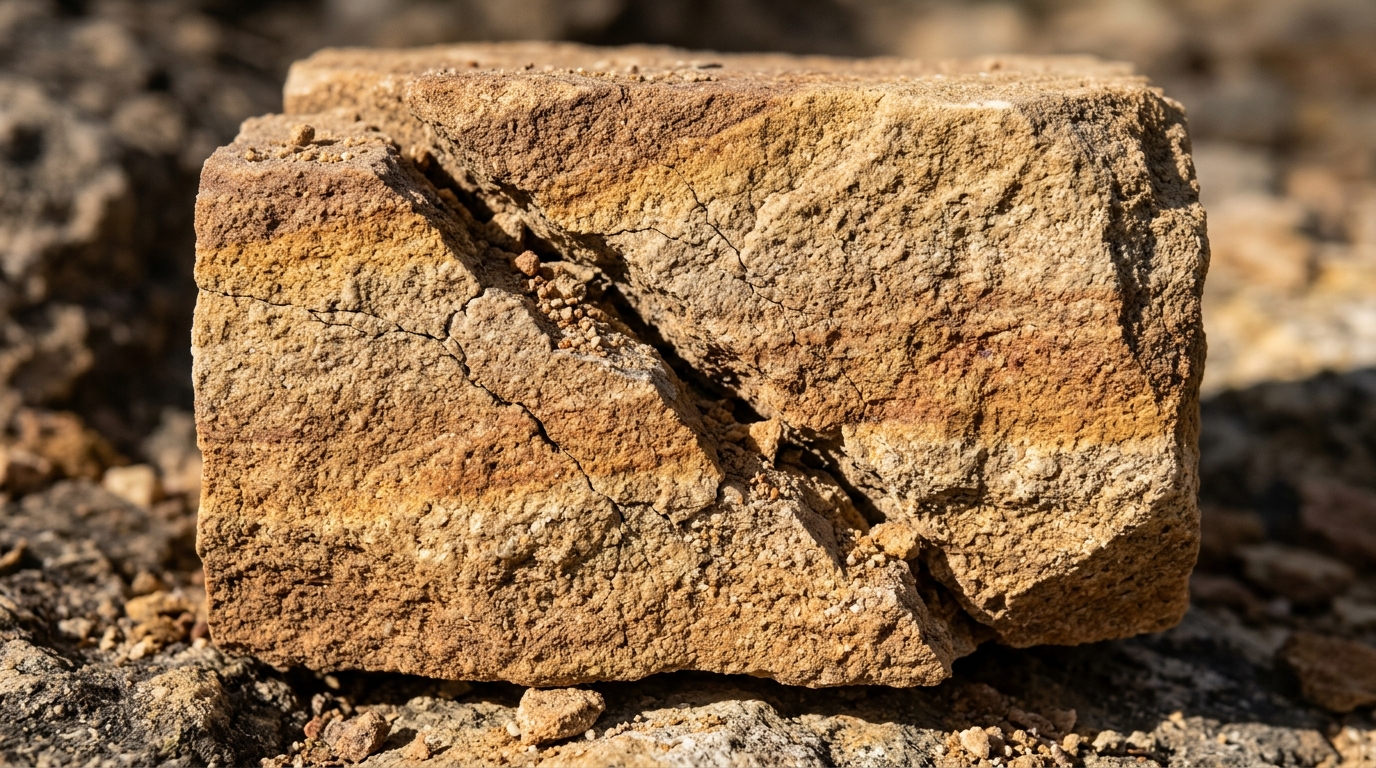
A study published in Geomechanics and Geophysics for Geo-Energy and Geo-Resources investigates how the orientation of pre-existing fissures and the rate of applied load influence the failure mechanisms of sandstone. The research, led by Wenpu Li and colleagues, focuses on flawed rock masses to provide critical parameters for assessing stability in underground engineering projects. By systematically analyzing the coupled effects of fissure inclination and loading rate, the team aims to offer practical guidance for ensuring engineering safety in structures such as tunnels, slopes, and chambers under mining disturbance.
The investigation employed uniaxial compression tests on sandstone specimens containing a single hole and double fissures. The experiments were monitored simultaneously using acoustic emission (AE) and digital image correlation (DIC). The systematic analysis covered fissure inclination angles ranging from 0 degrees to 90 degrees and loading rates between 0.05 and 0.20 MPa/s, enabling a detailed examination of how these variables interact to determine final failure modes.
The results demonstrate that both peak strength and peak strain increased significantly as the fissure inclination angle increased. This trend was accompanied by enhanced acoustic emission activity. The digital image correlation strain field evolution revealed that crack initiation consistently occurred at the tips of the fissures. These initial cracks subsequently interacted with the central hole, forming distinct stress concentration zones. These zones ultimately led to specimen instability.
Distinct failure modes were observed depending on the fissure orientation. Specimens with fissures inclined at 0 degrees and 45 degrees exhibited shear failure. In contrast, specimens with fissures oriented at 90 degrees failed through axial splitting. The study further identified three pure crack types and eight mixed crack types based on the characteristics of the strain fields, providing a comprehensive classification of failure mechanisms in flawed sandstone.
The proposed integrated AE-DIC monitoring framework offers a robust method for real-time stability assessment of rock masses.
The research provides critical parameters and criteria for assessing rock mass stability and optimizing support designs in underground engineering projects. By elucidating the coupled effects of fissure angle and loading rate, the study contributes to a better understanding of how pre-existing flaws influence the mechanical response of rock under stress. This research offers practical guidance for ensuring engineering safety throughout project lifecycles.
The study highlights the significance of considering both geometric and loading parameters when evaluating the stability of flawed rock masses. The findings are applicable to a wide range of geotechnical engineering challenges, including the design of tunnels, slopes, and mining chambers.
Subject of Research: The influence of fissure angle and loading rate on sandstone failure mechanisms and their implications for underground engineering stability.
Article Title: Influence of fissure angle and loading rate on sandstone failure mechanisms: implications for underground engineering stability
Article References: Li, W., Zhang, X., Zhao, T., Fan, N., Xie, X., Zhao, Z., Xi, S., Chen, X., & Wang, T. (2026). Influence of fissure angle and loading rate on sandstone failure mechanisms: implications for underground engineering stability. Geomechanics and Geophysics for Geo-Energy and Geo-Resources. https://doi.org/10.1007/s40948-026-01246-z
Image Credits: AI Generated
DOI: 10.1007/s40948-026-01246-z
Keywords: sandstone, fissure angle, loading rate, failure mechanisms, underground engineering, acoustic emission, digital image correlation, rock mechanics, uniaxial compression, stability assessment, Influence, fissure
News Source: Denise Maddox. (November 7, 2026). Sandstone Failure Mechanisms Driven by Fissure Angle and Loading Rate. Scienmag.