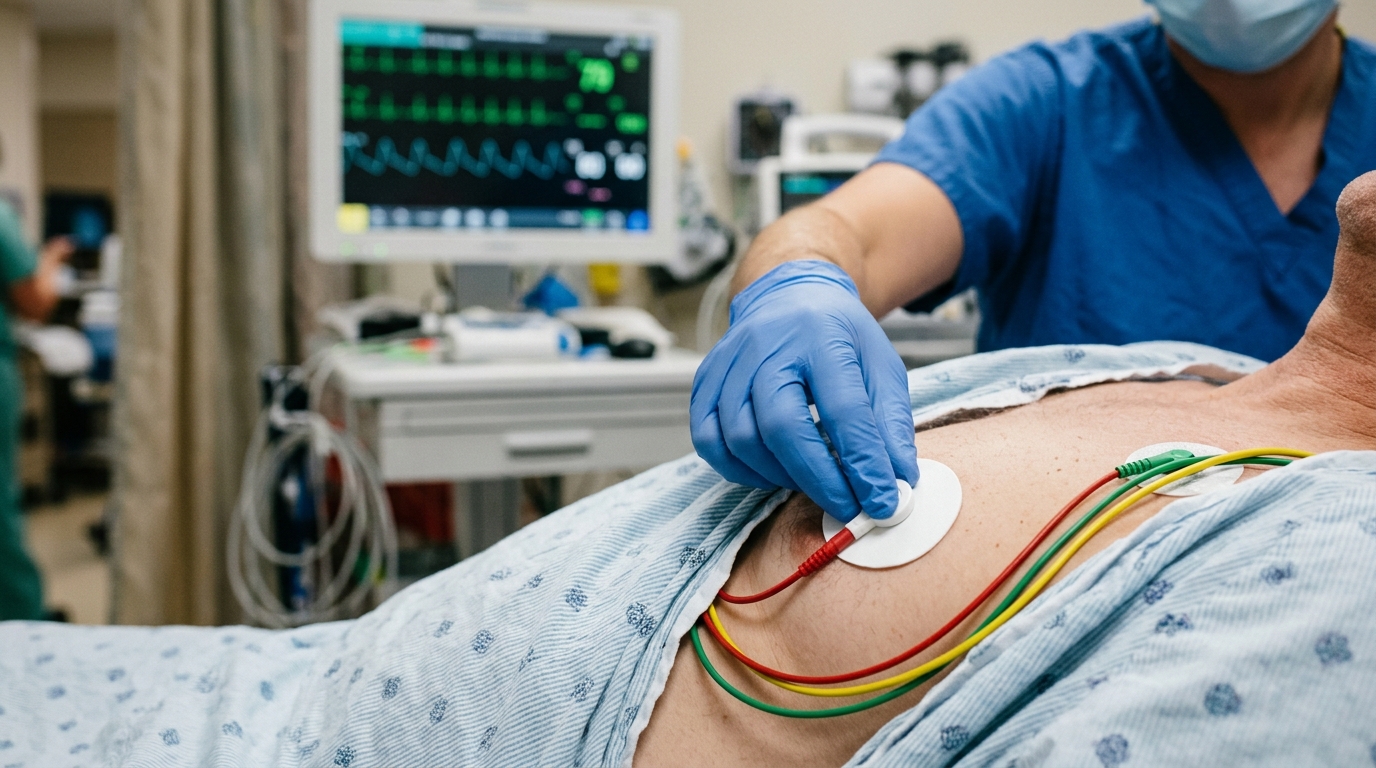
Researchers conducted a secondary analysis of the VitalDB Arrhythmia Database to determine whether the autonomic profile captured during a short intraoperative observation window can predict significant arrhythmia in the immediate minutes following that window. The study, published in BMC Cardiovascular Disorders, utilized anesthesiologist-adjudicated annotations from 482 surgical cases to test this specific predictive capability. The central finding indicates that a five-minute heart rate variability profile, derived solely from R peak timing and beat labels, is capable of predicting significant arrhythmia in the subsequent five minutes of surgery.
The background for this investigation stems from the clinical reality that rhythm disturbance is the most frequent cardiovascular abnormality during the operative period. New-onset atrial fibrillation, in particular, carries lasting risks for stroke and mortality. The researchers aimed to verify if the autonomic signals present in a brief intraoperative segment could serve as a reliable indicator for impending significant arrhythmic events. This approach focuses on short-horizon prediction, specifically looking at the minutes immediately following the initial observation period rather than long-term outcomes.
The methodology involved a secondary analysis of the VitalDB Arrhythmia Database, which contains annotations from 482 surgical cases. A 300-second index window was selected at the start of each annotated segment, with the following 300 seconds designated as the outcome window. Only cases that were free of significant arrhythmia during the initial index window were eligible for inclusion in the analysis. The primary endpoint was defined as incident significant arrhythmia, which served as a composite measure including atrial and ventricular tachyarrhythmias, atrioventricular block, and sinus node dysfunction.
From the total pool of 482 cases, 299 met the eligibility criteria for the study. Of these eligible cases, 109, representing 36.5% of the sample, reached the defined endpoint of incident significant arrhythmia. The researchers compared the performance of logistic regression, random forest, and gradient boosting models using repeated stratified cross-validation. This statistical approach allowed for a robust comparison of how well different machine learning and traditional statistical methods could discriminate between cases that would and would not experience significant arrhythmia in the outcome window.
The results showed that logistic regression and the random forest model discriminated similarly in their ability to predict the endpoint. The area under the curve for logistic regression was 0.670, with a 95% confidence interval ranging from 0.604 to 0.732. The random forest model achieved an area under the curve of 0.682, with a 95% confidence interval from 0.620 to 0.742. A DeLong test comparing the two models yielded a p-value of 0.55, indicating no statistically significant difference in their discriminatory power. The random forest model demonstrated a favorable calibration slope of 0.94, although it exhibited overprediction of absolute risk. The negative predictive value for the random forest was recorded at 80.9%.
The study identified specific heart rate variability metrics associated with the endpoint. Lower values of pNN50 and RMSSD were linked to the occurrence of significant arrhythmia. Unexpectedly, lower levels of ventricular ectopy were also associated with the endpoint. Additionally, the ventricular tachyarrhythmia episodes observed in the data were characterized by their brevity, with a median duration of only four beats.
The authors conclude that the five-minute heart rate variability profile provides a physiologically coherent signal for predicting significant arrhythmia in the following five minutes of surgery. The signal was found to be strongest for bradyarrhythmias and was captured as effectively by logistic regression as by machine learning models. This study establishes the first prediction benchmark on the VitalDB Arrhythmia Database, offering a reproducible foundation for future research. The findings suggest that externally validated and clinically enriched intraoperative rhythm prediction is a viable area for further development.
This research highlights the potential of using existing intraoperative data to predict short-term arrhythmic risks.
Subject of Research: Short-horizon prediction of intraoperative arrhythmia using heart rate variability
Article Title: Short horizon prediction of incident significant arrhythmia from intraoperative heart rate variability, a secondary analysis of the VitalDB Arrhythmia Database
Article References: Eini, P., Serpoush, H., Rezayee, M., & Tremblay, J. (2026). Short horizon prediction of incident significant arrhythmia from intraoperative heart rate variability, a secondary analysis of the VitalDB Arrhythmia Database. BMC Cardiovascular Disorders. https://doi.org/10.1186/s12872-026-07001-2
Image Credits: AI Generated
DOI: 10.1186/s12872-026-07001-2
Keywords: arrhythmia, heart rate variability, intraoperative monitoring, machine learning, VitalDB, cardiovascular, surgery, prediction model, Short, horizon, prediction, incident
News Source: Ophelia Keating. (November 7, 2026). Five-Minute Heart Rate Profile Predicts Surgical Arrhythmia. Scienmag.