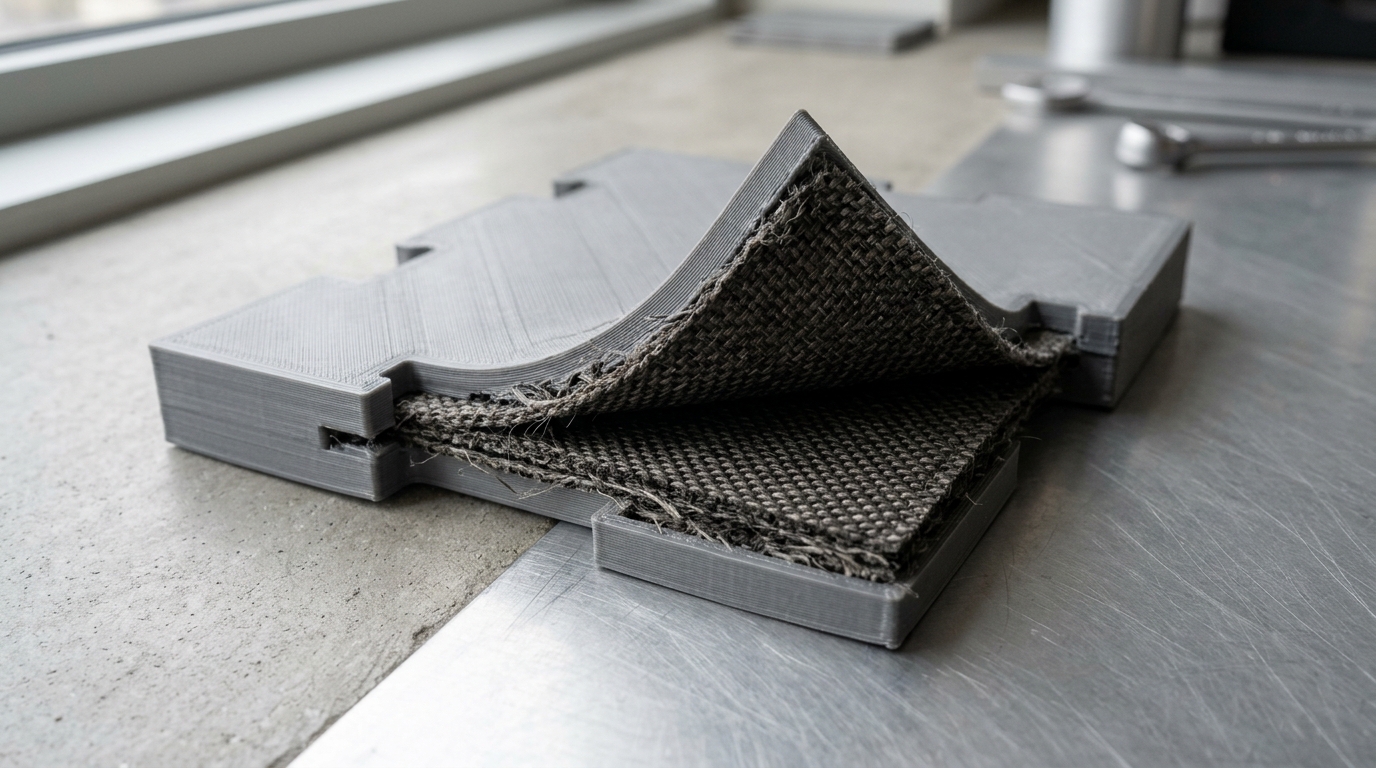
Published in the journal Architectural Intelligence, the study introduces a tri-material layered system that incorporates a woven thermoplastic polyurethane (TPU) matrix between a rigid polylactic acid (PLA) base and a hygroscopic cellulose-PLA active layer. This design allows the tiles to perform rapid, multi-axis deformations and recover their original flat shape more quickly than conventional bilayer actuators, which typically bend in only one direction and recover slowly.
The innovation is inspired by the mechanics of cardiac tissue, specifically the myocardium. In the heart, contractile muscle cells work in conjunction with an elastic extracellular matrix to generate complex, reversible three-dimensional movements. The research team translated this biological principle into a printable architecture where the hygroscopic layer acts as the active driver, the TPU matrix serves as an elastic moderator, and the PLA base provides rigid structural support. By mimicking the functional partnership between cardiomyocytes and the extracellular matrix, the tiles can execute coordinated deformations that are both durable and energy-efficient.
Conventional 4D-printed actuators often rely on a single hygroscopic layer to generate motion. While effective for simple bending, these systems lack an internal elastic layer to coordinate multi-axis movement or restrain over-curvature. As a result, they are limited to modest speeds and single-direction bending. The new tri-material system addresses these limitations by embedding a strategically placed TPU matrix that limits over-curvature and prevents reverse bending in overly dry conditions. This allows the tiles to maintain a stable deformation amplitude over repeated cycles, making them suitable for large-scale fabrication in kinetic facades.
The fabrication process utilizes a custom parametric workflow developed in Rhino and Grasshopper. The software generates tile geometry and material assignment, exporting the design as G-code for standard fused-filament 3D printers. A key technical challenge was achieving asymmetric bending, where different branches of the tile need to bend in opposite directions. To solve this, the researchers developed a custom toolpath generator that assigns the three filaments locally based on the required bending direction for each branch. This approach ensures that the layer order is optimized for each specific part of the tile, enabling complex spatial deformations from a single continuous print job.
For the active layer, the team selected LayWood, a hygroscopic composite containing approximately 30% cellulose. This material swells when exposed to moisture and shrinks when dried, driving the tile’s deformation. The TPU layer was chosen for its high elasticity and flexibility, acting as an elastic hinge that moderates strain and accelerates shape recovery. The PLA base provides a rigid, lightweight substrate that keeps the panel thin and printable on standard platforms. The combination of these materials satisfies both biomimetic logic and manufacturing practicality, allowing for a single-run, tri-material print that is compatible with existing 3D printing infrastructure.
Experimental testing was conducted in a controlled environmental chamber at a constant temperature of 32 degrees Celsius. Humidity levels were cycled from 10% to 80% relative humidity to observe the tiles’ response. The results demonstrated that tiles incorporating the TPU matrix reached a repeatable opening plateau, maintaining their programmed geometry even as humidity continued to rise. In contrast, bilayer control tiles without the elastic matrix continued to open beyond their intended shape, often exceeding the desired deformation. The TPU matrix effectively caps the amplitude of the movement, allowing designers to set a maximum opening without altering the density of the active LayWood pattern.
Furthermore, the presence of the elastic matrix significantly accelerated the reset process. When humidity dropped, the elastic energy stored in the TPU matrix pulled the branches back to their flat state more rapidly than in bilayer controls. These controls relaxed slowly and often retained residual curvature between cycles. The matrix-reinforced tiles also suppressed reverse bending and sagging under extended high-humidity exposure. While unsupported bilayer tiles could droop under their own weight or invert locally, the matrix-reinforced tiles maintained their programmed geometry and recovered cleanly upon drying. This stability is crucial for long-term performance in architectural applications.
The study also explored how varying the geometry of the TPU matrix could program different motion modes. By adjusting the density and path length of the woven strands, the researchers achieved three distinct behaviors: doming, slit opening, and hinge-like rotation. These modes were obtained solely by modifying the geometry of the TPU matrix, without changing the active or passive layer patterns. This geometric programming capability expands the design space for kinetic architecture, allowing for complex, reversible transformations that can be tailored to specific environmental responses.
Despite these promising results, the study acknowledges certain limitations. Repeatability was evaluated only within individual specimens, as a single specimen was fabricated for each configuration. Therefore, the terms “stable cycling” and “opening plateau” refer to cycle-to-cycle consistency within a single tile rather than reproducibility across multiple prints. The researchers note that establishing between-specimen variability and statistical confidence intervals will require multi-specimen testing in future work. Additionally, the influence of scale on deformation and reactivity remains an open question, as larger tiles may experience different balances of weight, elastic forces, and moisture diffusion.
Looking ahead, the team plans to scale up fabrication and testing to evaluate how mass and structural stiffness influence deformation speed and stability. Preliminary trials using a CNC extruder hybrid system have demonstrated that the parametric toolpath logic can be extended to panels of at least 50 by 80 centimeters. The next phase of research will focus on developing deployment strategies for exterior architectural use, addressing challenges such as exposure to rain, light, and temperature fluctuations. By integrating these tiles into ventilated or protective claddings, the passive nature of the actuation can be preserved while extending service life in outdoor environments.
This work represents a significant step toward self-shaping facade elements for sustainable kinetic architecture. By converting simple bending elements into durable, zero-energy actuators, the tri-material system offers a potential route for adaptive building envelopes that can respond to environmental changes without external power. The ability to programmably control amplitude, reset rate, and coupling between units through digital design tools provides architects with a new set of tools for creating responsive, energy-autonomous building skins.
The study, authored by Julia A. H. Barnoin, Jenny E. Sabin, and Jonathan T. Butcher, was published in the journal Architectural Intelligence in January 2026. It is classified as a research article and is available under an open access license. The work specifically addresses the limitations of conventional 4D-printed actuators, which typically embed programmability in a single hygroscopic layer. This structural constraint causes such actuators to bend primarily in one direction and recover slowly, limiting their utility in complex architectural applications. The authors propose that the absence of an internal elastic layer is the primary reason these systems fail to coordinate multi-axis movement or restrain over-curvature effectively.
To address this gap, the researchers looked to cardiac tissue as a design blueprint. The myocardium functions as a natural composite where contractile cells and an elastic layer cooperate to generate rapid, complex, and reversible three-dimensional deformation. In this biological system, cardiomyocytes shorten actively to dictate local strain fields, while the extracellular matrix, a three-dimensional collagenous network, distributes those forces, stores elastic energy, and drives shape recovery after each beat. The study translates this functional partnership into a printable architecture, using the extracellular matrix as a model for the TPU layer that governs tile deformation rather than reproducing cardiac microstructure in detail.
The fabrication process required overcoming the limitations of conventional slicers, which apply a single layer sequence across an entire part and cannot execute branch-specific layer orders. To implement the tri-material logic reproducibly, the team developed a Rhino 7/Grasshopper post-processor that converts the parametric toolpath into one continuous G-code file for a Marlin-based Ender-3 Pro printer. The script analyzes every unit, tags each branch as concave or convex based on its orientation vector, and writes a three-tool G-code file for a single-nozzle printer with a purge tower. This automation ensures that the print continues only if the new material is successfully loaded, minimizing material loss while maintaining structural integrity.
Specific printing parameters were calibrated to ensure strong bonding between the different materials. Where PLA must adhere to LayWood, the Z offset is reduced by 0.05 mm and the print speed is set to 15 mm per second. This configuration promotes melting and interdiffusion, creating a strong weld that prevents layer separation during bending while enabling very thin PLA layers. The entire process is scripted so that the tile prints in one continuous job with no model rotation or re-slicing. The full Grasshopper definition and a sample G-code file are available on GitHub, allowing for exact replication on any Ender 3D printer.
Deformation measurements were captured using a GoPro HERO11 Black in Linear mode at 5.3 K resolution, recording still frames every 30 seconds through the chamber window. Measurements were taken manually from the recorded images after testing to avoid opening the chamber and altering the humidity environment. A scaled grid was overlaid on each image for calibration, and opening was computed as the change in center-to-center distance between the two central nodes of the tile. When curvature was reported, it was estimated from the calibrated chord height between the central node and the tip of the bending branch. These values were normalized within each specimen so that 0 percent corresponds to the initial low humidity baseline and 100 percent corresponds to the maximum opening reached during the first excursion to high humidity.
Image-based displacement measurements carry an estimated uncertainty of plus or minus one to two pixels, which is approximately 0.05 to 0.10 mm, and up to five percent variation from manual point selection. These factors should be considered when interpreting absolute amplitudes. The study emphasizes that all reported curves represent within-specimen performance only, as a single specimen was fabricated for each configuration. Repeatability therefore refers to cycle-to-cycle behavior of the same specimen, not variability across different prints. This distinction is critical for understanding the current scope of the findings and the need for future multi-specimen testing to establish statistical confidence intervals.
Subject of Research: Woven elastic interlayer for 3D‑printed hygroscopic tiles
Article Title: Woven elastic interlayer for 3D‑printed hygroscopic tiles
Article References: Barnoin, J. A. H., Sabin, J. E., & Butcher, J. T. (2026). Woven elastic interlayer for 3D‑printed hygroscopic tiles. Architectural Intelligence, 5(1), Article 1. https://doi.org/10.1007/s44223-025-00110-6
Image Credits: AI Generated
DOI: 10.1007/s44223-025-00110-6
Keywords: Woven, elastic, interlayer, printed, hygroscopic, tiles, scientific research
News Source: Denise Maddox. (November 7, 2026). 3D-Printed Tiles Use Woven Elastic Layer for Rapid Shape Recovery. Scienmag.