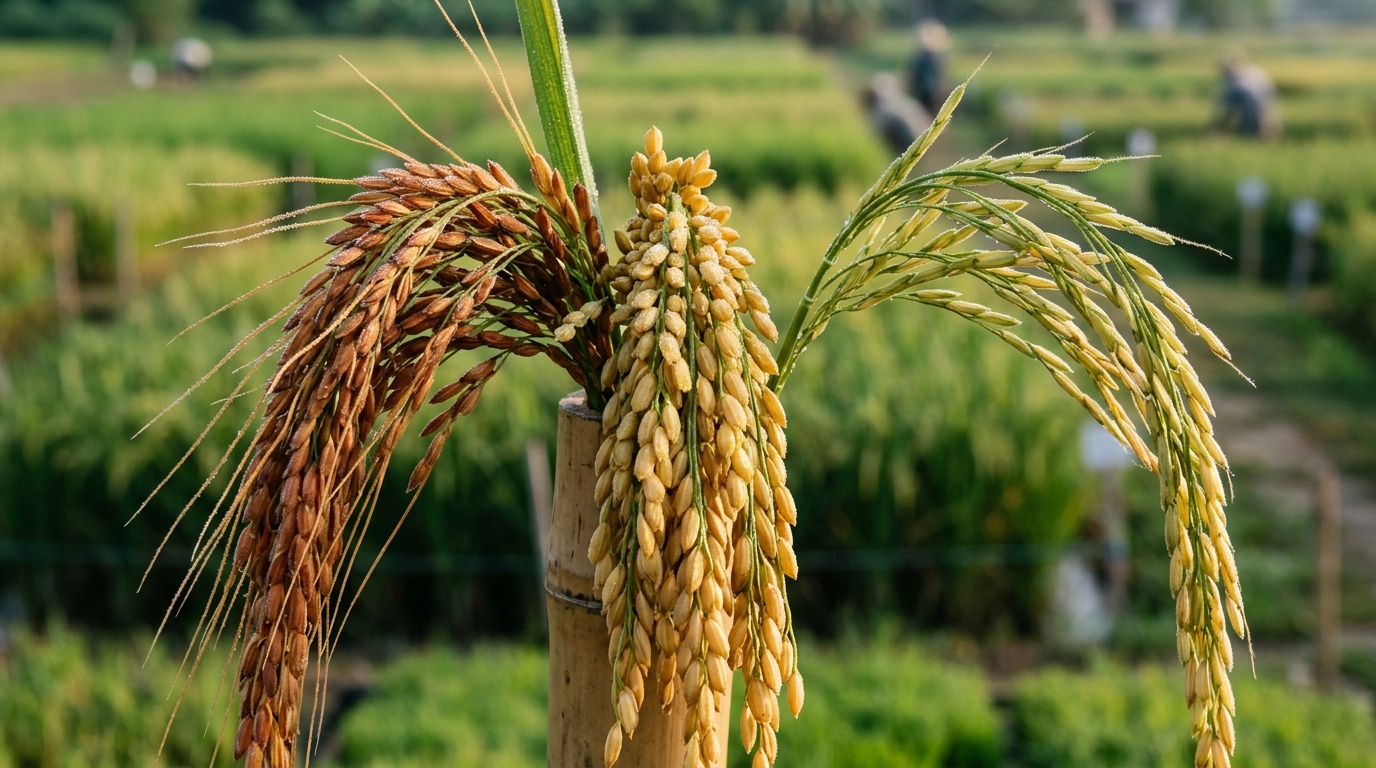
Published in the journal Genomics & Informatics, this brief report details a platform that aims to reduce the time and labor traditionally required for expert manual review of scientific literature. The system, which connects the Rice-Alterome database with the PubAnnotation platform, utilizes artificial intelligence to assist in the extraction, annotation, and validation of trait-related information. By leveraging these technologies, the researchers sought to create a more efficient workflow for organizing complex biological knowledge related to the rice plant, Oryza sativa.
Ontology frameworks are fundamental to biological research, serving as standardized vocabularies that organize genes, phenotypes, and pathways. In the specific context of rice genomics, the Rice Trait Ontology (RTO) provides a hierarchical structure for defining key agricultural traits and their relationships. However, the process of maintaining these ontologies has historically relied on human experts who manually review vast amounts of literature to ensure accurate data annotation. This manual approach, while accurate, is described as time-consuming and difficult to scale as the volume of biological data continues to grow. The new system addresses these challenges by introducing semi-automated curation capabilities that support cross-study comparison and hypothesis generation.
The core of the new curation system is its integration of two distinct data resources: Rice-Alterome and PubAnnotation. Rice-Alterome is a curated dataset containing over 500,000 sentences that describe relationships between genes and named entities. It is directly linked to PubMed literature IDs, providing evidence for specific biological claims. Each entry in this dataset is annotated with various terms, including genes, mutations, effects, and stress responses. The dataset is organized by gene, comprising approximately 8,169 genes, and provides associated descriptive sentences that characterize gene functions along with annotated Gene Ontology (GO) and Trait Ontology (TO) terms.
PubAnnotation serves as an open-source repository that supports the storage and alignment of literature annotations. It allows users to upload databases, annotate them automatically, and align them with existing data within the platform. By integrating PubAnnotation, the curation system can extract concrete knowledge from Rice-Alterome and map evidence data to standardized annotations. This integration eliminates the need for extensive manual annotation, thereby reducing the workload for domain experts. The system uses the PubMed ID as a common identifier to connect these disparate data sources, creating a robust foundation for unified data retrieval.
Large language models, specifically DeepSeek and KIMI, are integrated into the system via Application Programming Interfaces (APIs) to automate the extraction and validation of trait-related information. The researchers employed prompt engineering to guide these models in identifying relevant information from the literature. To mitigate the risk of hallucinations, where language models generate factually inaccurate outputs, the system operates within a controlled knowledge environment containing the curated data from Rice-Alterome and PubAnnotation. This setup ensures that the LLMs provide knowledge-based and reliable results, enhancing the overall rigor of the curation process.
The platform is accessible through a dedicated web interface that allows experts to interact with the ontology hierarchy. The interface is designed to facilitate critical knowledge management functions, enabling users to search for terms, verify existing entries, and evaluate traits based on relationships and expert comments. Authenticated experts are granted access to advanced curation tools that allow them to perform specific actions on ontological terms. These actions include adding a new class, merging a term into an existing trait, removing an obsolete class, or retaining a term as it is. This interactive approach ensures that human expertise remains central to the decision-making process, while the automated system handles the heavy lifting of evidence collection.
To demonstrate the functionality of the system, the researchers presented several use cases involving the curation of specific rice traits. One example involved the addition of a new class called “Seedling-stage submergence tolerance,” which represents early-stage water stress during seed germination. Evidence for this trait was derived from Rice-Alterome, PubAnnotation, and NCBI, totaling over 100 results. The system helped identify that this trait is closely linked to submergence tolerance, allowing experts to designate it as a child of the parent trait “submergence tolerance” within the hierarchical structure. This process illustrates how the system can support the expansion of the ontology with new, well-evidenced terms.
Another use case focused on the merging of similar traits, specifically “submergence tolerance” and “flooding tolerance.” Both traits belong to the same parent category, “submergence sensitivity,” and are considered synonyms in many contexts. The system retrieved 39 sentences and associated genes from the Rice-Alterome dataset that supported the conclusion that flooding tolerance is a synonym for submergence tolerance. By presenting this consolidated evidence, the system enabled experts to make an informed decision to merge the two terms, thereby improving the consistency and clarity of the ontology. This capability is crucial for maintaining a streamlined and non-redundant trait vocabulary.
The researchers also evaluated the reliability of the curation system through a manual assessment involving three domain experts. They distributed results for approximately 20 traits among the experts, who independently classified sentences as either positive or negative for the respective traits. To quantitatively assess the consistency of these evaluations, the team calculated Fleiss’ kappa, a statistical measure of inter-rater agreement. The resulting kappa value was 0.719, indicating substantial agreement among the raters beyond chance. The observed agreement was 0.8733, while the expected agreement was 0.5490. These metrics suggest that the curation system produces reliable and reproducible results that align with expert judgment.
The distribution of ratings further indicated that raters generally favored higher ratings, with category 3 being the most frequently assigned. This pattern may reflect the true prevalence of the measured traits or a tendency toward higher scoring, but the high level of agreement confirms the robustness of the classification process. The system’s ability to aggregate evidence from multiple sources and present it in a unified format allows experts to make faster and more confident decisions. By reducing the time spent on locating and validating information, the platform enhances the efficiency of ontology curation for agricultural genomics applications.
The development of this system represents a significant step toward automating the curation of biological ontologies using modern artificial intelligence techniques. By combining the structured data of Rice-Alterome and PubAnnotation with the natural language processing capabilities of LLMs, the researchers have created a tool that balances automation with human oversight. The system’s architecture, built on a Python Django back-end and a React-based front-end, ensures scalability and user-friendliness. It provides a seamless experience for experts who need to navigate complex ontological structures and manage large volumes of literature evidence.
Looking ahead, the researchers plan to extend this framework to additional crops, such as wheat and maize, to broaden its applicability in agricultural genomics. They also intend to refine the LLM-based retrieval and annotation mechanisms to improve accuracy and efficiency. The current system demonstrates that integrating specialized databases with large language models can effectively address the challenges of manual curation. As biological data continues to expand, such tools will be essential for maintaining the integrity and utility of ontological resources in plant science and related fields.
Subject of Research: A curation system of rice trait ontology with reliable interoperation by LLM and PubAnnotation
Article Title: A curation system of rice trait ontology with reliable interoperation by LLM and PubAnnotation
Article References: Ahmad, J. M., Liu, Y., Kim, J.-D., Yao, X., Larmande, P., & Xia, J. (2025). A curation system of rice trait ontology with reliable interoperation by LLM and PubAnnotation. Genomics & Informatics, 23(1), Article 24. https://doi.org/10.1186/s44342-025-00058-z
Image Credits: AI Generated
DOI: 10.1186/s44342-025-00058-z
Keywords: curation, system, rice, trait, ontology, reliable, interoperation, PubAnnotation, scientific research
News Source: Alan Morgan. (November 7, 2026). AI and Databases Streamline Rice Trait Ontology Curation. Scienmag.