Researchers in Uganda have demonstrated that a virtual learning course delivered via automated mobile phone calls can effectively support improved biosecurity practices among smallholder pig farmers. The study, published in the journal Discover Viruses, investigated a novel approach to educating stakeholders about preventing African swine fever (ASF) in domestic pigs. By utilizing audio-recorded drama sketches, the initiative aimed to overcome barriers to traditional training and facilitate the adoption of hygiene and disease prevention measures in a region where ASF is endemic.
The research was conducted in the greater Gulu area of the Acholi sub-region in Northern Uganda, a region characterized by poverty and limited access to veterinary extension services. The study focused on stakeholders within the smallholder pig value chain, including farmers, traders, butchers, and pork sellers. These individuals were part of a broader field study investigating co-created community contracts for biosecurity. The virtual learning course was introduced as an implementation support activity, specifically adapted to the restrictions imposed by the COVID-19 pandemic, which limited face-to-face interactions and group meetings.
The course consisted of ten short drama sketches, each approximately five minutes in length, translated from English to the Luo language. These audios were recorded by a team of performing artists at Makerere University in Kampala. The content was based on a previous course delivered by the International Livestock Research Institute in central Uganda. The system used to deliver the course was an interactive voice response platform set up at the International Livestock Research Institute. It automatically called participants on their preferred day and time once per week to deliver one audio sketch. Participants could replay audios or select from other recordings, ensuring flexibility in their learning schedule.
A total of 155 participants enrolled in the course, comprising 56 women and 99 men. The system was active from December 2020 to July 2021. According to the system-generated report, all 155 participants completed the first audio, and 121 participants, representing 78% of the cohort, completed all ten audios. Following the course delivery, 148 participants were reached for interviews between September and October 2021. The interviews were conducted via mobile phone or short messaging service and focused on the participants’ learning experience and any changes implemented in their pig management routines.
The results indicated that the virtual learning course was well-received and effective in disseminating knowledge. Almost all interviewees reported learning something new from the course, with 145 out of 148 respondents confirming this outcome. Furthermore, 139 respondents stated that they had changed some aspect of their pig management or disease prevention routines. The thematic analysis of the open-ended responses revealed three dominant topics: cleanliness, separation of pigs, and general pig health. These themes align with recent calls to mainstream ASF prevention into broader herd health messages, suggesting that participants gained relevant and applicable knowledge.
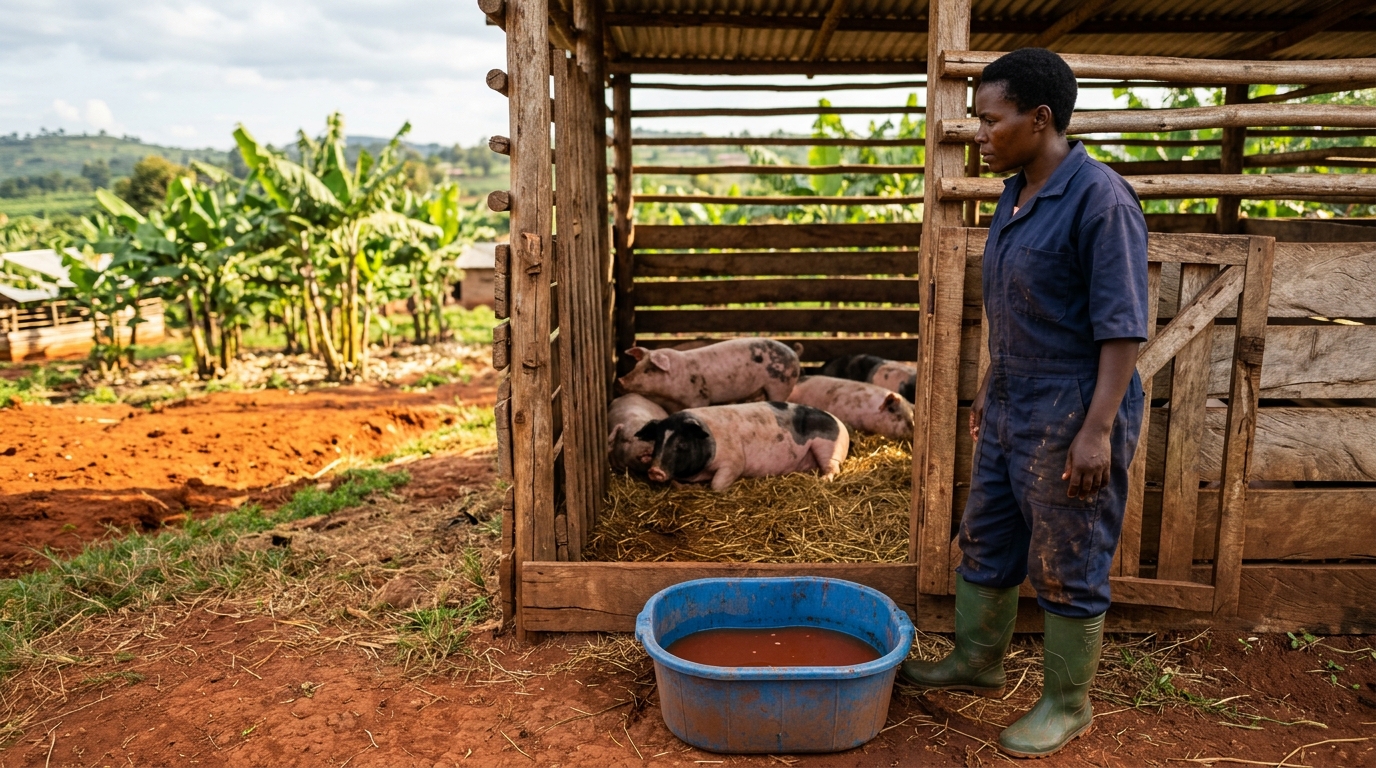
Specific changes included the construction or improvement of pigsties to house pigs, a practice mentioned by 48 respondents. This separation of pigs is fundamental to preventing direct contact between infected and healthy animals, which is the main route of ASF transmission in the domestic pig cycle. Additionally, many respondents demonstrated an understanding of indirect transmission routes, such as through contaminated equipment or clothing, and reported implementing cleaning measures to reduce this risk. The course also highlighted the importance of general pig health, with respondents noting that well-fed and healthy pigs are more resilient to infections.
However, the study also identified a significant misconception regarding vaccination. Despite the course repeatedly stating that there is no cure and no vaccine for ASF, some respondents believed that vaccination could prevent the disease. This confusion may stem from the informal use of the term “vaccination” in Ugandan English to refer to any injection, or from concurrent deworming campaigns promoted for other diseases like cysticercosis. The researchers noted that this erroneous belief was the only notable factual misunderstanding among the frequently mentioned topics, indicating that while the course was largely effective, clarity on this specific point could be improved in future iterations.
The study had several limitations that must be considered when interpreting the results. The participants were already involved in a previous community engagement intervention, which may have made them more interested in ASF prevention and more likely to adopt new practices. Additionally, the gender distribution was skewed towards men, and more women than men chose to be interviewed via SMS, which may have limited the depth of their responses. The researchers acknowledged that their data does not reflect women’s perspectives as well as men’s and therefore did not perform a gendered analysis. The selection of participants, who had access to mobile phones, may have excluded the poorest farmers, potentially biasing the results towards those with greater resources.
Despite these limitations, the study suggests that mobile phone-delivered virtual learning can be a cost-effective and efficient complement to other advisory services. The ability to choose when to listen and the possibility of replaying key messages offer advantages over traditional face-to-face training, particularly for hard-to-reach groups such as women and marginalized smallholders. The researchers emphasized that this method should not replace other forms of advice but can serve as an important tool in raising awareness and promoting biosecurity measures in regions with limited access to veterinary services.
Future research should focus on following up reported changes with participant observation to confirm the actual implementation of biosecurity measures. Clearer profiling of participants in terms of their baseline knowledge and capabilities would also help determine the general applicability of these findings across different smallholder populations. The success of this virtual learning course in Northern Uganda provides a promising model for other low-income settings where traditional extension services are insufficient to reach all stakeholders in the livestock value chain.
The study was conducted from December 2020 to October 2021, with the automated phone system active until July 2021. The virtual learning course was developed as an implementation support within a broader field study focused on co-created community contracts for biosecurity. This context is important because the participants were not a random sample of all pig farmers in the region but were already engaged in a community engagement intervention. The researchers noted that this prior involvement might have made participants more interested in learning about African swine fever and more willing to implement changes, potentially contributing to the positive results observed in the study.
Participant selection was purposive, targeting six villages in the Gulu, Omoro, and Amuru districts. Inclusion criteria required participants to be active stakeholders in the smallholder pig value chain, over 18 years old, and willing to participate. The study aimed to include both male and female participants, though the final cohort consisted of 99 men and 56 women. The researchers acknowledged that the gender distribution was skewed toward men, which limits the generalizability of the findings. In the study region, small livestock such as pigs are often managed by women, even if formal ownership lies with the male head of household. The researchers, who were both men, noted that this dynamic, along with potential interviewer bias or women’s limited time for phone calls, could have influenced participation and response depth.
The thematic analysis of the interviews revealed that while most respondents reported learning new information, the specific changes implemented were often constrained by economic factors. When respondents described why they had not implemented certain measures, such as building enclosures or providing high-quality feed, they invariably cited an inability to afford these actions. This highlights a critical distinction between knowledge acquisition and practical implementation. The study found that while the course successfully transmitted information about biosecurity, the translation of that knowledge into action was mediated by resource constraints. For instance, although 48 respondents mentioned housing their pigs, four explicitly stated they wanted to build a pigsty but could not afford to do so. This suggests that the participants, while still representing a marginalized segment of the population, were not necessarily the poorest farmers in the area, as the ability to construct or improve housing indicates a certain level of resource availability.
The discrepancy between the system-generated reports and the participants’ self-reported listening habits is another notable aspect of the data. The system recorded that 121 participants completed all ten audios, whereas only 56 respondents in the interviews stated they had listened to all audios. The researchers suggested that this discrepancy might be due to recall bias, as the interviews took place several months after the course ended. It is also possible that some participants had the audio playing in the background without actively listening. The study did not include participant observation to verify the actual implementation of the reported changes, which remains a limitation. Without direct observation, it is difficult to confirm whether the self-reported changes, such as building pigsties or altering cleaning routines, were fully realized and sustained over time.
The confusion regarding vaccination offers a specific insight into how information is processed in this context. Although the course repeatedly stated that there is no vaccine for African swine fever, some respondents believed that vaccination was a key preventive measure. The researchers proposed that this misunderstanding might stem from the informal use of the term “vaccination” in Ugandan English to refer to any injection, including deworming. Concurrent campaigns for deworming, often promoted for cysticercosis, may have contributed to this confusion. This finding underscores the importance of clear communication and coordination between different health initiatives. If virtual learning courses are implemented broadly, collaboration between different programs is essential to avoid conflicting messages or misunderstandings that could undermine the effectiveness of disease prevention efforts.
The study’s methodology, relying on telephone and SMS interviews, was chosen to adapt to the restrictions of the COVID-19 pandemic. While this approach allowed for repeated attempts to reach participants without the cost of travel, it may have limited the depth of the responses. The researchers assessed that the level of detail was sufficient for their purposes, but they acknowledged that face-to-face interactions might have yielded richer data. The use of SMS for a significant portion of the interviews, particularly among women, could have further constrained the complexity of the answers provided. This methodological choice reflects the practical challenges of conducting research in low-resource settings during a global health crisis, balancing the need for data collection with the safety and accessibility constraints of the time.
Ultimately, the study positions the virtual learning course as a complement to, rather than a replacement for, existing advisory services. The ability to listen at a chosen time and replay content offers flexibility that traditional group meetings may not provide. This is particularly relevant for stakeholders who face barriers to attending in-person training, such as women with domestic responsibilities or farmers in remote areas. The findings suggest that such digital tools can be effective in reaching hard-to-reach populations, provided that the content is clear, relevant, and supported by other forms of extension services. Future research should aim to profile participants more clearly in terms of their baseline knowledge and resources to better understand the applicability of these findings across different smallholder contexts.
Subject of Research: Drama-based mobile phone-delivered virtual learning as a way to support improved biosecurity in smallholder pig farming
Article Title: Drama-based mobile phone-delivered virtual learning as a way to support improved biosecurity in smallholder pig farming
Article References: Chenais, E., Fischer, K., Kagolobya, R., Dione, M., Ståhl, K., & Sternberg-Lewerin, S. (2025). Drama-based mobile phone-delivered virtual learning as a way to support improved biosecurity in smallholder pig farming. Discover Viruses, 2(1), Article 25. https://doi.org/10.1007/s44370-025-00031-y
Image Credits: AI Generated
DOI: 10.1007/s44370-025-00031-y
Keywords: Drama-based, mobile, phone-delivered, virtual, learning, support, improved, biosecurity, smallholder, farming, scientific research
News Source: Drew Townsend. (November 7, 2026). Mobile Drama Course Boosts Pig Biosecurity in Uganda. Scienmag.