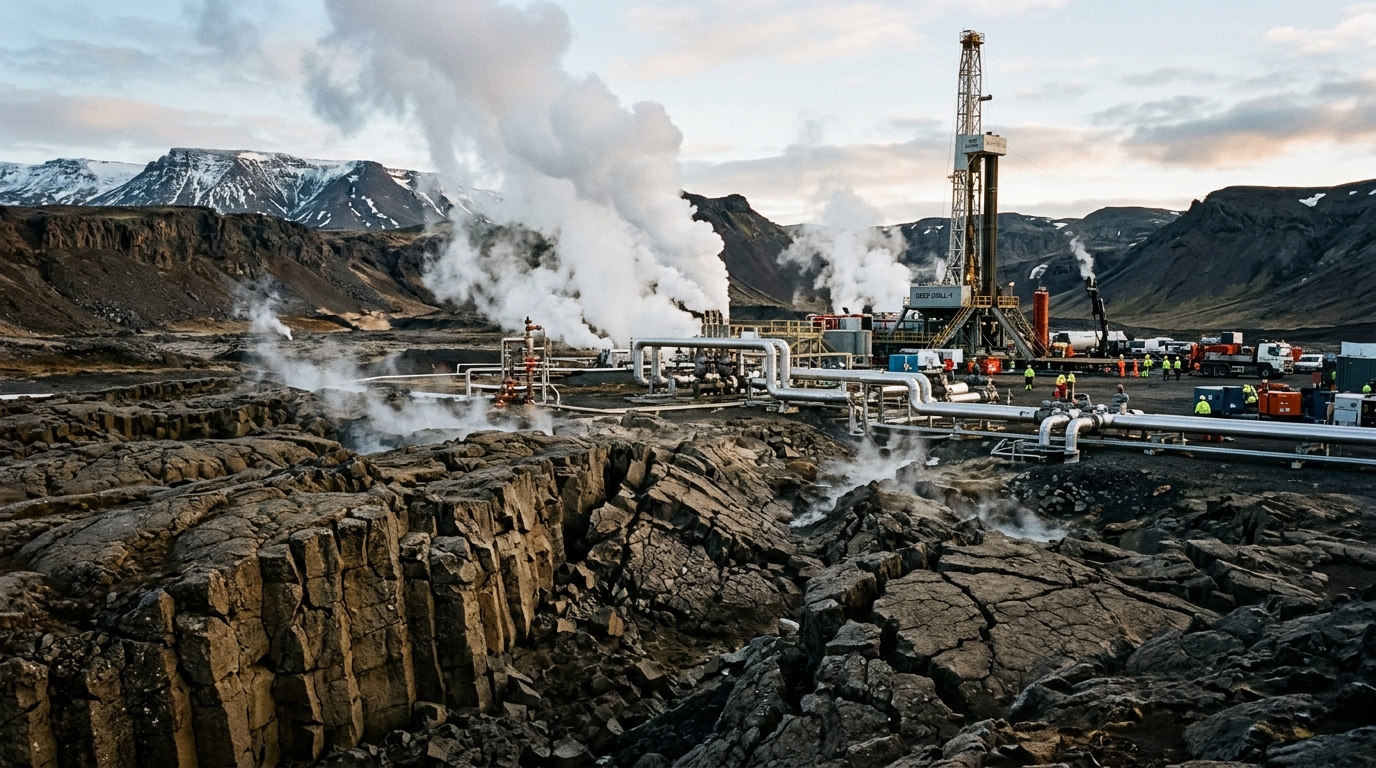
Published in the journal Geothermal Energy, the study systematically compares simultaneous fracturing (SMF) and sequential fracturing (SQF) to understand how fluid partitioning and thermal stress effects influence fracture propagation in high-temperature hot dry rock formations. The work addresses a critical gap in current research, as multi-perforation fracturing, while proven efficient in unconventional oil and gas extraction, has rarely been assessed for geothermal applications where thermal conditions significantly alter mechanical behavior.
The numerical platform established by the team quantifies the complex interactions between temperature, hydraulic pressure, mechanical stress, and rock damage. By simulating the injection of cold fluid into high-temperature formations, the model captures how thermal shock induces tensile stresses that modify the in-situ stress field. This coupled approach allows for a detailed examination of fracture initiation and propagation paths, providing insights that single-perforation models or ambient-temperature simulations cannot offer. The study focuses on the dimensionless perforation spacing (DPS), defined as the ratio of perforation spacing to perforation length, to characterize the regime of fracture interaction.
In the simultaneous fracturing scenario, the model reveals that fractures deviate from the maximum principal stress direction due to mutual stress shadowing. Specifically, external fractures deviate by 9 to 18 degrees, while the internal fracture requires higher initiation pressures and receives less fluid compared to the outer fractures. This uneven fluid distribution is driven by the compressive stresses generated by adjacent propagating fractures, which alter the local stress field and redirect the hydraulic energy. The internal fracture, compressed from both sides, faces the greatest resistance, resulting in a higher breakdown pressure and a reduced share of the total injection rate during the early stages of fracturing.
Conversely, the sequential fracturing scenario demonstrates different mechanical interactions depending on the perforation spacing. At a narrow dimensionless perforation spacing of 3.3, subsequent fractures deflect toward the previously formed fractures, a phenomenon attributed to the reduced mechanical strength of the fractured zones and the reorientation of principal stresses. However, at wider spacings of 6.7 and 10, the fractures propagate along straight paths perpendicular to the minimum principal stress, indicating minimal stress interference. This suggests that an optimal spacing exists that balances the creation of multiple fractures with the maintenance of controllable trajectories.
The analysis of multi-physical field evolution shows that the minimum principal stress transitions from compression to tension within the fractures and near the fracture tips as injection proceeds. In both SMF and SQF, the internal fracture in simultaneous fracturing and the subsequent fractures in sequential fracturing exhibit higher pore pressure and lower temperature. The model highlights that the cooling effect is most pronounced near the perforations and diminishes along the fracture length, with the temperature reduction being greatest in the regions of active fluid flow.
A key finding of the study is the quantification of the contribution of thermal stress to fracture initiation. The researchers found that thermal stress primarily facilitates fracture development by reducing the initiation pressure by approximately 5 to 8 MPa under the present conditions. This reduction occurs because the injection of cold fluid generates tensile thermal stress near the wellbore, which counteracts the compressive in-situ stress and promotes the onset of damage. While this thermal effect is significant for initiation, the study concludes that fluid pressure remains the dominant driver for the subsequent propagation of the fractures. Neglecting these coupled thermal and hydraulic effects would lead to a substantial overestimation of the required injection pressure in geothermal stimulation design.
The impact of perforation spacing on fracture geometry is further detailed in the results. In simultaneous fracturing, increasing the DPS from 3.3 to 10 cuts the deflection angle of the external fractures in half, from 18 degrees to 9 degrees, and reduces the length discrepancy between the longest and shortest fractures. This mitigation of the stress shadow effect leads to a more uniform fracture network. In sequential fracturing, the initiation pressure of subsequent fractures progressively increases due to the cumulative stress shadowing from previous stages, but this effect is significantly diminished at larger spacings. At a DPS of 10, the initiation pressure of the final fracture exceeds that of the first by only 7.5%, compared to a much larger difference at narrower spacings.
The study also examines the fluid partitioning dynamics during simultaneous fracturing. The injected fluid is redistributed among the perforations based on the internal pressure of the fractures. Perforations associated with lower internal pressures receive a greater share of the total injection rate. During the first 20 seconds of injection, the flow is distributed nearly uniformly, but as the stress shadow effect intensifies, the middle fracture’s injection rate drops to a minimum before gradually recovering. This dynamic redistribution is a critical factor in determining the final fracture network geometry and the efficiency of the stimulation process.
Validation of the numerical model was performed against analytical solutions and experimental measurements. The model was compared with the analytical KGD model for fracture length growth and with laboratory experiments conducted by Lei et al., Liu et al., and Zeng et al. The simulated fracture trajectories and initiation pressures closely matched the experimental observations, with relative errors of 1.71% and 3.2% for the respective experiments. These validations confirm the accuracy and reliability of the proposed THMD coupled model in simulating complex fracturing behaviors in heterogeneous rock under high-temperature conditions.
The engineering implications of these findings are significant for the design of deep geothermal reservoir stimulation strategies. The study suggests that the selection between simultaneous and sequential fracturing should be optimized by balancing operational efficiency, allowable initiation pressure, and required fracture geometry. Sequential fracturing generally provides more controllable trajectories but requires longer operational time, while simultaneous fracturing can shorten the cycle but may result in less uniform fracture development. The identification of an optimal dimensionless perforation spacing of 6.7 for sequential fracturing under the studied conditions provides a practical guideline for field applications, although the specific value may vary depending on site-specific geological and operational parameters.
Limitations of the study include the use of a two-dimensional plane-strain model, which, while sufficient for elucidating fundamental mechanisms, does not fully capture the three-dimensional complexity of field-scale fractures. The model also assumes a continuum damage mechanics approach and does not account for frictional sliding along closed fracture segments. Future work will aim to develop three-dimensional, field-scale models that incorporate realistic geological structures and in-situ stress distributions to provide more comprehensive support for reservoir stimulation in enhanced geothermal systems.
This research contributes to the theoretical foundation for designing multi-stage hydraulic fracturing in enhanced geothermal systems by clarifying the distinct roles of thermal stress and fluid pressure. The synergy between the cooling front and pore pressure distribution governs the evolution of the fracture network, and optimizing injection sequencing and spacing can minimize stress interference and enhance the overall effectiveness of reservoir stimulation. The findings offer a robust framework for predicting injection pressures and fracture geometries in deep geothermal reservoirs, supporting the transition toward sustainable and efficient geothermal energy development.
Subject of Research: Numerical modeling of multi-perforation fracturing for deep geothermal energy development
Article Title: Assessing the performance of multi-perforation fracturing for deep geothermal energy development: insights from THMD modeling
Article References: Wu, X., Li, Y., Li, T., Cui, G., & Tang, C. (2026). Assessing the performance of multi-perforation fracturing for deep geothermal energy development: insights from THMD modeling. Geothermal Energy, 14(1), Article 17. https://doi.org/10.1186/s40517-026-00388-3
Image Credits: AI Generated
DOI: 10.1186/s40517-026-00388-3
Keywords: geothermal energy, hydraulic fracturing, THMD modeling, stress shadowing, perforation spacing, reservoir stimulation, thermal stress, fluid partitioning, hot dry rock, fracture propagation, Assessing, performance
News Source: Violet Maxwell. (November 7, 2026). Modeling reveals optimal spacing for geothermal fracturing. Scienmag.