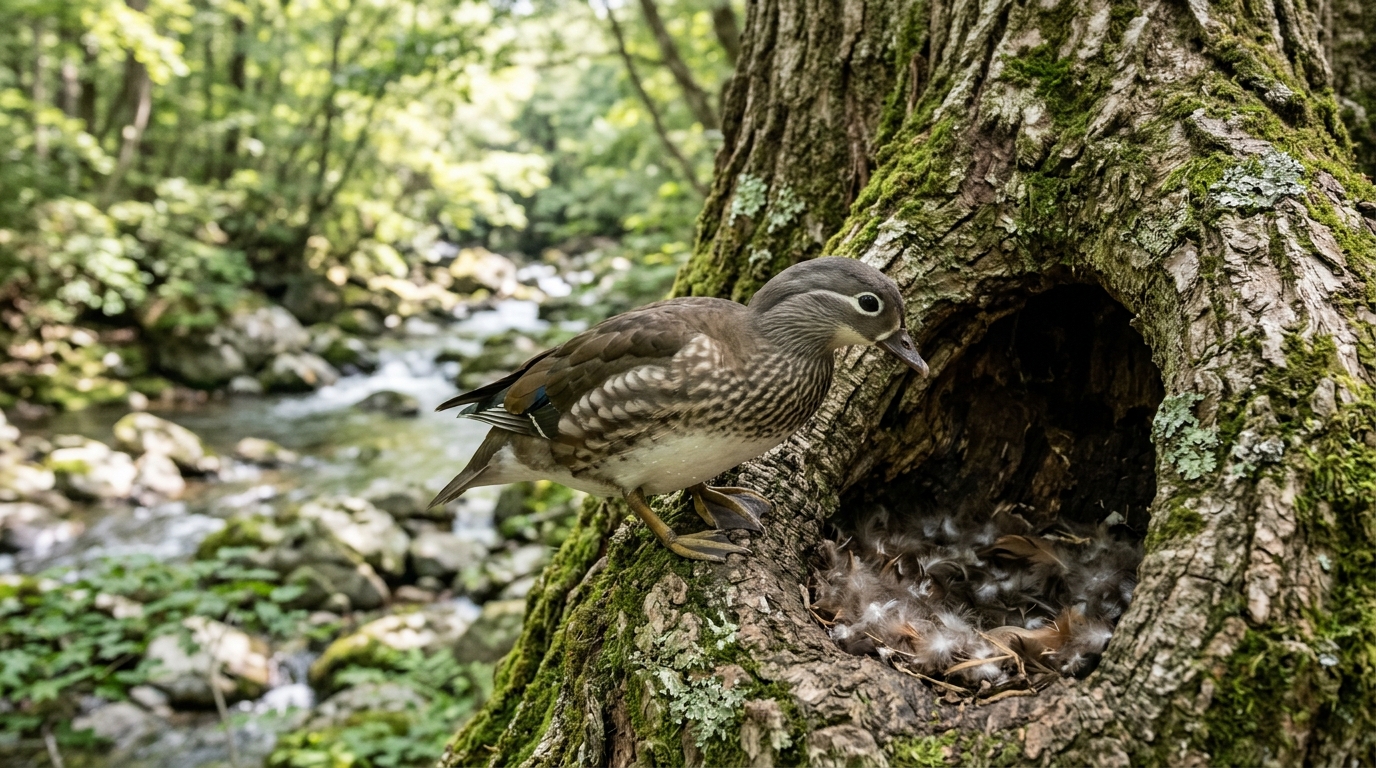
Researchers have documented the first molecularly confirmed case of successful interspecific brood parasitism by a Mandarin Duck on a Scaly-sided Merganser, a rare event that provides critical insight into the reproductive strategies of tree-cavity-nesting waterbirds. Published in BMC Zoology, the study details how a Mandarin Duck laid an egg in an artificial nest box occupied by a pair of Scaly-sided Mergansers during the 2024 breeding season in the Manjiang region of Changbai Mountain, Jilin Province, China. While field observations had previously suggested that Mandarin Ducks might parasitize the nests of these endangered mergansers, direct evidence of successful hatching had been lacking until this recent monitoring effort.
The study area, located in the western foothills of the Changbai Mountains, features a temperate forest ecosystem with a well-developed river network. This habitat is dominated by tall trees such as Populus ussuriensis, Betula platyphylla, and Ulmus pumila, making it a significant breeding ground for both the Scaly-sided Merganser and the Mandarin Duck. In April 2024, researchers initiated monitoring in areas with a historically high concentration of Scaly-sided Merganser nest sites, using cameras mounted on support poles to regularly inspect the interior of nest boxes. Following confirmation of occupancy by the mergansers, on-site monitoring was conducted every five days to document egg-laying, incubation, and parental behavior.
In May 2024, an artificial nest box located by the Manjiang River was occupied by a pair of Scaly-sided Mergansers. Prior to incubation, a total of eight eggs were observed in the nest. Six of these eggs were uniform in size, while the remaining two were notably smaller and were preliminarily identified as likely belonging to a Mandarin Duck based on their distinct yellowish-cream color and smaller dimensions. On June 7, the first hatched duckling displayed a short and broad bill and yellowish-brown plumage, characteristics that are not typical of the Scaly-sided Merganser. This individual was identified as a Mandarin Duck duckling and remained in the nest for one day before departing.
To confirm the species identity of the ducklings, the researchers collected eggshell membranes after hatching using non-invasive methods. The samples were stored at -20 °C and later processed for DNA extraction. The eggshell membranes, including the chorioallantoic membrane, were aseptically removed, washed, and subjected to a DNA lysis buffer containing Proteinase K. Genomic DNA was extracted using a column-based kit, allowing for the analysis of specific genetic markers.
The researchers selected the mitochondrial 12S rRNA gene for species identification due to its relatively conserved evolutionary rate. They designed specific primers based on an alignment of the mitochondrial genomes of the Scaly-sided Merganser and the Mandarin Duck, targeting a highly divergent region within the gene. PCR amplification was performed, and the resulting sequences were verified by agarose gel electrophoresis and subsequently sent for bidirectional Sanger sequencing. The obtained sequences were aligned against reference sequences from GenBank to calculate sequence similarity and confirm the identity of the parasitic duckling.
Sequence alignment revealed that the parasitic duckling showed 100% similarity to the Mandarin Duck reference sequence, confirming its identity. In contrast, the sequences from the co-nesting Scaly-sided Mergansers showed 98% similarity to the species reference sequence. This difference was primarily due to a 14-bp insertion present in all the obtained sequences but absent in the reference sequence. This insertion is located at position 1856 of the M. squamatus mitochondrial reference genome. The researchers further confirmed this characteristic by sequencing 18 additional Scaly-sided Merganser individuals from the region during 2023–2025, all of which exhibited the same insertion. This finding suggests a potential discrepancy in the existing reference sequence, prompting the authors to recommend re-sequencing the complete mitochondrial genome of the Scaly-sided Merganser.
Additionally, the study investigated the kinship relationships among the Scaly-sided Merganser ducklings to determine the mating system of the host pair. Mitochondrial D-loop region sequences were successfully obtained for all five Scaly-sided Merganser ducklings. Haplotype analysis identified only one haplotype among the five individuals, indicating that all ducklings shared the same maternal lineage. To provide paternal information, which mitochondrial DNA cannot offer, the researchers analyzed eight polymorphic microsatellite loci. These nuclear DNA markers are biparentally inherited and allow for a more comprehensive understanding of the genetic relationships within the nest.
Analysis of the microsatellite loci showed that all pairwise comparisons between the Scaly-sided Merganser ducklings were consistently identified as full-sibling relationships by both the ML-Relate and Colony software. This result confirms the absence of intraspecific brood parasitism in this instance and supports a monogamous genetic mating system for the Scaly-sided Merganser pair. The findings align with previous observations of social monogamy in this species, which exhibits behaviors associated with persistent pair bonds, such as reusing the same nest site over consecutive years and maintaining pair associations on the wintering grounds.
The study discusses several possible explanations for the interspecific brood parasitism event. One hypothesis is that the original nest of the Mandarin Duck female may have been destroyed, as evidenced by a snake intrusion observed in the same nest box in 2023. Failing to locate a suitable conspecific nest for intraspecific parasitism, the female may have laid her eggs in the Scaly-sided Merganser nest-box as a response to reproductive pressure. Another possibility is competition for limited high-quality nest-site resources. Despite the provision of multiple artificial nest boxes, high-quality tree cavities suitable for nesting may still be scarce, leading to intense competition between the two species. The Mandarin Duck female may have lost her original nest after being outcompeted in a contest over a cavity, subsequently depositing her egg in the nest of her competitor.
The acceptance and successful incubation of a morphologically distinct foreign egg by the Scaly-sided Merganser host is similar to responses observed in other brood-parasitized bird species. The researchers suggest that the Scaly-sided Merganser may not have evolved specific egg recognition or rejection abilities due to a lack of significant historical brood parasitism pressure. Additionally, the enclosed nature of tree-cavity nests may reduce the ability to discern egg color and pattern, making cavity-nesting birds more inclined to accept any object within the nest that conforms to the general shape of an egg. This case highlights the importance of considering interspecific nest-site competition and potential parasitic interference in the conservation of endangered species like the Scaly-sided Merganser.
The findings of this study provide molecular-level evidence for a case of successful interspecific brood parasitism, enriching our understanding of interspecific interactions among tree-cavity-nesting birds. By integrating morphological, ecological, and molecular data, the researchers were able to accurately identify the species and interpret the behavioral dynamics of the nest. The study also underscores the necessity of re-sequencing the complete mitochondrial genome of the Scaly-sided Merganser to better represent the species’ genetic identity.
Subject of Research: Interspecific brood parasitism between Mandarin Ducks and Scaly-sided Mergansers
Article Title: A case of successful brood parasitism by Mandarin Duck (Aix galericulata) on Scaly-sided Merganser (Mergus squamatus)
Article References: Liu, S., Li, D., Zhang, S., Yi, G., & Zhao, Y. (2026). A case of successful brood parasitism by Mandarin Duck (Aix galericulata) on Scaly-sided Merganser (Mergus squamatus). BMC Zoology, 11(1), Article 21. https://doi.org/10.1186/s40850-026-00271-5
Image Credits: AI Generated
DOI: 10.1186/s40850-026-00271-5
Keywords: brood parasitism, Mandarin Duck, Scaly-sided Merganser, avian reproduction, molecular identification, conservation biology, nesting behavior, genetic monogamy, case, successful, brood, parasitism
News Source: Drew Townsend. (November 7, 2026). Mandarin Duck Successfully Parasitizes Scaly-sided Merganser Nest. Scienmag.