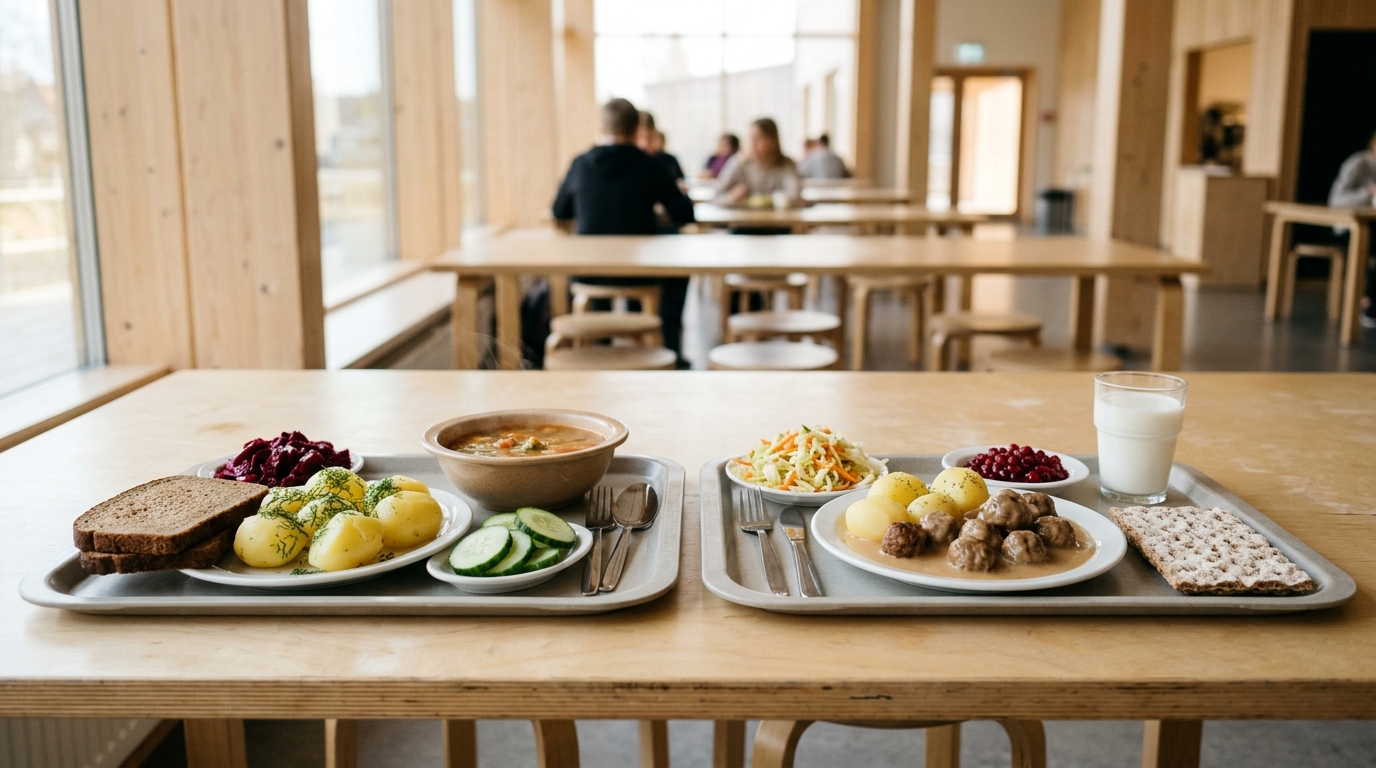
A new cross-sectional comparative study evaluated school lunch provision in Rezekne, Latvia, and Uppsala, Sweden, using a newly developed multidimensional evaluation index. The research, published in Agricultural and Food Economics, sought to move beyond traditional nutritional compliance checks by integrating menu-level analysis with broader system-level assessments of governance, organization, and sustainability. The findings indicate that menu-level evaluation alone is insufficient to explain or improve school lunch provision performance, suggesting that organizational design and governance capacity are critical determinants of effective and sustainable school catering.
The study covered the 2024/2025 academic year, analyzing weekly five-day lunch menus alongside stable organizational features in both municipalities. Rezekne and Uppsala were selected as illustrative mid-sized municipalities with established public school meal programs and distinct catering models. In Rezekne, school lunch provision is governed at the municipal level with meal preparation organized on-site in individual schools, resulting in school-specific menus. In contrast, Uppsala follows a centralized organizational model where menu planning is coordinated at the municipal level, applying a single common menu across public schools.
The analytical sample included four public schools in Rezekne and the unified school lunch system in Uppsala, focusing on student groups covered by publicly funded provision. In Rezekne, this encompassed grades 1–7, while in Uppsala, it included grades 1–9. The researchers developed a multidimensional index consisting of 41 components across six dimensions: Nutrition and Health, Environmental Sustainability, Economic Sustainability, Food Culture, Equity and Inclusion, and Governance and Policy. This framework was designed to capture the holistic nature of school lunch provision, addressing gaps in existing tools that often focus primarily on nutritional standards.
Scoring was based on binary No/Yes answers, with components weighted at 5 or 10 points depending on their importance within the dimension. The total index score ranges from 0 to 265 points, with higher scores indicating stronger overall performance. Performance levels were categorized into low, medium, and high using an equal-interval approach. The results showed that all Rezekne schools achieved a medium performance level, with total scores ranging from 135 to 142 points, while Uppsala schools achieved a high performance level with a score of 236 points.
In the Nutrition and Health dimension, Uppsala menus achieved consistently higher scores across most components compared to Rezekne. Uppsala menus consistently met criteria for providing at least two different vegetables and raw vegetables every day, whereas Rezekne schools showed more heterogeneous performance, with mean scores ranging from 42% to 87% for vegetable variety. Fruit provision displayed an inverse pattern, with daily fruit provision consistently low in Swedish menus at 16%, while Latvian menus achieved higher mean scores between 41% and 72%. This difference reflects structural approaches, with Uppsala integrating fruits into salad bars and Latvia utilizing a national school milk and fruit program.
Protein sources revealed the most consistent divergence between the two contexts. Uppsala school menus exhibited a diversified protein profile, with high performance in most protein-related components, including consistent inclusion of fish, legumes, and vegetarian options. In contrast, Rezekne menus were predominantly meat-based, with meat-based main dishes commonly served three to four times per week. The criterion limiting red meat to once per week was not met in any Rezekne school, and the daily availability of a vegetarian alternative was absent across all Latvian schools. This pattern highlights the limited integration of sustainability-related criteria within the Latvian school meal regulation compared to the Swedish system.
Environmental sustainability results showed a clear contrast, with Uppsala schools consistently fulfilling components related to plant-based meal structuring and food waste prevention. In Uppsala, all students were served a vegetarian main dish at least once per week, and weekly menus had a higher share of plant-based than animal-based protein. None of the Rezekne schools met these criteria, resulting in zero scores for these specific components. However, both contexts showed full compliance with components related to procurement practices, such as the consistent inclusion of seasonal and local products and the limitation of ultra-processed foods to once per week or less.
Economic sustainability differences were observed in budget adequacy and systematic evaluation mechanisms. While both contexts had organized procurement and cyclic menu planning, Uppsala demonstrated full compliance with budget adequacy for delivering nutritionally balanced menus, whereas Rezekne schools reached only a medium performance level. A more pronounced difference was the presence of systematic menu evaluation, which was consistently implemented in Uppsala but absent across all Rezekne schools. This gap in systematic evaluation limits the capacity of the Latvian system to learn from practice and adjust menus based on observed outcomes.
Food culture and equity dimensions highlighted shared and distinct organizational practices. Both contexts showed full compliance with equity and inclusion principles, ensuring free or subsidized meals for all eligible students and accommodating special dietary needs without financial or social differentiation. In terms of food culture, traditional and familiar food practices were well-established in both locations. However, Uppsala schools consistently included international cuisine dishes, offered students options for food amount and type selection, and provided lunch breaks of at least 30 minutes. Rezekne schools did not meet these criteria, reflecting a more standardized and predefined approach to school lunch provision that limits student autonomy and experiential variety.
Governance and policy results indicated that while both contexts complied with national nutrition standards and transparent procurement, Uppsala demonstrated superior data-driven governance. Systematic food waste monitoring and the use of digital tools were consistently implemented in Uppsala, supporting continuous adjustment of menus and practices. In contrast, none of the Rezekne schools met these criteria, indicating the absence of formalized monitoring systems and digital tools. This suggests that the Latvian system relies more on static menu planning rather than adaptive, performance-based management.
The study acknowledges several limitations, including the value-informed nature of the index, which reflects specific normative frameworks relevant to the Baltic-Nordic context. The menu-level assessment relied on information reported in weekly menus, which may not fully capture all qualitative aspects of menu composition. Additionally, the comparison contrasts a municipal-level system in Uppsala with multiple individual schools in Rezekne, which may limit direct comparability. The cross-sectional design also limits insights into how school lunch provision systems evolve over time or respond to policy changes.
Despite these limitations, the study provides a foundation for comparative, system-level evaluation of school lunch provision. The findings suggest that effective and sustainable school lunch provision depends less on formal menu standards alone and more on organizational and governance structures that support student choice, flexibility, monitoring, and continuous improvement. By identifying structural strengths and constraints, the multidimensional index offers practical insights to support context-sensitive improvements across diverse school catering settings, highlighting the importance of moving beyond narrow compliance-oriented assessments.
Subject of Research: Cross-country comparison of school lunch provision in Latvia and Sweden using a new multidimensional evaluation index
Article Title: Cross-country comparison of school lunch provision in Latvia and Sweden using a new multidimensional evaluation index
Article References: Deksne, J., Eriksson, M., Sundin, N., Lonska, J., Litavniece, L., & Tambovceva, T. (2026). Cross-country comparison of school lunch provision in Latvia and Sweden using a new multidimensional evaluation index. Agricultural and Food Economics, 14(1), Article 55. https://doi.org/10.1186/s40100-026-00500-y
Image Credits: AI Generated
DOI: 10.1186/s40100-026-00500-y
Keywords: Cross-country, comparison, school, lunch, provision, Latvia, Sweden, multidimensional, evaluation, index, scientific research
News Source: Alan Morgan. (November 7, 2026). Latvia and Sweden School Lunch Systems Compared. Scienmag.