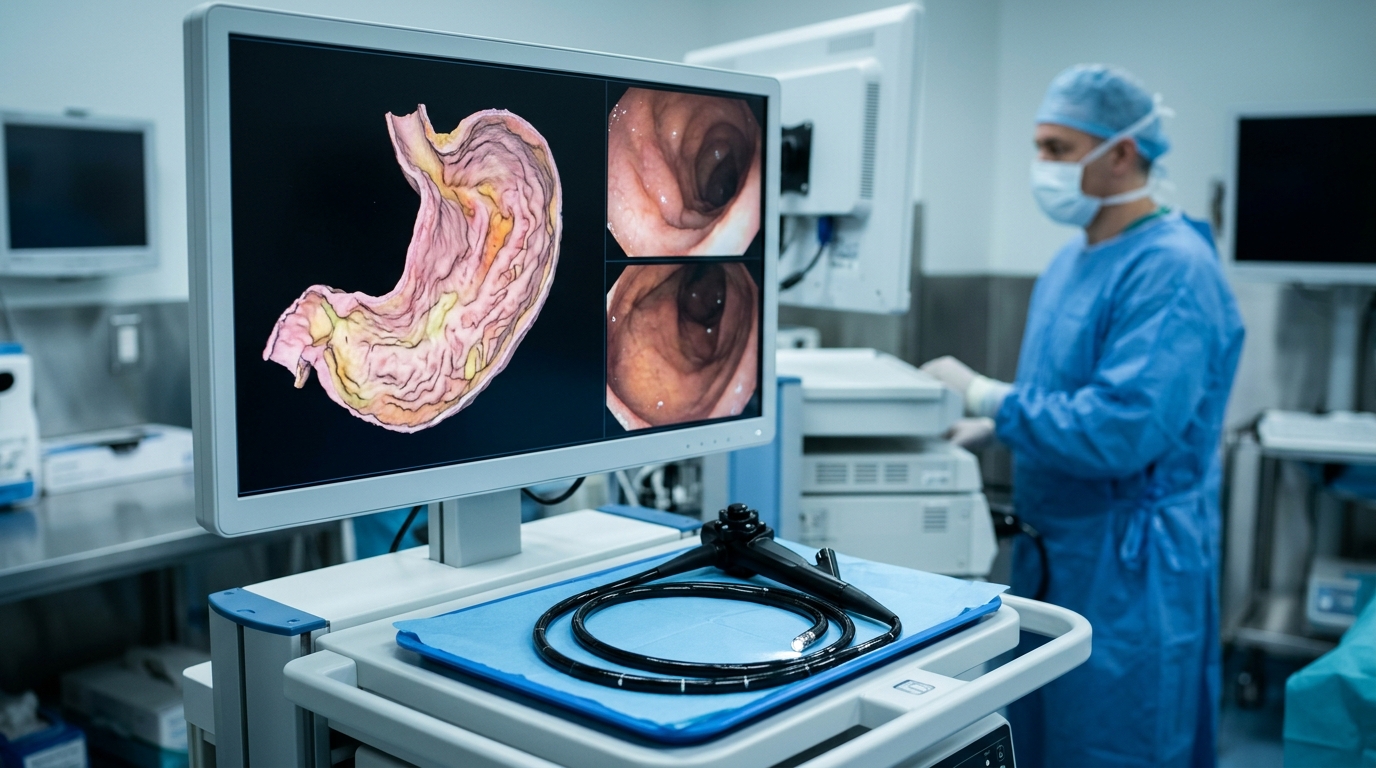
In a retrospective, offline technical feasibility study, researchers demonstrated that a densely connected convolutional neural network (Dense-UNet) matching model can successfully generate three-dimensional reconstructions of the stomach from routine gastroscopic images. Evaluated on key frames extracted from examination videos of eight patients diagnosed with superficial gastritis, the Dense-UNet approach increased the number of reconstructed images by 46.7 percent and produced more than 2.93 times as many three-dimensional points compared to traditional reconstruction methods.
The researchers developed and trained the Dense-UNet-based matching model using the extracted key-frame dataset before applying the matching results to three-dimensional reconstruction. The resulting three-dimensional point clouds captured the exact position and color information for all reconstructed points, alongside camera pose data for each successfully processed gastroscopy image. From these data, the system generated a comprehensive three-dimensional stomach model in which users can freely view the organ and switch between reconstructed gastroscopic images from matching perspectives.
The study was designed to address inherent limitations in conventional endoscopy, where narrow camera fields of view and an absence of depth perception make it difficult for diagnosticians to perceive lesion locations and three-dimensional stomach structures. Accurate spatial localization is particularly critical for surgical planning in cases involving early-stage gastric tumors or endophytic submucosal lesions that cannot be viewed directly during laparoscopy. By increasing point counts and image inclusion, the authors concluded that this offline method improves the stability and integrity of three-dimensional point clouds, aiding diagnostic physicians in perceiving real gastroscopic scenes to support clinical decision-making.
Subject of Research: Three-dimensional stomach reconstruction from routine gastroscopy images using Dense-UNet
Article Title: AI-assisted 3D reconstruction from routine gastroscopy: a technical feasibility study
Article References: Zhao, R., Mao, R., Zhang, L., & Zhang, L. (2026). AI-assisted 3D reconstruction from routine gastroscopy: a technical feasibility study. BMC Medical Informatics and Decision Making. https://doi.org/10.1186/s12911-026-03944-w
Image Credits: AI Generated
DOI: 10.1186/s12911-026-03944-w
Keywords: gastroscopy, 3D reconstruction, Dense-UNet, point cloud, medical imaging, superficial gastritis, surgical planning, artificial intelligence, AI-assisted, reconstruction, routine, technical
News Source: Ophelia Keating. (November 7, 2026). Feasibility Study Demonstrates AI-Assisted 3D Stomach Reconstruction From Routine Gastroscopy. Scienmag.